

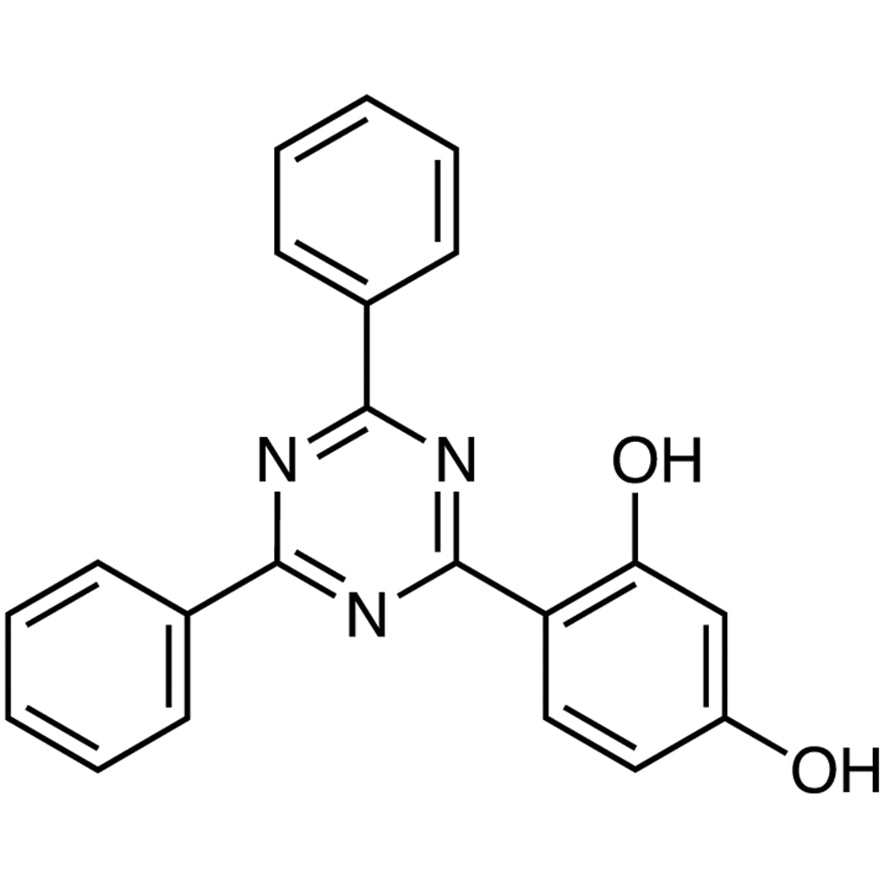
2-(2,4-Dihydroxyphenyl)-4,6-diphenyl-1,3,5-triazine is a chemical compound widely used in scientific research, particularly in organic chemistry and materials science. This compound plays a crucial role in laboratory settings as a reagent or additive, facilitating the synthesis of complex molecules and the development of advanced materials. Its unique molecular structure contributes to its versatility in various chemical reactions, making it an essential component in polymer and composite material research.
The compound’s molecular structure, featuring aromatic and heterocyclic groups, provides high reactivity and stability, which are key factors in its preference among researchers. These properties allow it to participate effectively in substitution and condensation reactions, enabling the formation of desired molecular structures. Its chemical stability ensures that it remains effective under controlled laboratory conditions, making it ideal for applications requiring precise chemical control.
In Indonesian laboratories, this compound is commonly used in polymer synthesis, the development of new materials, and the study of complex chemical properties. Researchers from educational and research institutions rely on it for experiments that require both reactivity and stability. Its application extends to various fields, including material science and chemical engineering, where it supports the creation of advanced functional materials.
- Polymer synthesis where this compound acts as a functional additive to modify polymer properties and enhance structural integrity.
- Composite material development due to its ability to interact with various matrix materials and improve mechanical performance.
- Organic synthesis reactions that require a stable and reactive intermediate for the formation of complex molecular structures.
- Material characterization studies to analyze the chemical behavior and reactivity of advanced materials under different conditions.
- Research on chemical stability and reactivity in controlled environments to develop new synthetic methodologies and material applications.
| Brand | TCI |
|---|---|
| CAS number | 38369-95-8 |
| Molecular formula | — |
| Purity | — |
| Category | Materials Science > Polymer/Macromolecule Reagents > Polymer Additives |
| Pack sizes | Available in standard laboratory quantities as per supplier specifications |
| Physical form | Solid powder (as per standard product description) |
| Storage | Store in a cool, dry place away from direct sunlight and moisture |
This compound should be stored in a cool, dry environment, away from direct sunlight and moisture to maintain its chemical stability. It is recommended to use airtight containers made of materials such as glass or high-density polyethylene to prevent contamination and degradation. Due to its reactive nature, it should be handled with appropriate personal protective equipment, including gloves and safety goggles, to ensure laboratory safety. Avoid exposure to incompatible substances and ensure proper ventilation when working with this material. Regular monitoring of storage conditions is advised to maintain the integrity and effectiveness of the compound in research applications.
—
Produk Terkait
-
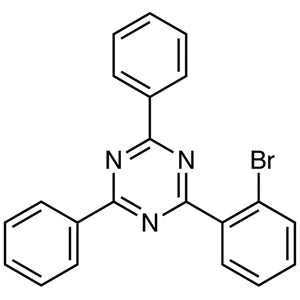
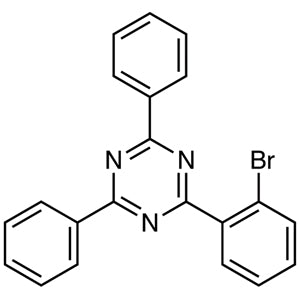
2-(2-Bromophenyl)-4,6-diphenyl-1,3,5-triazine TCI B5663
Regular price From Rp 1.856.400,00Regular price -
2-([1,1'-Biphenyl]-4-yl)-4-chloro-6-phenyl-1,3,5-triazine TCI B5792
Regular price From Rp 1.670.550,00Regular price -
2-([1,1'-Biphenyl]-3-yl)-4,6-dichloro-1,3,5-triazine TCI B5796
Regular price Rp 2.704.800,00Regular price -
2-([1,1'-Biphenyl]-3-yl)-4-chloro-6-phenyl-1,3,5-triazine TCI B5803
Regular price From Rp 717.150,00Regular price -
2,4-Bis[4-(tert-butyl)phenyl]-6-chloro-1,3,5-triazine TCI B5804
Regular price From Rp 2.279.550,00Regular price -
2-[3'-Bromo[1,1'-biphenyl]-3-yl]-4,6-diphenyl-1,3,5-triazine TCI B5895
Regular price From Rp 2.809.800,00Regular price -
4-[[4,6-Bis(n-octylthio)-1,3,5-triazin-2-yl]amino]-2,6-di-tert-butylphenol TCI B5977
Regular price From Rp 1.565.550,00Regular price -
Bemotrizinol TCI B6145
Regular price From Rp 1.431.150,00Regular price
![2-([1,1'-Biphenyl]-3-yl)-4,6-dichloro-1,3,5-triazine (CAS 1402225-89-1) - TCI B5796 - AMI Scientific](http://amiscientific.com/cdn/shop/files/TCI2510B5796.jpg?v=1768815898&width=533)
![2-([1,1'-Biphenyl]-3-yl)-4-chloro-6-phenyl-1,3,5-triazine (CAS 1689576-03-1) - TCI B5803 - AMI Scientific](http://amiscientific.com/cdn/shop/files/TCI2510B5803_dbb6d0f3-4eff-4744-81be-d259549ad9cd.jpg?v=1767863399&width=533)
![2,4-Bis[4-(tert-butyl)phenyl]-6-chloro-1,3,5-triazine (CAS 253158-13-3) - TCI B5804 - AMI Scientific](http://amiscientific.com/cdn/shop/files/TCI2510B5804.jpg?v=1769180232&width=533)
![2-[3'-Bromo[1,1'-biphenyl]-3-yl]-4,6-diphenyl-1,3,5-triazine (CAS 1606981-69-4) - TCI B5895 - AMI Scientific](http://amiscientific.com/cdn/shop/files/TCI2510B5895_c69d52a5-fe12-40ac-bc68-6adcf4ff2e0f.jpg?v=1767863771&width=533)
![2-[3'-Bromo[1,1'-biphenyl]-3-yl]-4,6-diphenyl-1,3,5-triazine (CAS 1606981-69-4) - TCI B5895 - AMI Scientific](http://amiscientific.com/cdn/shop/files/TCI2510B5895.jpg?v=1768815919&width=533)
![4-[[4,6-Bis(n-octylthio)-1,3,5-triazin-2-yl]amino]-2,6-di-tert-butylphenol (CAS 991-84-4) - TCI B5977 - AMI Scientific](http://amiscientific.com/cdn/shop/files/TCI2510B5977.jpg?v=1768815943&width=533)
