


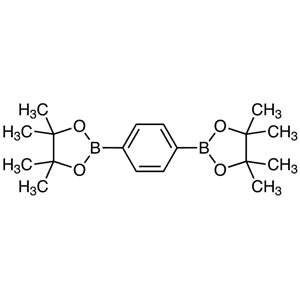
1,4-Benzenediboronic Acid Bis(pinacol) Ester is a key chemical reagent widely used in the field of organoboron chemistry. This compound plays a critical role in various synthetic reactions, particularly in the Suzuki-Miyaura coupling reaction, where it serves as a boronic acid derivative. Its unique molecular structure enables high reactivity and specificity, making it an essential tool for chemists working on complex organic synthesis. In laboratory settings, it is valued for its ability to facilitate the formation of diverse organic compounds with high efficiency and selectivity.
The compound's chemical properties, including its stability under controlled conditions and reactivity towards specific substrates, make it a preferred choice for advanced chemical research. Its ability to act as an efficient boron source in chemical reactions enhances the yield and purity of the final products. Additionally, its compatibility with a wide range of substrates allows for greater flexibility in synthetic strategies, making it a versatile reagent in both academic and industrial laboratories.
In Indonesian laboratories, this compound is commonly used in organic chemistry research, especially in universities and research institutions. Its demand is driven by the need for high-quality organoboron reagents in the development of new chemical compounds and pharmaceuticals. Due to its reliability and effectiveness, it is a highly sought-after material among researchers in the field of synthetic chemistry.
TCI brochures (PDF)
- Suzuki-Miyaura Cross Coupling Reaction 2025-12-01 · p. 16
- Boron Compounds 2025-10-07 · p. 15
- Building Blocks for Organic Semiconductor 2026-03-24 · p. 32
Related TCI products
- TCI B5070 196212-27-8 1,3-Benzenediboronic Acid Bis(pinacol) Ester
- TCI B5069 269410-07-3 1,2-Benzenediboronic Acid Bis(pinacol) Ester
- TCI B6050 5565-36-6 1,4-Benzenediboronic Acid Bis(neopentyl Glycol) Ester
- TCI T3515 365564-05-2 1,3,5-Tris(4,4,5,5-tetramethyl-1,3,2-dioxaborolan-2-yl)benzene
- TCI P2282 867044-33-5 4-(2-Phenyl-1H-benzimidazol-1-yl)phenylboronic Acid (contains varying amounts of Anhydride)
- TCI B5993 1821433-54-8 N,N'-Bis(2-ethylhexyl)-6,6'-bis(4,4,5,5-tetramethyl-1,3,2-dioxaborolan-2-yl)isoindigo
- Organic synthesis applications benefit from its role as a boronic acid derivative, enabling efficient coupling reactions in complex molecule construction.
- It is ideal for Suzuki-Miyaura reactions due to its reactivity and compatibility with a variety of aromatic halides, enhancing cross-coupling efficiency.
- The compound supports the development of pharmaceutical compounds by facilitating the formation of diverse organic structures with high selectivity.
- In academic research, it is used to explore new synthetic pathways and improve reaction yields in organoboron chemistry.
- Its stability under controlled conditions makes it suitable for long-term storage and use in multiple experimental setups.
| Brand | TCI |
|---|---|
| CAS number | 99770-93-1 |
| Molecular formula | — |
| Purity | — |
| Category | Chemistry > Organometallic Reagents > Organoboron [Organometallic Reagents] |
| Pack sizes | Available in various quantities as per standard laboratory supply |
| Physical form | Solid or liquid, depending on the specific formulation |
| Storage | Store in a cool, dry place away from moisture and direct sunlight |
This compound should be stored in a cool, dry environment to maintain its chemical stability and prevent degradation. It is recommended to use airtight containers to protect it from moisture and air exposure. Due to its reactivity, it should be handled in a well-ventilated area, and appropriate personal protective equipment should be worn. Avoid contact with incompatible substances and ensure proper disposal according to local regulations. Regular monitoring of storage conditions ensures the material remains suitable for use in laboratory applications.
—
Produk Terkait
-
1,3-BenzenediboronicAcidBis(pinacol)Ester TCI B5070
Regular price Rp 3.445.050,00Regular priceRp 2.424.450,00Sale price Rp 3.445.050,00 -
1,2-BenzenediboronicAcidBis(pinacol)Ester TCI B5069
Regular price From Rp 3.975.300,00Regular priceRp 2.795.100,00Sale price From Rp 3.975.300,00 -
1,4-BenzenediboronicAcidBis(neopentylGlycol)Ester TCI B6050
Regular price Rp 2.121.000,00Regular priceRp 1.498.350,00Sale price Rp 2.121.000,00 -
1,3,5-Tris(4,4,5,5-tetramethyl-1,3,2-dioxaborolan-2-yl)benzene TCI T3515
Regular price From Rp 2.332.050,00Regular priceRp 1.646.400,00Sale price From Rp 2.332.050,00 -
4-(2-Phenyl-1H-benzimidazol-1-yl)phenylboronicAcid(containsvaryingamountsofAnhydride) TCI P2282
Regular price Rp 2.677.500,00Regular priceRp 1.887.900,00Sale price Rp 2.677.500,00 -
N,N'-Bis(2-ethylhexyl)-6,6'-bis(4,4,5,5-tetramethyl-1,3,2-dioxaborolan-2-yl)isoindigo TCI B5993
Regular price Rp 5.883.150,00Regular priceRp 4.129.650,00Sale price Rp 5.883.150,00 -
Pinacol TCI D0691
Regular price From Rp 1.405.950,00Regular priceRp 998.550,00Sale price From Rp 1.405.950,00 -
2-([1,1':4',1''-Terphenyl]-4-yl)-4,4,5,5-tetramethyl-1,3,2-dioxaborolane TCI T3875
Regular price Rp 3.392.550,00Regular priceRp 2.387.700,00Sale price Rp 3.392.550,00


