

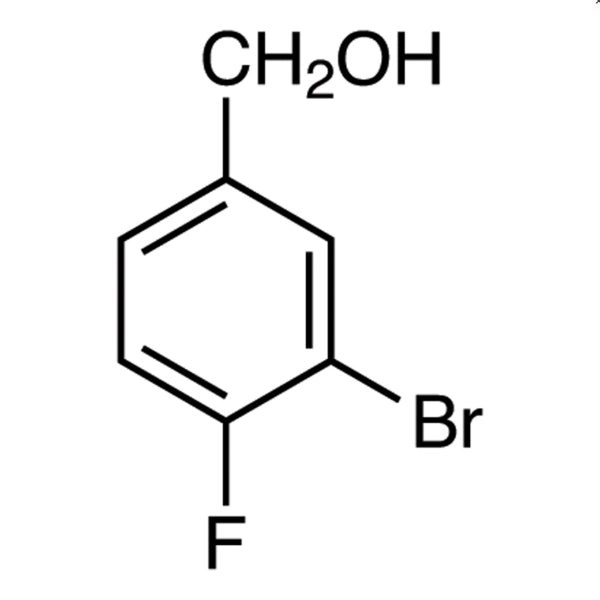
3-Bromo-4-fluorobenzyl Alcohol is a versatile chemical compound widely used in organic synthesis as a key building block. This compound plays a crucial role in the development of complex organic molecules, particularly in the creation of aromatic structures containing bromo and fluoro functionalities. Its unique chemical structure makes it an essential tool for researchers in various scientific disciplines. In laboratory settings, it is frequently employed to facilitate the synthesis of pharmaceuticals, industrial chemicals, and functional compounds. Due to its chemical stability and reactivity, it is a preferred choice for chemists working on advanced synthetic routes.
The compound’s bromo and fluoro substituents contribute to its specific reactivity, enabling the formation of novel compounds with diverse applications. Its ability to react under controlled conditions with various reagents makes it highly adaptable to different synthetic strategies. Additionally, its solubility in organic solvents simplifies purification and reaction processes, enhancing its utility in laboratory workflows. These properties ensure that it remains a valuable resource for researchers seeking to develop new materials and compounds.
In Indonesian laboratories, 3-Bromo-4-fluorobenzyl Alcohol is commonly used in chemical research projects aimed at creating new pharmaceuticals and industrial products. Its stability and reactivity make it a reliable component in the synthesis of functional compounds. Researchers in Indonesia rely on this compound for its consistent performance and compatibility with a wide range of chemical processes, making it an essential part of their laboratory toolkit.
TCI brochures (PDF)
- Fluorination Reagents, Fluorinated Building Blocks 2026-03-18 · p. 18
- Organic synthesis of pharmaceutical compounds due to its bromo and fluoro functionalities enabling tailored molecular structures.
- Development of industrial chemicals through its reactivity and compatibility with various synthetic methods.
- Functional compound creation in research settings where specific chemical modifications are required.
- Aromatic structure formation in complex molecule synthesis due to its unique chemical composition.
- Chemical research applications where stability and reactivity are essential for experimental success.
| Brand | TCI |
|---|---|
| CAS number | 77771-03-0 |
| Molecular formula | — |
| Purity | — |
| Category | Chemistry > Building Blocks > Fluorinated Building Blocks |
| Pack sizes | Available in standard laboratory quantities |
| Physical form | Liquid |
| Storage | Store in a cool, dry place away from light and incompatible materials |
This compound should be stored in a cool, dry environment, away from direct sunlight and sources of heat. It is recommended to keep it in a sealed container to prevent exposure to moisture and air. Due to its chemical nature, it should be stored separately from incompatible substances such as strong oxidizers or acids. Proper ventilation is essential when handling the compound to minimize inhalation risks. Laboratory personnel should use appropriate personal protective equipment, including gloves and safety goggles, to ensure safe handling. Regular monitoring of storage conditions is advised to maintain the compound’s stability and effectiveness for research purposes.
—
Produk Terkait
-
3-Bromo-2-fluorobenzylAlcohol TCI B5143
Regular price From Rp 875.700,00Regular priceRp 612.150,00Sale price From Rp 875.700,00 -
4-Bromo-3-fluorobenzylAlcohol TCI B4956
Regular price Rp 1.298.850,00Regular priceRp 908.250,00Sale price Rp 1.298.850,00 -
2-Bromo-4-fluorobenzylAlcohol TCI B3417
Regular price From Rp 1.115.100,00Regular priceRp 779.100,00Sale price From Rp 1.115.100,00 -
3-FluorobenzylAlcohol TCI F0370
Regular price From Rp 928.200,00Regular priceRp 648.900,00Sale price From Rp 928.200,00 -
2-FluorobenzylAlcohol TCI F0259
Regular price From Rp 505.050,00Regular priceRp 352.800,00Sale price From Rp 505.050,00 -
4-FluorobenzylAlcohol TCI F0251
Regular price From Rp 477.750,00Regular priceRp 333.900,00Sale price From Rp 477.750,00 -
2-Chloro-4-fluorobenzylAlcohol TCI C2527
Regular price Rp 1.431.150,00Regular priceRp 1.000.650,00Sale price Rp 1.431.150,00 -
4-Bromo-2,6-difluorobenzylAlcohol TCI B5090
Regular price From Rp 1.035.300,00Regular priceRp 723.450,00Sale price From Rp 1.035.300,00


