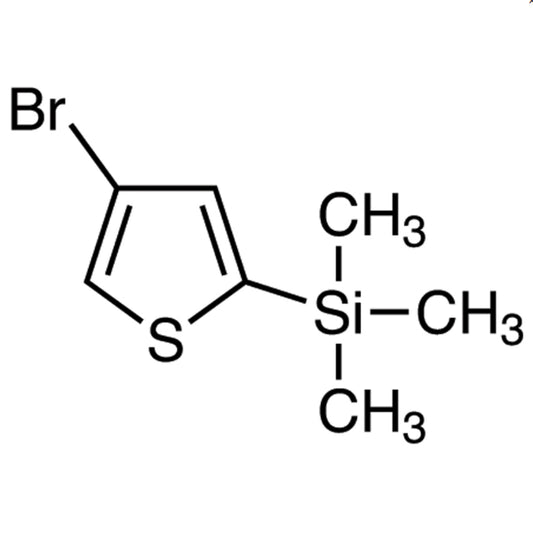
2-Bromo-5-(trimethylsilyl)thiophene is a versatile organic compound widely used in semiconductor material research and inorganic chemistry studies. This compound plays a crucial role in laboratories where the development of advanced materials is essential. Its unique molecular structure, featuring a bromo group and a trimethylsilyl group, makes it an important building block for synthesizing compounds with tailored electronic and optical properties. In the context of material science, it is a key component in the exploration of new materials that exhibit specific conductive or optical characteristics.
The compound’s chemical stability, solubility in organic solvents, and reactivity in substitution and sililation reactions make it a preferred choice for synthetic chemists. The presence of the trimethylsilyl group enhances its stability against hydrolysis, ensuring longer shelf life and improved efficiency in chemical processes. These properties allow it to be used in high-precision reactions where reactivity and stability are critical. Its ability to participate in various chemical transformations also makes it a valuable reagent in the synthesis of complex molecules.
In Indonesian laboratories, 2-Bromo-5-(trimethylsilyl)thiophene is commonly used in semiconductor material research, particularly in the development of novel electronic materials. It supports the creation of materials with specific conductive or optical properties, contributing to advancements in optoelectronics and electrochemistry. Its role in the synthesis of functional materials makes it an essential compound for researchers working on innovative material applications.
TCI brochures (PDF)
- Thiophenes 2026-06-29 · p. 5
- Please inquire for pricing and availability of listed products to our local sales representatives. Si Si Et 2026-07-16 · p. 6
- Building Blocks for Organic Semiconductor 2026-03-24 · p. 25
Related TCI products
- TCI B5196 139896-65-4 2,5-Bis[(trimethylsilyl)ethynyl]thieno[3,2-b]thiophene
- TCI B4856 77998-61-9 4-Bromo-2-(trimethylsilyl)thiophene
- TCI B5475 925899-21-4 2-Bromo-5-(2-ethylhexyl)thiophene
- TCI B4783 303734-52-3 2-Bromo-3-(2-ethylhexyl)thiophene
- TCI B5553 934368-79-3 2-Bromo-5-(4-hexylphenyl)thiophene
- TCI T3190 130995-13-0 3-(Trimethylsilylethynyl)thiophene
- Semiconductor material synthesis where high reactivity and stability are required for creating conductive or optoelectronic materials.
- Organic synthesis applications that need a compound with solubility in organic solvents and participation in substitution reactions.
- Research in electrochemistry where the compound’s chemical stability and reactivity support the development of new electroactive materials.
- Development of novel materials with tailored optical properties, leveraging the compound’s molecular structure for functional material design.
- Advanced material research focusing on the synthesis of compounds with specific electronic behavior for use in next-generation technologies.
| Brand | TCI |
|---|---|
| CAS number | 18246-28-1 |
| Molecular formula | — |
| Purity | — |
| Category | Materials Science > Material Building Blocks > Small Molecule Semiconductor Building Blocks |
| Pack sizes | — |
| Physical form | — |
| Storage | Store in a cool, dry place away from light and moisture |
This compound should be stored in a cool, dry environment, away from direct light and moisture to maintain its chemical stability. It is recommended to use airtight containers made of glass or high-density polyethylene to prevent contamination and degradation. Due to its organic nature, it should be handled in a well-ventilated laboratory setting, with appropriate personal protective equipment such as gloves and safety goggles. Avoid exposure to incompatible substances, and ensure that storage areas are free from potential sources of heat or ignition. Proper labeling and safe handling practices are essential to ensure the compound remains effective and safe for use in laboratory applications.
—
Produk Terkait
-
2,5-Bis[(trimethylsilyl)ethynyl]thieno[3,2-b]thiophene TCI B5196
Regular price From Rp 3.498.600,00Regular priceRp 2.462.250,00Sale price From Rp 3.498.600,00 -
4-Bromo-2-(trimethylsilyl)thiophene TCI B4856
Regular price From Rp 2.571.450,00Regular priceRp 1.813.350,00Sale price From Rp 2.571.450,00 -
2-Bromo-5-(2-ethylhexyl)thiophene TCI B5475
Regular price From Rp 3.180.450,00Regular priceRp 2.239.650,00Sale price From Rp 3.180.450,00 -
2-Bromo-3-(2-ethylhexyl)thiophene TCI B4783
Regular price From Rp 2.411.850,00Regular priceRp 1.702.050,00Sale price From Rp 2.411.850,00 -
2-Bromo-5-(4-hexylphenyl)thiophene TCI B5553
Regular price Rp 3.260.250,00Regular priceRp 2.295.300,00Sale price Rp 3.260.250,00 -
3-(Trimethylsilylethynyl)thiophene TCI T3190
Regular price From Rp 1.008.000,00Regular priceRp 720.300,00Sale price From Rp 1.008.000,00 -
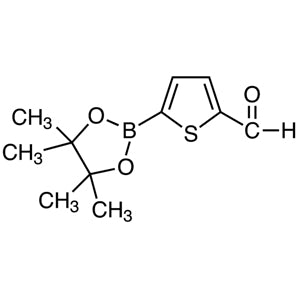
5-(4,4,5,5-Tetramethyl-1,3,2-dioxaborolan-2-yl)thiophene-2-carboxaldehyde TCI T3485
Regular price Rp 2.013.900,00Regular priceRp 1.423.800,00Sale price Rp 2.013.900,00 -
Thieno[3,2-b]thiophene-2-carbonitrile TCI T3221
Regular price From Rp 2.252.250,00Regular priceRp 1.590.750,00Sale price From Rp 2.252.250,00