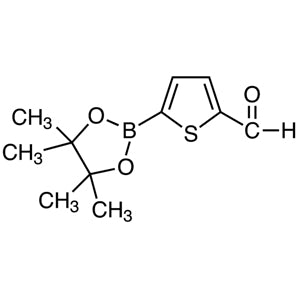
4-Bromo-2-(trimethylsilyl)thiophene is an organic compound widely used in materials science and chemical research. This compound is a modified thiophene derivative, featuring a bromo group and a trimethylsilyl group. Its unique structure makes it a valuable building block for synthesizing complex molecules. In laboratory settings, it serves as a key reagent in the development of advanced materials and functional compounds. Due to its controlled reactivity and structural versatility, it is frequently employed in synthetic pathways requiring precise chemical transformations.
The compound’s reactivity is enhanced by the presence of the bromo group, which facilitates substitution reactions, while the trimethylsilyl group provides chemical stability. These properties make it a preferred choice in both academic and industrial research. The combination of functional groups allows for selective modifications, making it ideal for creating new materials with tailored properties. Its utility extends to applications in semiconductor technology and optoelectronic devices.
In Indonesian laboratories, 4-Bromo-2-(trimethylsilyl)thiophene is commonly used in material science research, particularly in the development of semiconductor materials and organic composites. Researchers in educational institutions and research centers rely on this compound for experiments requiring high precision and controlled chemical reactions. Its role in advancing material innovation is significant, supporting the growth of scientific research in the region.
TCI brochures (PDF)
- Thiophenes 2026-06-29 · p. 4
- Please inquire for pricing and availability of listed products to our local sales representatives. Si Si Et 2026-07-16 · p. 6
- Building Blocks for Organic Semiconductor 2026-03-24 · p. 25
Related TCI products
- TCI B5196 139896-65-4 2,5-Bis[(trimethylsilyl)ethynyl]thieno[3,2-b]thiophene
- TCI B4855 18246-28-1 2-Bromo-5-(trimethylsilyl)thiophene
- TCI B5475 925899-21-4 2-Bromo-5-(2-ethylhexyl)thiophene
- TCI B4783 303734-52-3 2-Bromo-3-(2-ethylhexyl)thiophene
- TCI B5553 934368-79-3 2-Bromo-5-(4-hexylphenyl)thiophene
- TCI T3190 130995-13-0 3-(Trimethylsilylethynyl)thiophene
- Used in semiconductor material synthesis due to its reactivity and structural versatility, enabling the creation of advanced electronic components.
- Applied in optoelectronic device development because of its ability to participate in controlled chemical modifications and functional group substitutions.
- Utilized in organic composite research for its compatibility with various chemical reactions and its role in enhancing material properties.
- Employed in synthetic chemistry experiments where precise functional group manipulation is required for complex molecule construction.
- Integrated into microelectronics research for its contribution to the development of high-performance semiconductor materials and components.
| Brand | TCI |
|---|---|
| CAS number | 77998-61-9 |
| Molecular formula | — |
| Purity | — |
| Category | Materials Science > Material Building Blocks > Small Molecule Semiconductor Building Blocks |
| Pack sizes | Available in standard laboratory quantities as per supplier specifications |
| Physical form | Solid or liquid, depending on formulation and supplier packaging |
| Storage | Store in a cool, dry place away from light and moisture |
This compound should be stored in a cool, dry environment, away from direct light and moisture to maintain its chemical integrity. It is recommended to use airtight containers made of inert materials such as glass or polyethylene to prevent contamination and degradation. Due to its reactivity, it should be handled in a well-ventilated laboratory setting, with appropriate personal protective equipment. Avoid exposure to incompatible substances, and ensure proper disposal in accordance with local regulations. Regular monitoring of storage conditions is advised to ensure the material remains stable and suitable for use in research applications.
—
Produk Terkait
-
2,5-Bis[(trimethylsilyl)ethynyl]thieno[3,2-b]thiophene TCI B5196
Regular price From Rp 3.498.600,00Regular priceRp 2.462.250,00Sale price From Rp 3.498.600,00 -
2-Bromo-5-(trimethylsilyl)thiophene TCI B4855
Regular price Rp 3.630.900,00Regular priceRp 2.554.650,00Sale price Rp 3.630.900,00 -
2-Bromo-5-(2-ethylhexyl)thiophene TCI B5475
Regular price From Rp 3.180.450,00Regular priceRp 2.239.650,00Sale price From Rp 3.180.450,00 -
2-Bromo-3-(2-ethylhexyl)thiophene TCI B4783
Regular price From Rp 2.411.850,00Regular priceRp 1.702.050,00Sale price From Rp 2.411.850,00 -
2-Bromo-5-(4-hexylphenyl)thiophene TCI B5553
Regular price Rp 3.260.250,00Regular priceRp 2.295.300,00Sale price Rp 3.260.250,00 -
3-(Trimethylsilylethynyl)thiophene TCI T3190
Regular price From Rp 1.008.000,00Regular priceRp 720.300,00Sale price From Rp 1.008.000,00 -
5-(4,4,5,5-Tetramethyl-1,3,2-dioxaborolan-2-yl)thiophene-2-carboxaldehyde TCI T3485
Regular price Rp 2.013.900,00Regular priceRp 1.423.800,00Sale price Rp 2.013.900,00 -
Thieno[3,2-b]thiophene-2-carbonitrile TCI T3221
Regular price From Rp 2.252.250,00Regular priceRp 1.590.750,00Sale price From Rp 2.252.250,00