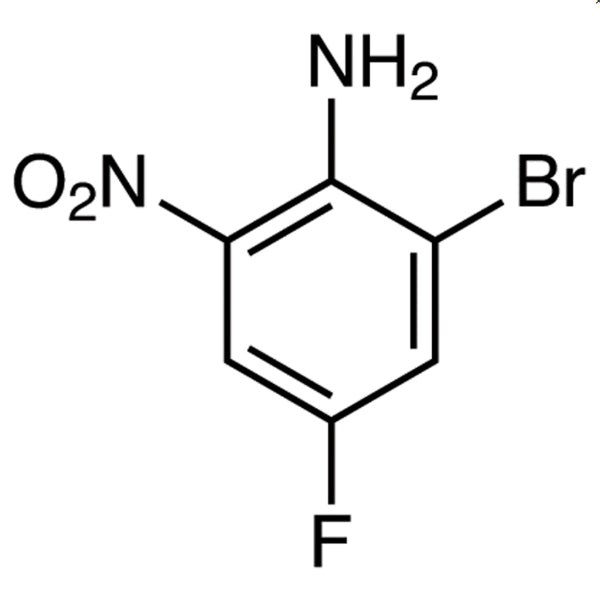
2-Bromo-4-fluoro-6-nitroaniline is a chemical compound widely used as a foundational building block in the synthesis of complex molecules. This compound plays a critical role in organic chemistry laboratories, where it serves as a versatile reagent for various chemical transformations. Its unique molecular structure, containing bromo, fluoro, and nitro functional groups, makes it a valuable tool for chemists seeking to create a wide range of derivatives. Due to its reactivity and specificity, it is frequently utilized in the development of pharmaceuticals, industrial chemicals, and functional compounds.
The compound's reactivity stems from its bromo and nitro groups, which are highly susceptible to substitution and electrophilic reactions. These properties make it an ideal candidate for a variety of synthetic pathways, including nitration, bromination, and functional group modifications. Its ability to participate in multiple reaction types enhances its utility in both academic and industrial research settings. Additionally, its solubility in organic solvents facilitates its use in purification and reaction processes, making it a preferred choice for chemists.
In Indonesian laboratories, 2-Bromo-4-fluoro-6-nitroaniline is commonly used in organic chemistry research, drug development, and the production of industrial chemicals. Its availability and chemical properties make it a key component in the synthesis of complex molecules, supporting both basic and applied research. The compound's role in these applications highlights its importance in the chemical industry and academic institutions across Indonesia.
TCI brochures (PDF)
- Fluorination Reagents, Fluorinated Building Blocks 2026-03-18 · p. 27
- Organic synthesis is a primary application where this compound is used to create complex molecules through substitution and electrophilic reactions.
- Pharmaceutical research benefits from its reactivity, allowing the development of new drug compounds and derivatives.
- Industrial chemical production utilizes its functional groups for the synthesis of various chemical intermediates.
- Functional compound development relies on its ability to participate in multiple reaction types, enhancing synthetic versatility.
- Academic research in chemistry laboratories uses it as a key reagent for teaching and experimental purposes.
| Brand | TCI |
|---|---|
| CAS number | 10472-88-5 |
| Molecular formula | — |
| Purity | — |
| Category | Chemistry > Building Blocks > Fluorinated Building Blocks |
| Pack sizes | — |
| Physical form | — |
| Storage | Store in a cool, dry place away from light and incompatible materials. |
This compound should be stored in a cool, dry environment, away from direct sunlight and sources of heat. It is recommended to use airtight containers made of materials that are chemically inert to prevent degradation. Due to its reactivity, it should be handled with care, using appropriate personal protective equipment such as gloves and safety goggles. Avoid contact with incompatible substances like strong oxidizing agents or acids. Ensure proper ventilation in the workspace to minimize exposure. Regular monitoring of storage conditions is essential to maintain the compound's integrity and ensure safe handling in laboratory settings.
—
Produk Terkait
-
2-Fluoro-4-nitroaniline TCI F0798
Regular price From Rp 452.550,00Regular priceRp 316.050,00Sale price From Rp 452.550,00 -
5-Fluoro-2-nitroaniline TCI F0789
Regular price From Rp 1.590.750,00Regular priceRp 1.111.950,00Sale price From Rp 1.590.750,00 -
3-Fluoro-4-nitroaniline TCI F0787
Regular price From Rp 795.900,00Regular priceRp 556.500,00Sale price From Rp 795.900,00 -
4-Fluoro-2-nitroaniline TCI F0380
Regular price From Rp 584.850,00Regular priceRp 408.450,00Sale price From Rp 584.850,00 -
2-Fluoro-5-nitroaniline TCI F0267
Regular price Rp 2.094.750,00Regular priceRp 1.464.750,00Sale price Rp 2.094.750,00 -
4-Fluoro-3-nitroaniline TCI F0168
Regular price Rp 1.035.300,00Regular priceRp 723.450,00Sale price Rp 1.035.300,00 -
5-Chloro-4-fluoro-2-nitroaniline TCI C3141
Regular price From Rp 769.650,00Regular priceRp 537.600,00Sale price From Rp 769.650,00 -
2,3,4-Trifluoro-6-nitroaniline TCI T2783
Regular price From Rp 1.008.000,00Regular priceRp 704.550,00Sale price From Rp 1.008.000,00