


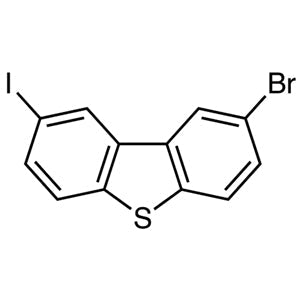
2-Bromo-8-iododibenzothiophene is a complex chemical compound widely used as a building block in the synthesis of heterocyclic compounds. This material plays a crucial role in organic chemistry laboratories, where it serves as a key reagent for modifying aromatic ring structures. Its unique chemical structure allows for versatile chemical transformations, making it an essential tool for researchers working on the development of new compounds. Due to its reactivity and structural complexity, it is frequently employed in synthetic pathways that require precise functional group manipulation.
The compound’s chemical properties, including its stability under controlled conditions and reactivity in appropriate chemical environments, make it a preferred choice for various synthetic applications. Its ability to participate in substitution reactions, electrophilic reactions, and radical processes enhances its utility in laboratory settings. The presence of both bromo and iodine substituents further contributes to its reactivity, enabling it to be a valuable reagent in the synthesis of pharmaceuticals and advanced materials. These characteristics make it a sought-after compound among scientists engaged in organic synthesis.
In Indonesian laboratories, 2-Bromo-8-iododibenzothiophene is commonly used in organic chemistry research, particularly in academic and industrial settings. Its application spans across various scientific disciplines, including pharmaceutical development and material science. The compound’s versatility and chemical reactivity make it an essential component in the toolkit of researchers working on complex molecular structures and functional group modifications.
TCI brochures (PDF)
- Thiophenes 2026-06-29 · p. 12
- Building Blocks for Organic Semiconductor 2026-03-24 · p. 28
- Organic synthesis of heterocyclic compounds due to its reactive bromo and iodine substituents.
- Development of pharmaceuticals through functional group modification and structural variation.
- Research in material science for the creation of advanced polymers and chemical intermediates.
- Investigation of radical reactions and electrophilic substitution pathways in synthetic chemistry.
- Exploration of chemical reactivity in controlled laboratory environments for academic research.
| Brand | TCI |
|---|---|
| CAS number | 1206544-88-8 |
| Molecular formula | — |
| Purity | — |
| Category | Chemistry > Building Blocks > Heterocyclic Building Blocks |
| Pack sizes | As per supplier specifications |
| Physical form | Solid (as per standard chemical properties) |
| Storage | Store in a cool, dry, and well-ventilated area away from light |
This compound should be stored in a cool, dry, and well-ventilated area, away from direct light to maintain its chemical stability. It is recommended to use airtight containers made of materials compatible with its chemical properties, such as glass or high-density polyethylene. Due to its reactivity, it should be handled with appropriate personal protective equipment, including gloves and safety goggles. In laboratory settings, it should be stored separately from incompatible substances to prevent unwanted chemical interactions. Always ensure proper ventilation when working with this material to minimize exposure risks.
—
Produk Terkait
-
3-Bromodibenzothiophene5,5-Dioxide TCI B5268
Regular price Rp 2.809.800,00Regular priceRp 1.980.300,00Sale price Rp 2.809.800,00 -
1-Bromodibenzothiophene TCI B5861
Regular price Rp 4.399.500,00Regular priceRp 3.092.250,00Sale price Rp 4.399.500,00 -
Dibenzothiophene5,5-Dioxide TCI D4153
Regular price From Rp 1.431.150,00Regular priceRp 1.016.400,00Sale price From Rp 1.431.150,00 -
Dibenzothiophene TCI D0148
Regular price From Rp 717.150,00Regular priceRp 516.600,00Sale price From Rp 717.150,00 -
2-Iododibenzothiophene TCI I0973
Regular price From Rp 1.431.150,00Regular priceRp 1.016.400,00Sale price From Rp 1.431.150,00 -
4-Iododibenzothiophene TCI I0947
Regular price From Rp 1.192.800,00Regular priceRp 849.450,00Sale price From Rp 1.192.800,00 -
4-(4,4,5,5-Tetramethyl-1,3,2-dioxaborolan-2-yl)dibenzothiophene TCI T3236
Regular price From Rp 1.272.600,00Regular priceRp 905.100,00Sale price From Rp 1.272.600,00 -
4-(4-Bromophenyl)dibenzothiophene TCI B5384
Regular price From Rp 1.378.650,00Regular priceRp 979.650,00Sale price From Rp 1.378.650,00


