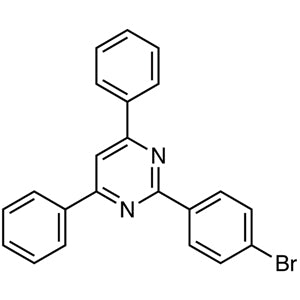
4-(3-Bromophenyl)-2,6-diphenylpyrimidine is a chemical compound widely used in scientific research, particularly in the development of semiconductor materials. This compound plays a critical role in the synthesis of complex molecules that are essential for advanced electronic and optical applications. Its unique molecular structure, consisting of a pyrimidine ring connected to two phenyl groups and a bromo group on an aromatic ring, makes it a versatile building block in material science. Due to its structural complexity, it is often utilized in laboratories to create novel materials with tailored properties.
The compound is preferred for its stable chemical properties and controlled reactivity, which allow researchers to manipulate its behavior in various synthetic processes. Its ability to form bonds with different functional groups enhances its utility in creating compounds with specific functionalities. The stability of the molecule under certain conditions also ensures that it remains effective over time, reducing the need for frequent replenishment. These characteristics make it a reliable choice for laboratories requiring consistent and predictable results.
In Indonesian laboratories, this compound is commonly used in research focused on semiconductor development and optoelectronic materials. Its application is particularly relevant in academic and industrial settings where precision and reliability are key. The compound’s role in creating materials with specific optical and electronic properties makes it an essential tool for researchers working on next-generation technologies. Its use is also observed in projects involving molecular design and functional material synthesis, where its structural adaptability is highly valued.
TCI brochures (PDF)
- Building Blocks for Organic Semiconductor 2026-03-24 · p. 16
Related TCI products
- TCI B4933 58536-46-2 4-(4-Bromophenyl)-2,6-diphenylpyrimidine
- TCI B5797 457613-56-8 2-(4-Bromophenyl)-4,6-diphenylpyrimidine
- TCI B4662 56181-49-8 2-Bromo-4,6-diphenylpyrimidine
- TCI D5505 26032-72-4 2,4-Dichloro-6-phenylpyrimidine
- TCI D4895 607740-08-9 4-(3,5-Dibromophenyl)-2,6-diphenylpyrimidine
- TCI C3518 1354749-13-5 4-Chloro-6-(4-chlorophenyl)-2-phenylpyrimidine
- Semiconductor material synthesis where precise molecular structure is essential for electronic device development.
- Optoelectronic research due to its potential for creating materials with tailored optical properties.
- Molecular design projects requiring a versatile building block with multiple functional groups.
- Advanced material development in academic and industrial research settings.
- Functional material synthesis where controlled reactivity and stability are critical for process reliability.
| Brand | TCI |
|---|---|
| CAS number | 864377-28-6 |
| Molecular formula | — |
| Purity | — |
| Category | Materials Science > Material Building Blocks > Small Molecule Semiconductor Building Blocks |
| Pack sizes | Available in various quantities as per supplier specifications |
| Physical form | Solid (as per standard chemical properties) |
| Storage | Store in a cool, dry place away from direct sunlight |
This compound should be stored in a cool, dry environment, away from direct sunlight and sources of heat. It is recommended to use airtight containers to prevent moisture absorption and contamination. Due to its chemical stability, it does not require refrigeration but should be kept in a secure location to avoid accidental exposure. Laboratory personnel should handle the compound with appropriate personal protective equipment, such as gloves and safety goggles, to ensure safe handling. Proper labeling of storage containers is essential to maintain safety and prevent mix-ups. Regular inspection of storage conditions is advised to ensure the compound remains in optimal condition for use.
—
Produk Terkait
-
4-(4-Bromophenyl)-2,6-diphenylpyrimidine TCI B4933
Regular price Rp 2.041.200,00Regular priceRp 1.442.700,00Sale price Rp 2.041.200,00 -
2-(4-Bromophenyl)-4,6-diphenylpyrimidine TCI B5797
Regular price From Rp 1.618.050,00Regular priceRp 1.146.600,00Sale price From Rp 1.618.050,00 -
2-Bromo-4,6-diphenylpyrimidine TCI B4662
Regular price From Rp 1.776.600,00Regular priceRp 1.257.900,00Sale price From Rp 1.776.600,00 -
2,4-Dichloro-6-phenylpyrimidine TCI D5505
Regular price From Rp 2.942.100,00Regular priceRp 2.072.700,00Sale price From Rp 2.942.100,00 -
4-(3,5-Dibromophenyl)-2,6-diphenylpyrimidine TCI D4895
Regular price From Rp 769.650,00Regular priceRp 553.350,00Sale price From Rp 769.650,00 -
4-Chloro-6-(4-chlorophenyl)-2-phenylpyrimidine TCI C3518
Regular price From Rp 1.008.000,00Regular priceRp 720.300,00Sale price From Rp 1.008.000,00 -
2-Chloro-4,6-diphenylpyrimidine TCI C3123
Regular price From Rp 1.801.800,00Regular priceRp 1.275.750,00Sale price From Rp 1.801.800,00 -
4-Chloro-2,6-diphenylpyrimidine TCI C3016
Regular price From Rp 1.033.200,00Regular priceRp 738.150,00Sale price From Rp 1.033.200,00