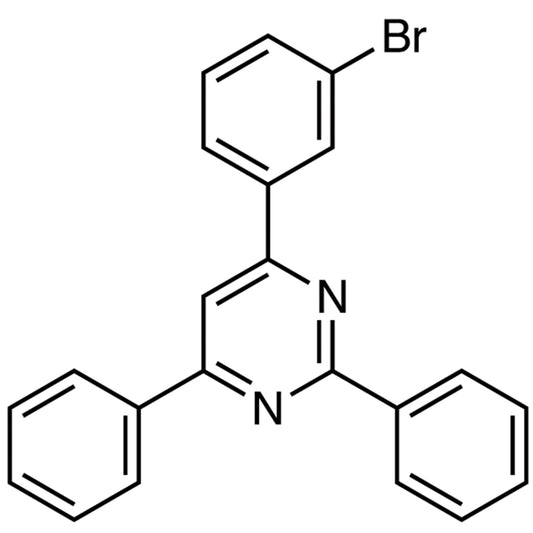
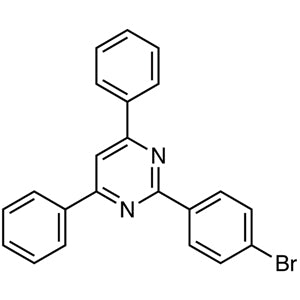
4-(4-Bromophenyl)-2,6-diphenylpyrimidine is an organic compound widely utilized in scientific material research, particularly in the development of semiconductor materials. This compound plays a crucial role in the synthesis of advanced functional materials due to its unique molecular structure. It consists of a pyrimidine ring substituted with phenyl groups and a bromophenyl group, making it a versatile building block in chemical synthesis. Its structural complexity allows for a wide range of chemical interactions, making it a valuable resource for researchers in the field of materials science.
The compound's stability and controlled reactivity make it a preferred choice for laboratory applications. It exhibits favorable characteristics for substitution and electrophilic reactions, enabling researchers to tailor its properties for specific applications. Its chemical versatility supports the development of materials with specialized properties such as conductivity, fluorescence, and photoresponsiveness. These features make it a key component in the creation of advanced electronic and optoelectronic materials.
In Indonesian laboratories, this compound is commonly used in material science and technology research. Many research institutions and universities incorporate it into their studies to develop new materials with enhanced performance. Its application spans across various scientific disciplines, contributing to the advancement of functional and semiconductor-based technologies in the region.
TCI brochures (PDF)
- Building Blocks for Organic Semiconductor 2026-03-24 · p. 16
Related TCI products
- TCI B4930 864377-28-6 4-(3-Bromophenyl)-2,6-diphenylpyrimidine
- TCI B5797 457613-56-8 2-(4-Bromophenyl)-4,6-diphenylpyrimidine
- TCI B4662 56181-49-8 2-Bromo-4,6-diphenylpyrimidine
- TCI D5505 26032-72-4 2,4-Dichloro-6-phenylpyrimidine
- TCI D4895 607740-08-9 4-(3,5-Dibromophenyl)-2,6-diphenylpyrimidine
- TCI C3518 1354749-13-5 4-Chloro-6-(4-chlorophenyl)-2-phenylpyrimidine
- Material synthesis for semiconductor and optoelectronic devices due to its structural versatility and reactivity.
- Development of functional materials with specific optical and electronic properties through chemical modification.
- Research in electro-optic materials where controlled chemical reactivity is essential for performance optimization.
- Synthesis of advanced organic compounds used in photovoltaic and light-emitting technologies.
- Exploration of new chemical pathways in material science for improved conductivity and stability.
| Brand | TCI |
|---|---|
| CAS number | 58536-46-2 |
| Molecular formula | — |
| Purity | — |
| Category | Materials Science > Material Building Blocks > Small Molecule Semiconductor Building Blocks |
| Pack sizes | Available in standard laboratory quantities as per supplier specifications |
| Physical form | Solid |
| Storage | Store in a cool, dry place away from light and moisture |
This compound should be stored in a cool, dry environment, away from direct light and moisture to maintain its chemical integrity. It is recommended to use airtight containers made of inert materials such as glass or polyethylene to prevent contamination and degradation. Due to its reactivity, it should be handled with appropriate personal protective equipment, including gloves and safety goggles. Proper ventilation is essential when working with this compound to minimize exposure. It is important to keep it away from incompatible substances such as strong oxidizers or acids to ensure safe laboratory practices. Regular monitoring of storage conditions will help maintain the compound's quality and usability for research purposes.
—
Produk Terkait
-
4-(3-Bromophenyl)-2,6-diphenylpyrimidine TCI B4930
Regular price From Rp 557.550,00Regular priceRp 405.300,00Sale price From Rp 557.550,00 -
2-(4-Bromophenyl)-4,6-diphenylpyrimidine TCI B5797
Regular price From Rp 1.618.050,00Regular priceRp 1.146.600,00Sale price From Rp 1.618.050,00 -
2-Bromo-4,6-diphenylpyrimidine TCI B4662
Regular price From Rp 1.776.600,00Regular priceRp 1.257.900,00Sale price From Rp 1.776.600,00 -
2,4-Dichloro-6-phenylpyrimidine TCI D5505
Regular price From Rp 2.942.100,00Regular priceRp 2.072.700,00Sale price From Rp 2.942.100,00 -
4-(3,5-Dibromophenyl)-2,6-diphenylpyrimidine TCI D4895
Regular price From Rp 769.650,00Regular priceRp 553.350,00Sale price From Rp 769.650,00 -
4-Chloro-6-(4-chlorophenyl)-2-phenylpyrimidine TCI C3518
Regular price From Rp 1.008.000,00Regular priceRp 720.300,00Sale price From Rp 1.008.000,00 -
2-Chloro-4,6-diphenylpyrimidine TCI C3123
Regular price From Rp 1.801.800,00Regular priceRp 1.275.750,00Sale price From Rp 1.801.800,00 -
4-Chloro-2,6-diphenylpyrimidine TCI C3016
Regular price From Rp 1.033.200,00Regular priceRp 738.150,00Sale price From Rp 1.033.200,00