


4-(3,5-Dibromophenyl)-2,6-diphenylpyrimidine is an organic compound with a complex molecular structure, widely used in scientific research across materials and chemical sciences. This compound plays a crucial role in laboratory settings as a building block for the synthesis of advanced materials. Its unique structural features make it a valuable resource for researchers aiming to develop novel compounds with specific electronic and optical properties. In the context of materials science, it serves as a foundational element for creating semiconductor materials that exhibit tailored performance characteristics.
The compound's chemical properties, including its bromo and phenyl substituents, contribute to its stability and reactivity. These features allow for precise control in chemical reactions, making it a preferred choice for applications that require high accuracy and reproducibility. The combination of these substituents also enhances its compatibility with various synthetic pathways, enabling researchers to design and produce materials with specific functionalities. This versatility makes it an essential component in modern laboratory research.
In Indonesian laboratories, this compound is commonly used in semiconductor material research, particularly in the development of new materials for electronic and optical applications. Scientists at educational institutions and research organizations rely on it as a key reagent for experiments that require compounds with complex structures and specific chemical behavior. Its role in advancing material science is evident in its frequent use in cutting-edge research projects.
Related TCI products
- TCI B4933 58536-46-2 4-(4-Bromophenyl)-2,6-diphenylpyrimidine
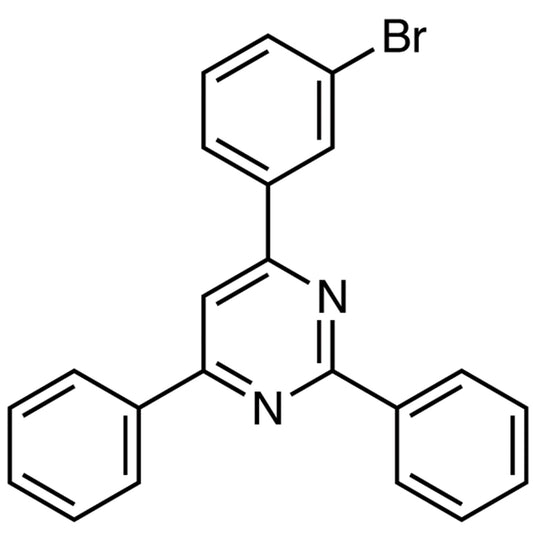
- TCI B4930 864377-28-6 4-(3-Bromophenyl)-2,6-diphenylpyrimidine
- TCI B4662 56181-49-8 2-Bromo-4,6-diphenylpyrimidine
- TCI D5505 26032-72-4 2,4-Dichloro-6-phenylpyrimidine
- TCI C3518 1354749-13-5 4-Chloro-6-(4-chlorophenyl)-2-phenylpyrimidine
- TCI C3123 2915-16-4 2-Chloro-4,6-diphenylpyrimidine
- Organic semiconductor development: This compound is ideal for synthesizing organic semiconductors due to its complex structure and controlled reactivity, enabling the design of materials with tailored electronic properties.
- Material synthesis research: Its stability and reactivity make it a preferred choice for creating new materials with unique chemical and physical characteristics.
- Electronic device prototyping: It supports the creation of advanced electronic components by providing a foundation for materials with specific conductive and optical behaviors.
- Optical material innovation: The compound’s structural features allow for the development of materials used in optical applications, such as light-emitting diodes and photovoltaic cells.
- Chemical reaction optimization: Its predictable behavior in chemical reactions makes it suitable for experiments requiring precise control and reproducibility in synthetic processes.
| Brand | TCI |
|---|---|
| CAS number | 607740-08-9 |
| Molecular formula | — |
| Purity | — |
| Category | Materials Science > Material Building Blocks > Small Molecule Semiconductor Building Blocks |
| Pack sizes | — |
| Physical form | — |
| Storage | Store in a cool, dry place away from light and moisture |
This compound should be stored in a cool, dry environment, away from direct light and moisture to maintain its chemical integrity. It is recommended to use airtight containers made of materials that are chemically inert to prevent contamination and degradation. Due to its complex structure, it is important to handle it with care during synthesis and experimentation to avoid unintended reactions. Proper ventilation should be maintained in the laboratory to ensure safe handling. Always follow standard laboratory safety protocols when working with organic compounds to minimize risks and ensure a controlled environment.
—
Produk Terkait
-
4-(4-Bromophenyl)-2,6-diphenylpyrimidine TCI B4933
Regular price Rp 1.988.700,00Regular price -
4-(3-Bromophenyl)-2,6-diphenylpyrimidine TCI B4930
Regular price From Rp 505.050,00Regular price -
2-Bromo-4,6-diphenylpyrimidine TCI B4662
Regular price From Rp 1.724.100,00Regular price -
2,4-Dichloro-6-phenylpyrimidine TCI D5505
Regular price From Rp 2.889.600,00Regular price -
4-Chloro-6-(4-chlorophenyl)-2-phenylpyrimidine TCI C3518
Regular price From Rp 955.500,00Regular price -
2-Chloro-4,6-diphenylpyrimidine TCI C3123
Regular price From Rp 1.749.300,00Regular price -
4-Chloro-2,6-diphenylpyrimidine TCI C3016
Regular price From Rp 980.700,00Regular price -
4-([1,1'-Biphenyl]-4-yl)-6-chloro-2-phenylpyrimidine TCI B5802
Regular price From Rp 3.312.750,00Regular price




![4-([1,1'-Biphenyl]-4-yl)-6-chloro-2-phenylpyrimidine (CAS 1689538-58-6) - TCI B5802 - AMI Scientific](http://amiscientific.com/cdn/shop/files/TCI2510B5802.jpg?v=1768815900&width=533)