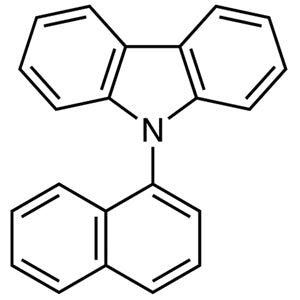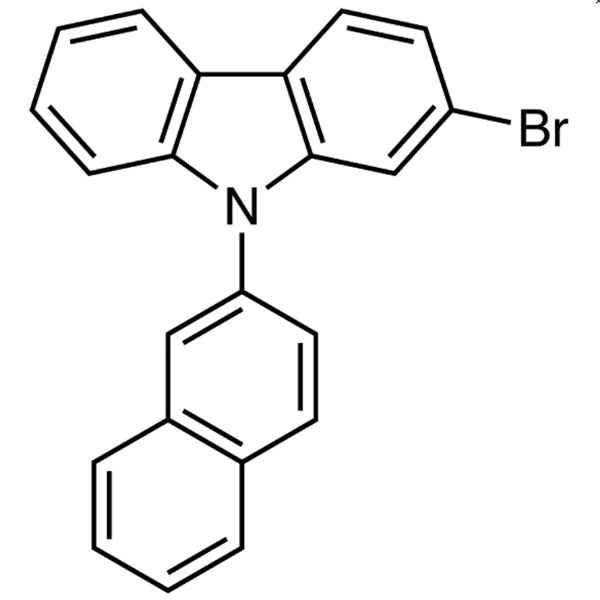
2-Bromo-9-(2-naphthyl)-9H-carbazole is an organic compound widely used in semiconductor material research and materials science. This compound plays a crucial role in the development of organic conductive materials, particularly in the creation of optoelectronic devices and organic-based electronic components. Its unique molecular structure, consisting of a carbazole core with a bromo group and a naphthyl substituent, provides it with specific electronic properties that make it valuable for advanced material applications.
The compound's high conductivity and chemical stability make it a preferred choice for researchers working on organic semiconductors. These properties allow it to be used in the fabrication of thin-film devices and active materials for applications such as light-emitting diodes (LEDs), organic light-emitting diodes (OLEDs), and optical sensors. Its controlled reactivity and consistent performance also make it ideal for experiments requiring precision and reproducibility.
In Indonesian laboratories, this compound is commonly used in material science and semiconductor technology research. Scientists and researchers in educational institutions and research organizations rely on it for experiments focused on developing new materials, processing methods, and improving the performance of organic electronic devices. Its versatility and reliability make it a key component in the advancement of optoelectronic technologies in the region.
TCI brochures (PDF)
- Carbazoles 2025-06-27 · p. 6
- Building Blocks for Organic Semiconductor 2026-03-24 · p. 18
Related TCI products
- TCI B5050 934545-83-2 3-Bromo-9-(1-naphthyl)-9H-carbazole
- TCI B5028 934545-80-9 3-Bromo-9-(2-naphthyl)carbazole
- TCI N1012 22034-43-1 9-(1-Naphthyl)carbazole
- TCI B5502 750573-24-1 9,9'-(5-Bromo-1,3-phenylene)bis(9H-carbazole)
- TCI B5471 177775-87-0 9-Benzoyl-3-bromo-9H-carbazole
- TCI B5461 339576-55-5 9-Benzyl-3-bromo-9H-carbazole
- Organic Semiconductor Research – This compound is ideal for studying the electronic properties of organic materials, enabling the development of advanced optoelectronic devices.
- Thin-Film Device Fabrication – Its stability and conductivity make it suitable for creating thin-film layers used in LED and OLED manufacturing.
- Optical Sensor Development – The compound's unique electronic structure allows it to be used in the creation of sensitive optical sensors for various analytical applications.
- Material Processing Studies – Researchers use it to explore new processing techniques for organic semiconductors, enhancing material performance and efficiency.
- Semiconductor Material Innovation – Its molecular structure supports research into new semiconductor materials with improved electrical and optical properties.
| Brand | TCI |
|---|---|
| CAS number | 1427316-53-7 |
| Molecular formula | — |
| Purity | — |
| Category | Materials Science > Material Building Blocks > Small Molecule Semiconductor Building Blocks |
| Pack sizes | Available in various quantities as per supplier specifications |
| Physical form | Solid, crystalline appearance |
| Storage | Store in a cool, dry place away from light and moisture |
This compound should be stored in a cool, dry environment, away from direct light and moisture to maintain its chemical stability. It is recommended to use airtight containers made of glass or high-density polyethylene to prevent contamination and degradation. Due to its bromo group, it may exhibit moderate reactivity, so it should be handled with care in a well-ventilated laboratory setting. Avoid exposure to strong oxidizing agents or incompatible materials. Always use appropriate personal protective equipment, including gloves and safety goggles, when handling this compound. Proper storage and handling ensure the compound remains effective and safe for use in laboratory applications.
—
Produk Terkait
-
3-Bromo-9-(1-naphthyl)-9H-carbazole TCI B5050
Regular price From Rp 557.550,00Regular priceRp 405.300,00Sale price From Rp 557.550,00 -
3-Bromo-9-(2-naphthyl)carbazole TCI B5028
Regular price From Rp 1.113.000,00Regular priceRp 793.800,00Sale price From Rp 1.113.000,00 -
9-(1-Naphthyl)carbazole TCI N1012
Regular price From Rp 900.900,00Regular priceRp 645.750,00Sale price From Rp 900.900,00 -
9,9'-(5-Bromo-1,3-phenylene)bis(9H-carbazole) TCI B5502
Regular price From Rp 2.835.000,00Regular priceRp 1.998.150,00Sale price From Rp 2.835.000,00 -
9-Benzoyl-3-bromo-9H-carbazole TCI B5471
Regular price Rp 1.934.100,00Regular priceRp 1.368.150,00Sale price Rp 1.934.100,00 -
9-Benzyl-3-bromo-9H-carbazole TCI B5461
Regular price From Rp 1.563.450,00Regular priceRp 1.108.800,00Sale price From Rp 1.563.450,00 -
9-Benzyl-2-bromo-9H-carbazole TCI B5460
Regular price From Rp 1.856.400,00Regular priceRp 1.313.550,00Sale price From Rp 1.856.400,00 -
9-(2'-Bromo-4-biphenylyl)carbazole TCI B5312
Regular price From Rp 1.008.000,00Regular priceRp 720.300,00Sale price From Rp 1.008.000,00