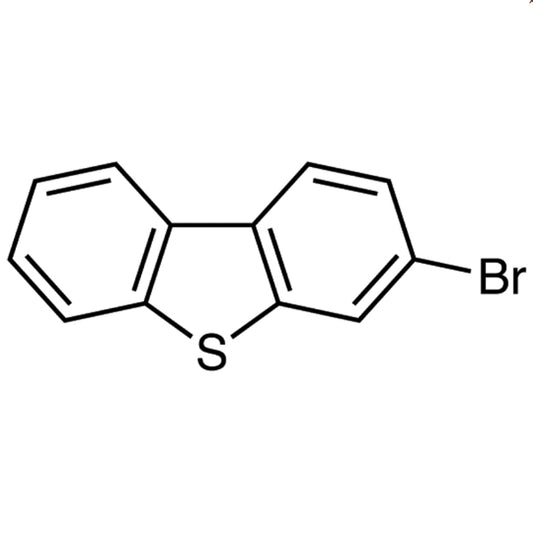
2-Bromodibenzothiophene 5,5-Dioxide is a chemical compound widely used in material science research, particularly in the development of organic semiconductors. This compound plays a crucial role in laboratories where the synthesis of complex molecules with specific reactivity and stability is required. Its molecular structure, featuring two bromine atoms and two oxygen atoms attached to a dibenzothiophene ring, makes it a versatile building block for advanced material applications. Due to its unique chemical properties, it is frequently utilized in studies involving molecular structure and electronic behavior of materials used in display technologies and solar cells.
The compound’s high reactivity and structural complexity make it a preferred choice for researchers aiming to achieve precise molecular modifications. Its ability to participate in substitution reactions and its stability under controlled conditions allow it to be a key component in the creation of new semiconductor materials. These characteristics are essential for achieving the desired electronic properties in organic materials, which are critical for modern technological applications. The compound’s chemical versatility supports a wide range of experimental approaches in material science.
In Indonesian laboratories, 2-Bromodibenzothiophene 5,5-Dioxide is commonly used in material research, especially in the development of organic semiconductors. Many research institutions and universities employ this compound to expand their understanding of molecular structures and electronic properties. Its relevance to the needs of the technology industry makes it a valuable resource in both academic and applied research settings.
TCI brochures (PDF)
- Thiophenes 2026-06-29 · p. 12
- Building Blocks for Organic Semiconductor 2026-03-24 · p. 28
Related TCI products
- TCI B5268 116668-69-0 3-Bromodibenzothiophene 5,5-Dioxide
- TCI B5452 97511-04-1 3-Bromodibenzothiophene
- TCI B4449 97511-05-2 4-Bromodibenzothiophene
- TCI B3525 22439-61-8 2-Bromodibenzothiophene
- TCI B5861 65642-94-6 1-Bromodibenzothiophene
- TCI T3236 912824-84-1 4-(4,4,5,5-Tetramethyl-1,3,2-dioxaborolan-2-yl)dibenzothiophene
- Organic Semiconductor Development: This compound is ideal for synthesizing organic semiconductors due to its reactivity and molecular structure, enabling precise control over electronic properties.
- Molecular Structure Studies: Researchers use it to investigate molecular configurations and electronic behaviors, contributing to advancements in display and solar cell technologies.
- Advanced Material Synthesis: Its stability and reactivity make it suitable for creating complex materials with tailored properties for various industrial applications.
- Electronic Property Research: It supports studies on how molecular structures influence electronic characteristics, crucial for developing next-generation materials.
- Chemical Modification Experiments: Its ability to undergo substitution reactions makes it a key component in experiments requiring molecular customization and innovation.
| Brand | TCI |
|---|---|
| CAS number | 53846-85-8 |
| Molecular formula | — |
| Purity | — |
| Category | Materials Science > Material Building Blocks > Small Molecule Semiconductor Building Blocks |
| Pack sizes | Available in standard laboratory quantities as specified by the supplier |
| Physical form | Solid |
| Storage | Store in a cool, dry place away from light and moisture |
This compound should be stored in a cool, dry environment, away from direct sunlight and moisture to maintain its chemical integrity. It is recommended to use airtight containers made of materials that are chemically inert to prevent any unwanted reactions. Due to its reactivity, it should be handled with care using appropriate personal protective equipment such as gloves and safety goggles. Proper ventilation is essential when working with this compound to minimize exposure. Laboratories should ensure that storage conditions are consistent with standard chemical safety protocols to prevent degradation and ensure safe usage.
—
Produk Terkait
-
3-Bromodibenzothiophene5,5-Dioxide TCI B5268
Regular price Rp 2.809.800,00Regular priceRp 1.980.300,00Sale price Rp 2.809.800,00 -
3-Bromodibenzothiophene TCI B5452
Regular price From Rp 3.153.150,00Regular priceRp 2.220.750,00Sale price From Rp 3.153.150,00 -
4-Bromodibenzothiophene TCI B4449
Regular price From Rp 1.272.600,00Regular priceRp 905.100,00Sale price From Rp 1.272.600,00 -
2-Bromodibenzothiophene TCI B3525
Regular price From Rp 2.942.100,00Regular priceRp 2.072.700,00Sale price From Rp 2.942.100,00 -
1-Bromodibenzothiophene TCI B5861
Regular price Rp 4.399.500,00Regular priceRp 3.092.250,00Sale price Rp 4.399.500,00 -
4-(4,4,5,5-Tetramethyl-1,3,2-dioxaborolan-2-yl)dibenzothiophene TCI T3236
Regular price From Rp 1.272.600,00Regular priceRp 905.100,00Sale price From Rp 1.272.600,00 -
4-(4-Bromophenyl)dibenzothiophene TCI B5384
Regular price From Rp 1.378.650,00Regular priceRp 979.650,00Sale price From Rp 1.378.650,00 -
3,7-Dibromodibenzothiophene5,5-Dioxide TCI D5052
Regular price Rp 2.013.900,00Regular priceRp 1.423.800,00Sale price Rp 2.013.900,00