2-Bromo-9-hexyl-9H-carbazole is an organic compound widely used in material science research. It plays a crucial role in the development of organic semiconductor materials, particularly in the fabrication of optoelectronic devices. This compound is essential for creating active layers in organic solar cells and light-emitting diodes (LEDs), where its molecular structure contributes to efficient charge transport and light emission. In laboratory settings, it serves as a fundamental building block for synthesizing advanced materials with tailored electronic properties.
The compound's unique chemical properties make it a preferred choice for researchers. Its stable molecular structure ensures consistent performance in various experimental conditions, while its controlled reactivity allows for precise manipulation during synthesis. The presence of a bromo group and a hexyl chain enhances its chemical versatility, enabling it to interact with a wide range of functional groups. These characteristics make it ideal for applications requiring both stability and adaptability in molecular design.
In Indonesian laboratories, this compound is frequently used in research focused on the development of new materials for energy and electronic applications. Its role in advancing optoelectronic technologies has made it a key component in studies related to sustainable energy solutions and next-generation electronic devices. Researchers rely on its predictable behavior and chemical compatibility to achieve reliable results in their experiments.
TCI brochures (PDF)
- Building Blocks for Organic Semiconductor 2026-03-24 · p. 19
Related TCI products
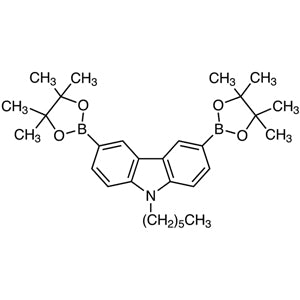
- TCI H1649 628336-95-8 9-Hexyl-3,6-bis(4,4,5,5-tetramethyl-1,3,2-dioxaborolan-2-yl)-9H-carbazole
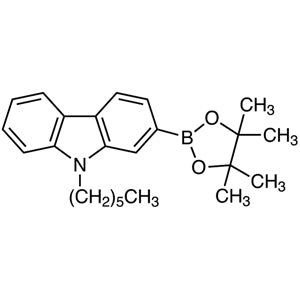
- TCI H1647 1339953-35-3 9-Hexyl-2-(4,4,5,5-tetramethyl-1,3,2-dioxaborolan-2-yl)-9H-carbazole
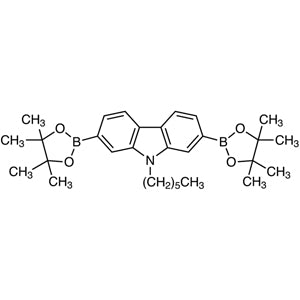
- TCI H1642 871696-12-7 9-Hexyl-2,7-bis(4,4,5,5-tetramethyl-1,3,2-dioxaborolan-2-yl)-9H-carbazole
- TCI D5410 150623-72-6 3,6-Dibromo-9-hexyl-9H-carbazole
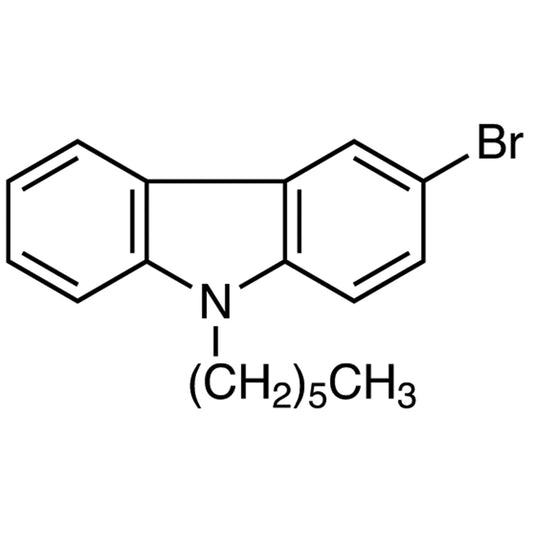
- TCI B5608 156972-74-6 3-Bromo-9-hexyl-9H-carbazole
- TCI B5502 750573-24-1 9,9'-(5-Bromo-1,3-phenylene)bis(9H-carbazole)
- Organic Semiconductor Fabrication: This compound is ideal for creating organic semiconductor materials due to its stable molecular structure and ability to form active layers in devices like solar cells and LEDs.
- Optoelectronic Device Development: Its unique electronic properties make it suitable for research into light-emitting diodes and photovoltaic systems, supporting efficient charge transport and light emission.
- Material Synthesis Research: The compound's reactivity and structural adaptability allow it to be used in the synthesis of advanced materials with tailored electronic and optical properties.
- Energy Storage Material Innovation: Its chemical stability and compatibility with various functional groups make it a valuable tool in the development of new energy storage solutions.
- Electronic Device Prototyping: Researchers use it to design and test new electronic components, leveraging its conductive properties and molecular flexibility for improved performance.
| Brand | TCI |
|---|---|
| CAS number | 864550-95-8 |
| Molecular formula | — |
| Purity | — |
| Category | Materials Science > Material Building Blocks > Small Molecule Semiconductor Building Blocks |
| Pack sizes | Available in standard laboratory quantities |
| Physical form | Solid |
| Storage | Store in a cool, dry place away from light and moisture |
This compound should be stored in a cool, dry environment, away from direct light and moisture to maintain its stability and prevent degradation. It is recommended to use airtight containers made of glass or high-density polyethylene to ensure long-term preservation. Due to its organic nature, it should be handled in a well-ventilated area, and appropriate personal protective equipment, such as gloves and safety goggles, should be worn. Avoid exposure to incompatible substances, and ensure proper disposal in accordance with local regulations. Regular inspection of storage conditions is advised to maintain the integrity of the material during experimental use.
—
Produk Terkait
-
9-Hexyl-3,6-bis(4,4,5,5-tetramethyl-1,3,2-dioxaborolan-2-yl)-9H-carbazole TCI H1649
Regular price From Rp 1.510.950,00Regular price -
9-Hexyl-2-(4,4,5,5-tetramethyl-1,3,2-dioxaborolan-2-yl)-9H-carbazole TCI H1647
Regular price From Rp 1.829.100,00Regular price -
9-Hexyl-2,7-bis(4,4,5,5-tetramethyl-1,3,2-dioxaborolan-2-yl)-9H-carbazole TCI H1642
Regular price From Rp 1.485.750,00Regular price -
3,6-Dibromo-9-hexyl-9H-carbazole TCI D5410
Regular price From Rp 1.035.300,00Regular price -
3-Bromo-9-hexyl-9H-carbazole TCI B5608
Regular price From Rp 1.167.600,00Regular price -
9,9'-(5-Bromo-1,3-phenylene)bis(9H-carbazole) TCI B5502
Regular price From Rp 2.782.500,00Regular price -
9-Benzoyl-3-bromo-9H-carbazole TCI B5471
Regular price Rp 1.881.600,00Regular price -
9-Benzyl-3-bromo-9H-carbazole TCI B5461
Regular price From Rp 1.510.950,00Regular price