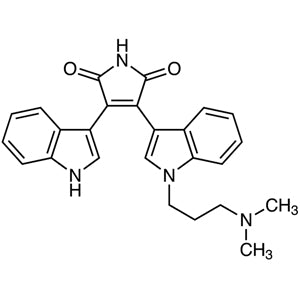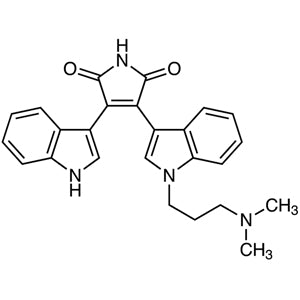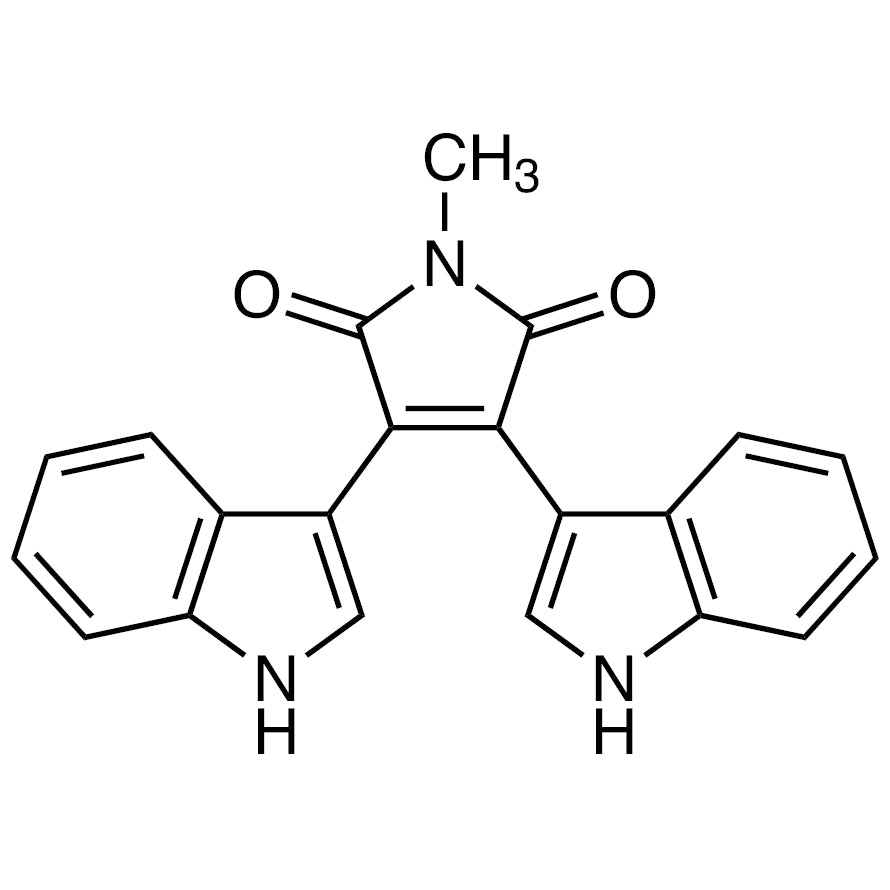
Bisindolylmaleimide V is a small organic compound belonging to the bisindolylmaleimide family, a class of molecules built around a maleimide core bearing two indole groups attached at the 3 and 4 positions. This family of compounds is widely recognised in cell biology research, particularly in studies of signalling pathways that involve protein kinase C. In molecular biology and pharmacology laboratories, compounds in this group serve as chemical tools for examining how cells relay signals from the cell surface toward the nucleus, and Bisindolylmaleimide V in particular is frequently employed as a structural comparison compound within such experimental series.
The property that leads researchers to select this compound is its very close structural resemblance to other members of the bisindolylmaleimide series. Because of that similarity, it can be paired with related analogues within a single experimental design in order to distinguish effects that genuinely arise from kinase inhibition from effects that arise instead from the physicochemical character of the molecular scaffold itself. This ability to separate a specific biochemical response from a general scaffold-driven response is what gives the compound its value as a reference material in carefully controlled signalling studies.
As a small molecule with relatively lipophilic character, this compound is generally dissolved in dimethyl sulfoxide before being diluted into culture medium — a working pattern already very familiar to cell culture laboratories in Indonesia. University research laboratories, molecular biology facilities, and pharmacology groups working on cell signalling typically handle the compound in this manner, preparing concentrated stock solutions that are then introduced into treatment experiments on cultured cells.
- Protein kinase C signalling studies, where the compound serves as a chemical tool for probing how signals initiated at the cell surface are transmitted through the cytoplasm toward the nucleus.
- Structural comparison experiments, in which this compound is paired with other bisindolylmaleimide analogues so that scaffold-related effects can be separated from genuine kinase-inhibition effects.
- Cell biology research on signal transduction, where small-molecule modulators are applied to cultured cells to examine downstream cellular responses under controlled treatment conditions.
- Pharmacology investigations of compound specificity, since the close structural relationship within the bisindolylmaleimide series supports rational experimental designs that test whether an observed response is target-specific.
- Neuroscience-oriented cell signalling work, where members of this compound family are used to interrogate kinase-dependent pathways in neuronal and other cultured cell models under laboratory conditions.
| Brand | TCI |
|---|---|
| CAS number | 113963-68-1 |
| Molecular formula | — |
| Purity | — |
| Category | Life Science > Cell Biology > Cell Signaling and Neuroscience |
| Pack sizes | available in the research-scale pack sizes listed by the manufacturer for this catalogue item |
| Physical form | — |
| Storage | store according to the manufacturer's stated conditions on the product label and accompanying documentation |
- Product code: B6143
Store the compound in its original tightly closed container, protected from moisture and light, and follow the storage conditions stated by the manufacturer on the product label and safety data sheet. Amber glass vials are suitable for both the solid material and any prepared stock solution. Because the compound is typically dissolved in dimethyl sulfoxide before dilution into culture medium, prepare stock solutions in a clean working area, label aliquots clearly, and avoid repeated freeze-thaw cycles where practicable. Handle the material with gloves, a laboratory coat, and eye protection, weigh the solid in a well-ventilated enclosure to limit inhalation of fine powder, and dispose of residues and contaminated consumables through the laboratory's established chemical waste stream.
—
Produk Terkait
-
BisindolylmaleimideIV TCI B6068
Regular price From Rp 1.510.950,00Regular price -
BisindolylmaleimideI TCI B5781
Regular price From Rp 4.161.150,00Regular price -
Imatinib TCI I0906
Regular price From Rp 1.326.150,00Regular price -
WHI-P180Hydrochloride TCI W0021
Regular price Rp 3.340.050,00Regular price -
WHI-P154 TCI W0013
Regular price From Rp 2.491.650,00Regular price -
Wortmannin TCI W0007
Regular price Rp 11.580.450,00Regular price -
VE-821 TCI V0206
Regular price From Rp 2.889.600,00Regular price -
Vandetanib TCI V0199
Regular price From Rp 2.121.000,00Regular price