


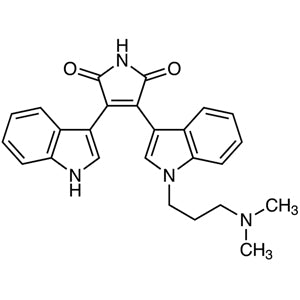
Bisindolylmaleimide I is a chemical compound widely used in life sciences research, particularly in cell biology and neuroscience. It functions as a potent inhibitor of protein kinase C (PKC), a critical enzyme involved in various cellular signaling pathways. In laboratory settings, this compound is essential for controlling PKC activity and studying its role in cellular processes such as cell differentiation, apoptosis, and immune responses. Its utility spans across multiple research areas, making it a valuable tool for scientists aiming to understand complex biological mechanisms.
The compound is favored for its chemical stability and good solubility in organic solvents, which simplifies its use in diverse experimental protocols. Its high specificity and effectiveness in inhibiting PKC make it a preferred choice for researchers requiring precise control over enzymatic activity. This reliability ensures consistent results, which is crucial in both basic and applied research. Additionally, its well-documented properties contribute to its widespread adoption in both academic and industrial research environments.
In Indonesian laboratories, Bisindolylmaleimide I is commonly used in studies related to neurodegenerative diseases, drug development, and cellular signaling mechanisms. Its relevance in local research efforts highlights its importance in advancing scientific understanding and innovation within the region. Researchers rely on this compound to achieve accurate and reproducible outcomes in their experiments.
- Neurodegenerative disease research utilizes Bisindolylmaleimide I to study the role of PKC in neuronal cell death and disease progression.
- Drug development projects employ this compound to investigate its potential as a therapeutic agent in targeting PKC-related pathways.
- Cellular signaling studies benefit from its ability to modulate PKC activity, enabling the analysis of intracellular communication pathways.
- Apoptosis research uses Bisindolylmaleimide I to examine how PKC inhibition affects programmed cell death mechanisms.
- Immunological studies incorporate this compound to explore its impact on immune cell signaling and response pathways.
| Brand | TCI |
|---|---|
| CAS number | 133052-90-1 |
| Molecular formula | — |
| Purity | — |
| Category | Life Science > Cell Biology > Cell Signaling and Neuroscience |
| Pack sizes | As available from supplier |
| Physical form | Solid (as per standard product description) |
| Storage | Store in a cool, dry place away from light |
Bisindolylmaleimide I should be stored in a cool, dry environment, away from direct light to maintain its chemical stability. It is recommended to use airtight containers to prevent moisture absorption and contamination. Due to its chemical nature, it should be handled with appropriate personal protective equipment, such as gloves and safety goggles, to ensure laboratory safety. Proper ventilation is essential when working with this compound to minimize exposure. It is important to store it separately from incompatible substances to avoid any potential chemical reactions. Always follow standard laboratory safety protocols when handling and storing this compound.
—