

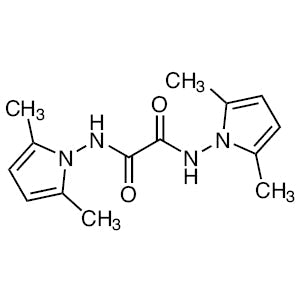
N1,N2-Bis(2,5-dimethyl-1H-pyrrol-1-yl)oxalamide is an organic compound belonging to the oxalamide family, and in synthesis laboratories it serves as a supporting ligand for transition metal catalysts, particularly copper-based systems. The molecule consists of an oxalamide core — two directly linked amide groups — bearing two 2,5-dimethylpyrrole rings attached at the nitrogen atoms. This arrangement forms a clamp-like framework capable of binding a metal center in a bidentate fashion and stabilizing it throughout the catalytic cycle. The presence of a ligand of this kind is often the deciding factor in whether a cross-coupling reaction proceeds smoothly or stalls partway through.
The characteristics that make this compound a preferred choice are the combination of electron density at the amide groups and the controlled steric effect of the two dimethylpyrrole substituents. The methyl groups at positions 2 and 5 of the pyrrole rings provide spatial protection around the metal center, thereby reducing catalyst aggregation and undesirable decomposition pathways. The oxalamide framework itself is relatively rigid, so the geometry of the metal–ligand complex is better defined than with flexible amine ligands. As a solid, the compound is easy to weigh out and introduce into a reaction.
In Indonesian laboratories, this ligand typically appears in university and institutional research groups working on organic synthesis methodology, where copper-catalysed coupling routes are explored on a small scale. Its solid form suits the practical realities of local bench work: weighing on an analytical balance, transfer into a reaction vessel, and use in modest quantities per experiment. It is generally purchased in research-scale packs rather than bulk, since a single project consumes only small amounts.
TCI brochures (PDF)
Related TCI products
- TCI B4489 151486-56-5 [[(4-Butyl-3,5-dimethyl-1H-pyrrol-2-yl)(4-butyl-3,5-dimethyl-2H-pyrrol-2-ylidene)methyl]methane](difluoroborane)
- TCI B4400 137829-79-9 [[(4-tert-Butyl-3,5-dimethyl-1H-pyrrol-2-yl)(4-tert-butyl-3,5-dimethyl-2H-pyrrol-2-ylidene)methyl]methane](difluoroborane)
- TCI E1065 131083-16-4 [[(4-Ethyl-3,5-dimethyl-1H-pyrrol-2-yl)(4-ethyl-3,5-dimethyl-2H-pyrrol-2-ylidene)methyl]methane](difluoroborane)
- TCI D5724 121207-31-6 [[(3,5-Dimethyl-1H-pyrrol-2-yl)(3,5-dimethyl-2H-pyrrol-2-ylidene)methyl]methane](difluoroborane) (purified by sublimation)
- TCI D4632 250734-47-5 [1-[(3,5-Dimethyl-1H-pyrrol-2-yl)(3,5-dimethyl-2H-pyrrol-2-ylidene)methyl]-4-iodobenzene](difluoroborane)
- TCI D4341 121207-31-6 [[(3,5-Dimethyl-1H-pyrrol-2-yl)(3,5-dimethyl-2H-pyrrol-2-ylidene)methyl]methane](difluoroborane)
- Copper-catalysed cross-coupling reactions — the bidentate oxalamide core binds and stabilises the copper centre through the catalytic cycle, helping the reaction reach completion instead of stalling.
- Ligand screening in methodology development — researchers comparing supporting ligands can include this oxalamide to assess how a rigid framework influences conversion relative to flexible amine ligands.
- Catalyst stabilisation studies — the 2,5-dimethyl substitution provides steric shielding around the metal centre, making this compound useful for investigating how bulk suppresses catalyst aggregation.
- Preparation of metal–ligand complexes — the relatively rigid oxalamide backbone yields complexes with better-defined geometry, which is valuable when coordination environment must be controlled deliberately.
- Small-scale synthetic route optimisation — as a weighable solid it is straightforward to dose accurately across repeated trial reactions when tuning catalyst loading and reaction conditions.
| Brand | TCI |
|---|---|
| CAS number | 289708-48-1 |
| Molecular formula | — |
| Purity | — |
| Category | Chemistry > Catalysis and Inorganic Chemistry > Ligands (Other) [Catalysis] |
| Pack sizes | available in research-scale packs; please confirm currently listed sizes when ordering |
| Physical form | solid |
| Storage | — |
- Catalogue code: B6291
Store the container tightly closed in a cool, dry place away from direct sunlight, heat sources, and moisture, following the storage conditions stated on the manufacturer's label and safety data sheet. Keep the material in its original container or in a chemically compatible, well-sealed vessel that is clearly labelled with the compound name and CAS number. Handle in a fume hood or a well-ventilated working area, and wear a laboratory coat, safety goggles, and suitable gloves. Use clean, dry spatulas when weighing to avoid contaminating the remaining stock, and close the container immediately after use. Segregate from strong oxidising agents and incompatible chemicals during storage. Consult the safety data sheet before first use and dispose of residues and contaminated materials in accordance with applicable laboratory waste procedures.
—
Product Categories
Produk Terkait
-
[[(4-Butyl-3,5-dimethyl-1H-pyrrol-2-yl)(4-butyl-3,5-dimethyl-2H-pyrrol-2-ylidene)methyl]methane](difluoroborane) TCI B4489
Regular price Rp 5.485.200,00Regular price -
[[(4-tert-Butyl-3,5-dimethyl-1H-pyrrol-2-yl)(4-tert-butyl-3,5-dimethyl-2H-pyrrol-2-ylidene)methyl]methane](difluoroborane) TCI B4400
Regular price Rp 3.287.550,00Regular price -
[[(4-Ethyl-3,5-dimethyl-1H-pyrrol-2-yl)(4-ethyl-3,5-dimethyl-2H-pyrrol-2-ylidene)methyl]methane](difluoroborane) TCI E1065
Regular price Rp 2.439.150,00Regular price -
[[(3,5-Dimethyl-1H-pyrrol-2-yl)(3,5-dimethyl-2H-pyrrol-2-ylidene)methyl]methane](difluoroborane)(purifiedbysublimation) TCI D5724
Regular price From Rp 2.545.200,00Regular price -
[1-[(3,5-Dimethyl-1H-pyrrol-2-yl)(3,5-dimethyl-2H-pyrrol-2-ylidene)methyl]-4-iodobenzene](difluoroborane) TCI D4632
Regular price From Rp 3.817.800,00Regular price -
[[(3,5-Dimethyl-1H-pyrrol-2-yl)(3,5-dimethyl-2H-pyrrol-2-ylidene)methyl]methane](difluoroborane) TCI D4341
Regular price Rp 6.015.450,00Regular price -
N1-(2-Ethoxyphenyl)-N2-(2-ethylphenyl)oxalamide TCI E1382
Regular price From Rp 1.246.350,00Regular price -
[[(3,4,5-Trimethyl-1H-pyrrol-2-yl)(3,4,5-trimethyl-2H-pyrrol-2-ylidene)methyl]carbonitrile](difluoroborane) TCI T3127
Regular price Rp 5.592.300,00Regular price
![151486-56-5 [[(4-Butyl-3,5-dimethyl-1H-pyrrol-2-yl)(4-butyl-3,5-dimethyl-2H-pyrrol-2-ylidene)methyl]methane](difluoroborane) - AMI Scientific](http://amiscientific.com/cdn/shop/files/TCI2510B4489.jpg?v=1768815625&width=533)
![137829-79-9 [[(4-tert-Butyl-3,5-dimethyl-1H-pyrrol-2-yl)(4-tert-butyl-3,5-dimethyl-2H-pyrrol-2-ylidene)methyl]methane](difluoroborane) - AMI Scientific](http://amiscientific.com/cdn/shop/files/TCI2510B4400.jpg?v=1768815604&width=533)
![[[(4-Ethyl-3,5-dimethyl-1H-pyrrol-2-yl)(4-ethyl-3,5-dimethyl-2H-pyrrol-2-ylidene)methyl]methane](difluoroborane) (CAS 131083-16-4) - TCI E1065 - AMI Scientific](http://amiscientific.com/cdn/shop/files/TCI2510E1065.jpg?v=1768818777&width=533)
![[[(3,5-Dimethyl-1H-pyrrol-2-yl)(3,5-dimethyl-2H-pyrrol-2-ylidene)methyl]methane](difluoroborane) (purified by sublimation) (CAS 121207-31-6) - TCI D5724 - AMI Scientific](http://amiscientific.com/cdn/shop/files/TCI2510D5724.jpg?v=1769180709&width=533)
![[1-[(3,5-Dimethyl-1H-pyrrol-2-yl)(3,5-dimethyl-2H-pyrrol-2-ylidene)methyl]-4-iodobenzene](difluoroborane) (CAS 250734-47-5) - TCI D4632 - AMI Scientific](http://amiscientific.com/cdn/shop/files/TCI2510D4632.jpg?v=1769142022&width=533)
![[[(3,5-Dimethyl-1H-pyrrol-2-yl)(3,5-dimethyl-2H-pyrrol-2-ylidene)methyl]methane](difluoroborane) (CAS 121207-31-6) - TCI D4341 - AMI Scientific](http://amiscientific.com/cdn/shop/files/TCI2510D4341.jpg?v=1768818079&width=533)

![157410-23-6 [[(3,4,5-Trimethyl-1H-pyrrol-2-yl)(3,4,5-trimethyl-2H-pyrrol-2-ylidene)methyl]carbonitrile](difluoroborane) - AMI Scientific](http://amiscientific.com/cdn/shop/files/TCI2510T3127.jpg?v=1769058164&width=533)