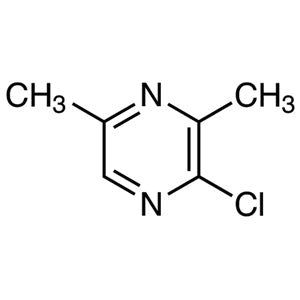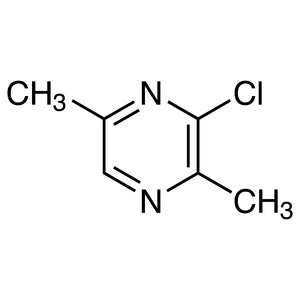
TCI C2040 3-Chloro-2,5-dimethylpyrazine is a heterocyclic compound built around a pyrazine core, a six-membered aromatic ring containing two nitrogen atoms in opposite positions, carrying two methyl groups and one chlorine atom. In the organic synthesis laboratory, this compound serves as a heterocyclic building block that supplies a pre-substituted pyrazine framework directly. Constructing a pyrazine ring with a defined substitution pattern from simple precursors generally demands several steps and frequently yields mixtures of isomers, so having a starting material whose pattern is already fixed saves a considerable amount of research time.
The property that makes this compound a preferred choice is the reactivity of the chlorine atom on an electron-poor ring. The two ring nitrogen atoms withdraw electron density, leaving the chlorine-bearing position susceptible to nucleophilic aromatic substitution; amines, alkoxides, and thiolates can be installed there under relatively simple conditions. That carbon–chlorine bond also functions as a handle for palladium-catalysed cross-coupling reactions to attach aryl or alkenyl groups. The two methyl groups present improve solubility in organic solvents and give characteristic signals that assist in reaction monitoring and structural confirmation.
In Indonesian laboratories, this building block is typically used in university and institutional research groups working on medicinal chemistry and heterocyclic synthesis, where nitrogen-containing aromatic scaffolds are prepared and diversified. It is also drawn upon in method development work, where a reliable, well-defined starting material is needed to reproduce published routes or to develop new ones. Supplied as a TCI catalogue item, it fits routine bench-scale synthetic work rather than production-scale operations.
Related TCI products
- TCI C3118 38557-72-1 2-Chloro-3,5-dimethylpyrazine
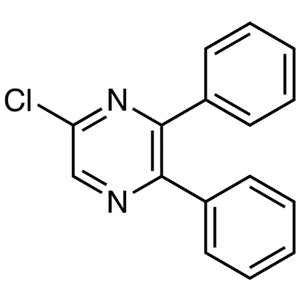
- TCI C3205 41270-66-0 5-Chloro-2,3-diphenylpyrazine
- TCI C2777 38557-71-0 2-Chloro-6-methylpyrazine
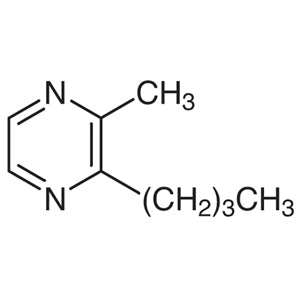
- TCI B1173 15987-00-5 2-Butyl-3-methylpyrazine
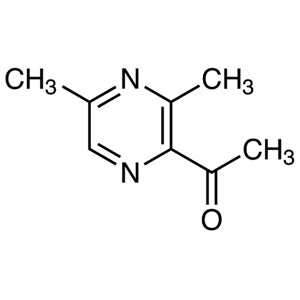
- TCI A3326 54300-08-2 2-Acetyl-3,5-dimethylpyrazine (contains 2-Acetyl-3,6-dimethylpyrazine)
- TCI A2992 5521-56-2 2-Amino-6-methylpyrazine
- Nucleophilic aromatic substitution studies: the electron-poor pyrazine ring activates the chlorine position toward amines, alkoxides, and thiolates under relatively mild and straightforward reaction conditions.
- Palladium-catalysed cross-coupling chemistry: the carbon–chlorine bond acts as a reliable handle for attaching aryl or alkenyl groups onto a defined pyrazine framework.
- Medicinal chemistry scaffold preparation: it delivers a substituted pyrazine core directly, sparing researchers the multi-step ring construction that often produces unwanted isomer mixtures.
- Heterocyclic library synthesis: a single fixed substitution pattern allows systematic variation at the chlorine position to generate related analogues for structure–activity comparison.
- Synthetic methodology development: the characteristic methyl group signals support convenient reaction monitoring and structural confirmation when new routes or conditions are being evaluated.
| Brand | TCI (Tokyo Chemical Industry) |
|---|---|
| CAS number | 95-89-6 |
| Molecular formula | — |
| Purity | — |
| Category | Chemistry > Building Blocks > Heterocyclic Building Blocks |
| Pack sizes | available in standard TCI research-scale packaging; please confirm the size required when ordering |
| Physical form | — |
| Storage | — |
- Chemical name: 3-Chloro-2,5-dimethylpyrazine
- Catalogue number: C2040
Store the container tightly closed in a cool, dry, well-ventilated area away from direct sunlight, heat sources, and incompatible materials, following the conditions stated on the manufacturer's label and safety data sheet. Keep the material in its original supplier container, or in a suitably resistant, clearly labelled chemical container if transfer is necessary. Handle in a fume hood using appropriate personal protective equipment, including safety glasses, gloves, and a laboratory coat. Avoid inhalation of vapours and contact with skin and eyes. Close containers promptly after use and dispose of residues in accordance with institutional chemical waste procedures.
—
Produk Terkait
-
2-Chloro-3,5-dimethylpyrazine TCI C3118
Regular price Rp 2.411.850,00Regular price -
5-Chloro-2,3-diphenylpyrazine TCI C3205
Regular price From Rp 1.538.250,00Regular price -
2-Chloro-6-methylpyrazine TCI C2777
Regular price From Rp 2.199.750,00Regular price -
2-Butyl-3-methylpyrazine TCI B1173
Regular price Rp 3.232.950,00Regular price -
2-Acetyl-3,5-dimethylpyrazine(contains2-Acetyl-3,6-dimethylpyrazine) TCI A3326
Regular price From Rp 1.326.150,00Regular price -
2-Amino-6-methylpyrazine TCI A2992
Regular price From Rp 903.000,00Regular price -
2-Acetyl-3-ethylpyrazine TCI A2003
Regular price From Rp 1.035.300,00Regular price -
2-Acetyl-3-methylpyrazine TCI A1978
Regular price Rp 1.035.300,00Regular price