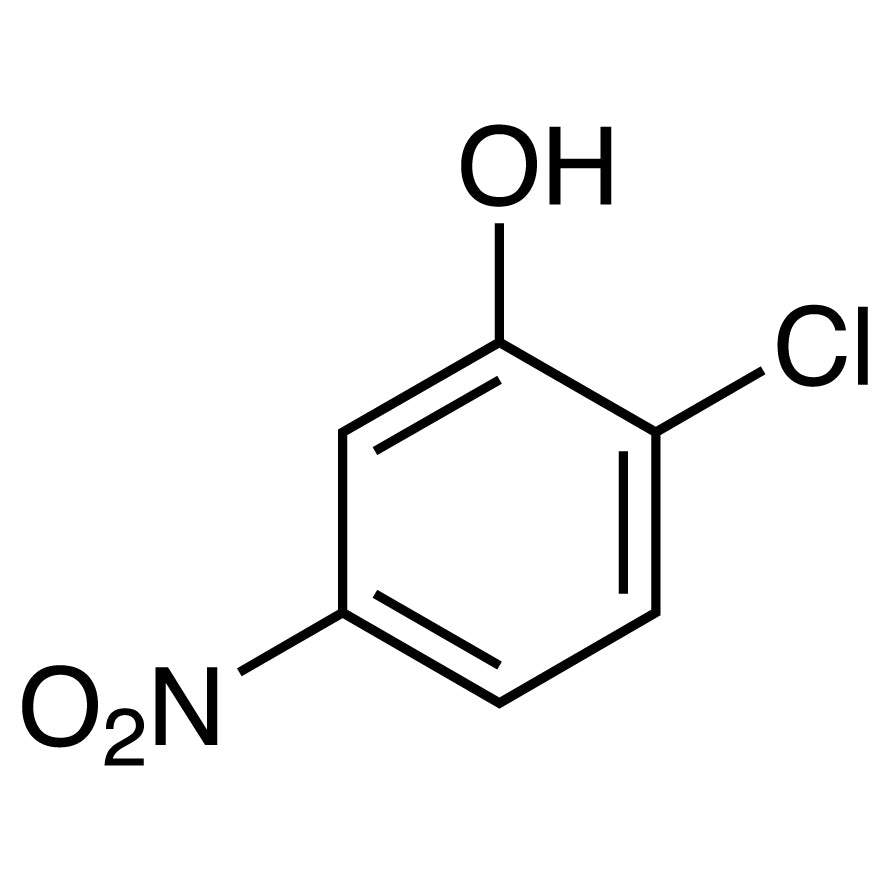
2-Chloro-5-nitrophenol is a chemical compound widely used in laboratory settings for various chemical experiments and organic synthesis processes. It belongs to the class of aromatic compounds and features a phenolic structure with substituents of chlorine and nitro groups. This compound plays a crucial role in the development of complex chemical structures, particularly in the fields of organic chemistry and pharmacology. Its unique chemical properties make it a valuable reagent for researchers aiming to explore new chemical reactions and synthetic pathways.
The compound is known for its stability and specific reactivity, which make it a preferred choice in substitution and oxidation reactions. Its polar nature allows it to dissolve well in organic solvents such as ethyl acetate and ethanol, facilitating ease of use in laboratory procedures. These solubility characteristics are essential for ensuring efficient chemical reactions and accurate experimental results. Additionally, its molecular structure enables it to participate in a wide range of chemical reactions, making it a versatile and sought-after material for scientific research.
In Indonesian laboratories, 2-Chloro-5-nitrophenol is commonly used in chemical research, particularly in the synthesis of pharmaceutical compounds. Its availability and chemical properties make it an essential component in the development of new drugs and chemical products. Researchers in Indonesia rely on this compound for its reliability and effectiveness in various experimental applications, contributing to advancements in both academic and industrial chemical research.
- Organic synthesis is a key application where 2-Chloro-5-nitrophenol is used due to its reactivity and ability to participate in substitution reactions.
- Pharmaceutical research benefits from this compound as it is used in the development of new drug molecules through chemical modification.
- Analytical chemistry utilizes this compound as a standard for qualitative and quantitative analysis in spectroscopic and chromatographic techniques.
- Environmental studies incorporate this compound to investigate the behavior of aromatic compounds in different environmental matrices.
- Industrial chemical processes use this compound as a building block for the production of dyes, pesticides, and other specialty chemicals.
| Brand | TCI |
|---|---|
| CAS number | 619-10-3 |
| Molecular formula | — |
| Purity | — |
| Category | Chemistry > Building Blocks > Non-Heterocyclic Building Blocks |
| Pack sizes | Available in various quantities as per standard laboratory supply options |
| Physical form | Solid, typically in crystalline form |
| Storage | Store in a cool, dry place away from direct sunlight and incompatible materials |
This compound should be stored in a cool, dry environment to maintain its chemical stability. It is recommended to keep it in a sealed container to prevent exposure to moisture and air. Due to its polar nature, it is important to use appropriate containers that are resistant to chemical reactions. Laboratory personnel should handle it with care, using personal protective equipment to minimize exposure. Proper labeling and storage conditions are essential to ensure safety and maintain the compound's integrity over time. Always follow standard laboratory safety protocols when working with this material.
—
Produk Terkait
-
2-Chloro-6-nitrophenol TCI C3074
Regular price From Rp 743.400,00Regular price -
2-Bromo-4-methoxy-6-nitrophenol TCI B4723
Regular price From Rp 505.050,00Regular price -
2-Bromo-4-nitrophenol TCI B3918
Regular price From Rp 2.625.000,00Regular price -
4-tert-Butyl-2,6-dinitrophenol TCI B1803
Regular price Rp 2.016.000,00Regular price -
2-NitrophenolSodiumSalt TCI N0222
Regular price From Rp 1.220.100,00Regular price -
2-Methoxy-6-nitrophenol TCI M3747
Regular price From Rp 2.889.600,00Regular price -
2,4-Dibromo-6-nitrophenol TCI D5323
Regular price Rp 1.881.600,00Regular price -
2,4-Dichloro-3-ethyl-6-nitrophenol TCI D3510
Regular price From Rp 743.400,00Regular price