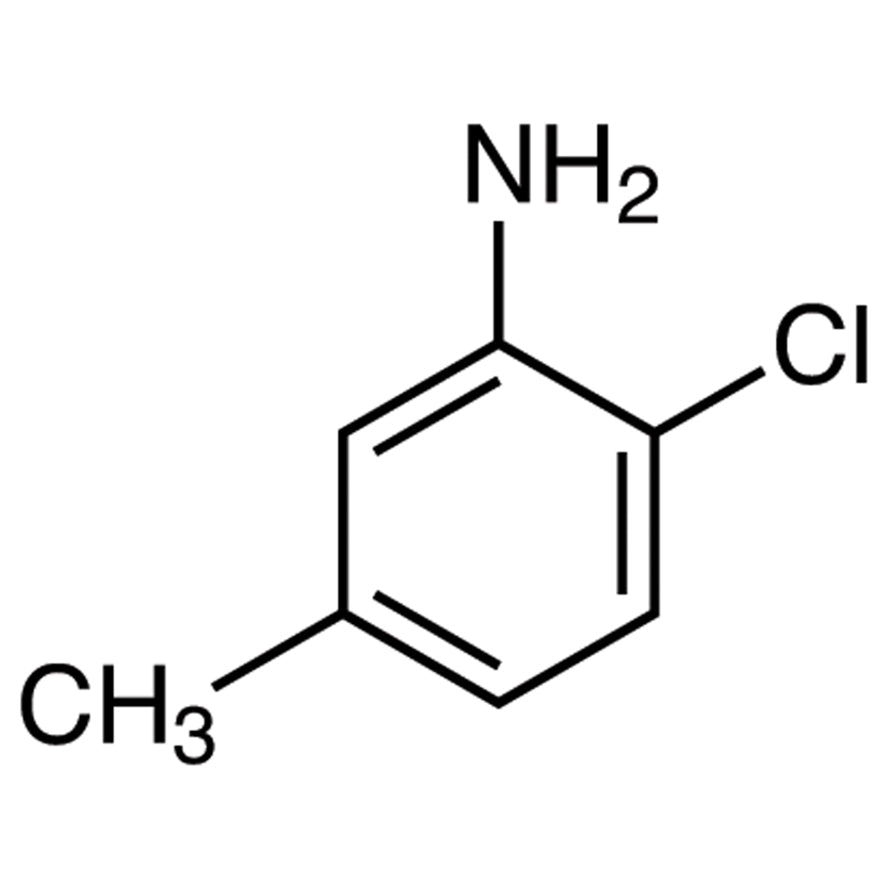
2-Chloro-5-methylaniline is a chemical compound widely used in various laboratory experiments across different scientific disciplines. As a building block in organic chemistry, it serves as a foundational material for the synthesis of more complex compounds. Its versatility makes it an essential component in the development of new chemical structures and functional materials. This compound is particularly valuable in research settings where controlled chemical reactions are required to produce target molecules with specific properties.
The compound's stability and reactivity make it a preferred choice for a range of chemical reactions, including electrophilic and nucleophilic substitutions. Its aromatic nature and solubility in organic solvents further enhance its utility in synthetic processes. These properties allow it to participate effectively in both substitution and condensation reactions, making it a key reagent in the synthesis of pharmaceuticals, dyes, and other organic compounds. Its ability to react with various reagents ensures its applicability in a broad spectrum of chemical applications.
In Indonesian laboratories, 2-Chloro-5-methylaniline is commonly used in scientific research across fields such as pharmaceuticals, organic chemistry, and materials science. Researchers rely on its predictable chemical behavior and compatibility with a wide range of reagents to develop new compounds and test chemical hypotheses. Its presence in laboratory workflows supports the advancement of scientific knowledge and the creation of innovative chemical products.
- Used in pharmaceutical research for the synthesis of drug molecules due to its reactivity and structural versatility.
- Applied in organic chemistry for the preparation of complex aromatic compounds through substitution reactions.
- Utilized in material science for the development of functional polymers and dyes due to its aromatic and reactive nature.
- Employed in analytical chemistry for the calibration of chromatographic and spectroscopic instruments.
- Integrated into synthetic pathways for the production of industrial chemicals and specialty compounds.
| Brand | TCI |
|---|---|
| CAS number | 95-81-8 |
| Molecular formula | — |
| Purity | — |
| Category | Chemistry > Building Blocks > Non-Heterocyclic Building Blocks |
| Pack sizes | Available in various quantities as per standard laboratory requirements |
| Physical form | Liquid or solid, depending on the specific formulation |
| Storage | Store in a cool, dry place away from light and incompatible substances |
This compound should be stored in a cool, dry environment, away from direct sunlight and sources of heat. It is recommended to keep it in a tightly sealed container to prevent moisture absorption and contamination. Due to its chemical nature, it should be stored separately from strong oxidizers and acids to avoid potential hazardous reactions. Proper ventilation is essential when handling the material to minimize exposure. Laboratory personnel should wear appropriate personal protective equipment, including gloves and safety goggles, when working with this compound. Regular monitoring of storage conditions ensures the compound remains stable and safe for use in experimental settings.
—
Produk Terkait
-
2-Chloro-6-methylaniline TCI A1959
Regular price From Rp 1.431.150,00Regular priceRp 1.000.650,00Sale price From Rp 1.431.150,00 -
4-Chloro-3-methylaniline TCI A1610
Regular price Rp 1.565.550,00Regular priceRp 1.094.100,00Sale price Rp 1.565.550,00 -
2-Chloro-4-methylaniline TCI A1437
Regular price From Rp 1.193.850,00Regular priceRp 834.750,00Sale price From Rp 1.193.850,00 -
4-Chloro-2-methylaniline TCI A0704
Regular price From Rp 1.378.650,00Regular priceRp 963.900,00Sale price From Rp 1.378.650,00 -
3-Chloro-2-methylanilineHydrochloride TCI A0285
Regular price Rp 795.900,00Regular priceRp 556.500,00Sale price Rp 795.900,00 -
3-Chloro-N-methylaniline TCI C1891
Regular price From Rp 2.466.450,00Regular priceRp 1.724.100,00Sale price From Rp 2.466.450,00 -
5-Chloro-2-methylaniline TCI C1876
Regular price Rp 1.565.550,00Regular priceRp 1.094.100,00Sale price Rp 1.565.550,00 -
4-Chloro-N-methylaniline TCI C1620
Regular price From Rp 1.961.400,00Regular priceRp 1.371.300,00Sale price From Rp 1.961.400,00