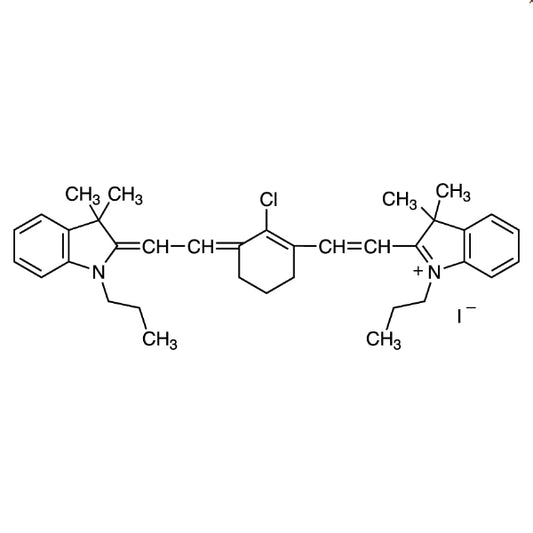
TCI C3693 2311980-68-2 IR 754 Carboxylic Acid is a specialized chemical compound used in scientific experiments, particularly in the field of optical and photonic materials. This compound plays a crucial role in laboratory settings where the manipulation of light properties is essential. Its unique molecular structure allows it to interact with specific wavelengths of light, making it a valuable component in the development of advanced optical materials. Due to its reactivity and ability to form complexes with various ions, it is widely used in research involving photochemical reactions and light-sensitive materials.
The compound’s carboxylic acid functional group contributes to its reactivity and versatility in chemical applications. This group enables the formation of stable complexes with metal ions, which is essential for applications in spectroscopy and material synthesis. Additionally, its ability to absorb light effectively makes it suitable for use in photonic devices and optical coatings. The compound’s stability under controlled conditions further enhances its reliability in laboratory experiments, ensuring consistent results in research and development.
In Indonesian laboratories, this compound is commonly used in optical material research, pigment development, and studies on light-material interactions. Researchers in educational institutions and research centers rely on it for experiments involving photonic and optical properties. Its role in creating light-sensitive materials and optical coatings makes it an essential tool for advancing scientific knowledge in the field of materials science.
Advantages (TCI brochure)
- Near-infrared fluorescence
TCI brochures (PDF)
- Fluorescent Labeling Dyes 2025-11-18 · p. 3
- Cell Imaging Reagents 2026-06-25 · p. 8
- Reagents for Biological Research 2025-03-11 · p. 6
- Optical Material Development: This compound is ideal for creating advanced optical materials due to its light absorption properties and ability to form light-sensitive compounds.
- Pigment and Dye Synthesis: Its reactivity and ability to form complexes with ions make it suitable for synthesizing high-quality dyes and pigments.
- Spectroscopic Analysis: The compound’s interaction with specific wavelengths of light makes it useful for spectroscopic studies and analytical techniques.
- Photonic Device Fabrication: Its optical properties are essential for the development of photonic devices and optical coatings.
- Light-Sensitive Material Research: The compound is used in studies involving light-sensitive materials and their applications in various scientific fields.
| Brand | TCI |
|---|---|
| CAS number | 2311980-68-2 |
| Molecular formula | — |
| Purity | — |
| Category | Materials Science > Photonic Materials and Optical Materials > Cyanine Dyes, Squarylium Dyes |
| Pack sizes | As per supplier specifications |
| Physical form | Solid or liquid, depending on supplier packaging |
| Storage | Store in a cool, dry place away from direct light |
Data from the TCI brochure
| λex,max | 748 nm |
|---|---|
| λem,max | 779 nm |
Source: TCI brochure LL039 (2025-11-18)
This compound should be stored in a cool, dry environment, away from direct sunlight and sources of heat. It is recommended to use airtight containers to prevent moisture absorption and contamination. Due to its reactivity, it should be handled with care, using appropriate personal protective equipment such as gloves and safety goggles. In laboratory settings, it should be stored separately from incompatible substances to avoid chemical reactions. Proper labeling and storage conditions are essential to maintain its stability and ensure safe handling during experiments. Always follow standard laboratory safety protocols when working with this compound.
—
Product Categories
Produk Terkait
-
ICGCarboxylicAcid TCI O0574
Regular price From Rp 4.240.950,00Regular price -
5-TAMRA TCI C2686
Regular price Rp 4.957.050,00Regular price -
Sulfo-cyanine5CarboxylicAcidPotassiumSalt TCI U0186
Regular price Rp 2.889.600,00Regular price -
Sulfo-cyanine5CarboxylicAcid TCI U0172
Regular price From Rp 3.392.550,00Regular price -
JC-1 TCI T4300
Regular price Rp 7.421.400,00Regular price -
IR780 TCI I1281
Regular price From Rp 848.400,00Regular price -
IR783 TCI I1031
Regular price From Rp 2.650.200,00Regular price -
IR775Chloride TCI I1026
Regular price From Rp 2.359.350,00Regular price