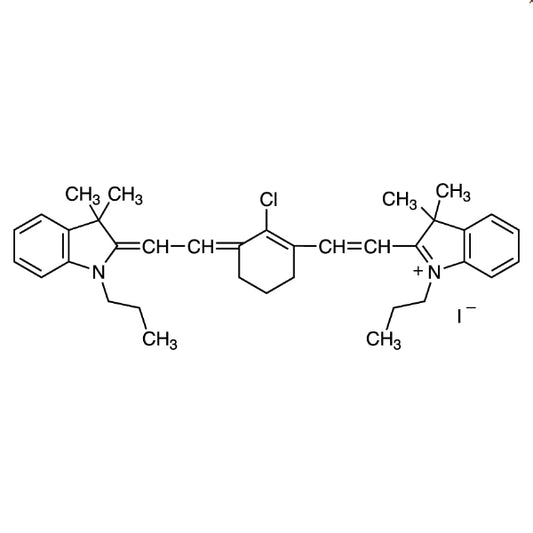
Indocyanine Green Carboxylic Acid (ICG Carboxylic Acid) is a versatile organic compound widely used in scientific research, particularly in the fields of optical and photonic materials. This compound plays a crucial role in laboratories where the development of advanced materials with unique optical properties is required. It is commonly employed in the synthesis of cyanine dyes and squarylium dyes, which are essential for various applications such as imaging, optical sensing, and functional material design. Due to its chemical structure and reactivity, it is a key component in the creation of complex compounds that require high precision and control in experimental settings.
The high reactivity of ICG Carboxylic Acid, attributed to its carboxyl group, makes it a preferred choice for chemical synthesis. Its stability and ability to interact with diverse substrates allow for the development of materials with tailored optical characteristics. These properties make it ideal for use in environments where precise chemical reactions and controlled material properties are necessary. The compound’s compatibility with a wide range of substrates also enhances its utility in the design of functional optical materials.
In Indonesian laboratories, ICG Carboxylic Acid is frequently used in applied research within material technology and analytical chemistry. It is an essential component in the development of new optical materials and is often integrated into research projects aimed at advancing imaging and sensing technologies. Its role in scientific innovation is significant, supporting both academic and industrial research efforts in the field of photonic materials.
Advantages (TCI brochure)
- Near-infrared fluorescence, similar to Indocyanine Green (ICG)
TCI brochures (PDF)
- Building Blocks for Near-infrared/Short-wave-infrared Dyes 2025-08-07 · p. 1
- Fluorescent Labeling Dyes 2025-11-18 · p. 3
- Cell Imaging Reagents 2026-06-25 · p. 8
- Reagents for Biological Research 2025-03-11 · p. 6
- Optical imaging applications benefit from ICG Carboxylic Acid due to its ability to produce high-quality dyes with unique optical properties.
- Optical sensor development utilizes this compound because of its reactivity and compatibility with various substrates.
- Functional material design relies on ICG Carboxylic Acid for creating materials with tailored optical characteristics.
- Analytical chemistry research uses this compound for its role in synthesizing complex optical compounds.
- Material technology innovation incorporates ICG Carboxylic Acid to develop new photonic materials with enhanced performance.
| Brand | TCI |
|---|---|
| CAS number | — |
| Molecular formula | — |
| Purity | — |
| Category | Materials Science > Photonic Materials and Optical Materials > Cyanine Dyes, Squarylium Dyes |
| Pack sizes | — |
| Physical form | — |
| Storage | Store in a cool, dry place away from light |
Data from the TCI brochure
| λex,max | 790 nm |
|---|---|
| λem,max | 820 nm |
Source: TCI brochure LL039 (2025-11-18)
ICG Carboxylic Acid should be stored in a cool, dry place, away from direct light to maintain its stability and reactivity. It is recommended to use airtight containers to prevent moisture absorption and contamination. Due to its chemical nature, it should be handled with care, using appropriate personal protective equipment such as gloves and safety goggles. In laboratory settings, it is important to ensure proper ventilation and to avoid exposure to incompatible substances. Regular monitoring of storage conditions is essential to maintain the integrity of the compound and ensure safe handling during experiments.
—
Produk Terkait
-
IR754CarboxylicAcid TCI C3693
Regular price From Rp 7.552.650,00Regular price -
Sulfo-cyanine5CarboxylicAcidPotassiumSalt TCI U0186
Regular price Rp 2.889.600,00Regular price -
Sulfo-cyanine5CarboxylicAcid TCI U0172
Regular price From Rp 3.392.550,00Regular price -
IR780 TCI I1281
Regular price From Rp 848.400,00Regular price -
IR783 TCI I1031
Regular price From Rp 2.650.200,00Regular price -
IR775Chloride TCI I1026
Regular price From Rp 2.359.350,00Regular price -
DiR TCI C4078
Regular price From Rp 2.411.850,00Regular price -
Hexacyanine2 TCI T4274
Regular price From Rp 980.700,00Regular price