

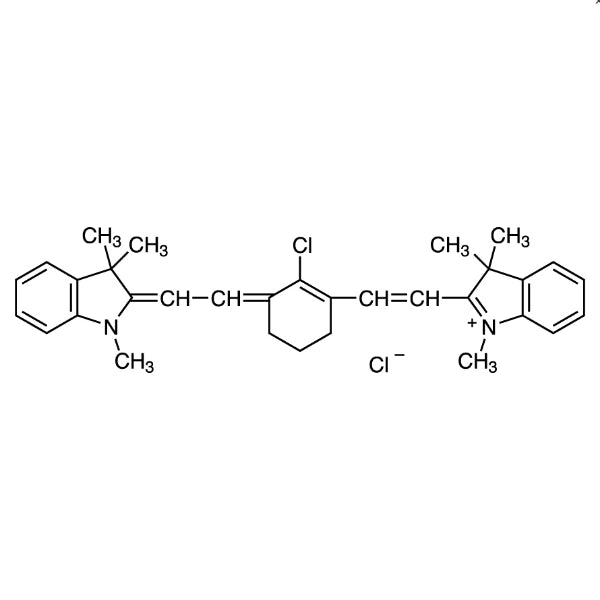
TCI I1026 199444-11-6 IR 775 Chloride is a specialized chemical compound used in materials science, particularly in the development of optical and photonic materials. This compound belongs to the class of cyanine dyes, known for their unique fluorescent properties. In laboratory settings, it serves as a key component in the creation of optical coatings, optical sensors, and optoelectronic devices. Its ability to absorb and emit light at specific wavelengths makes it highly valuable for research in optical material science and photonics.
The compound is preferred due to its chemical stability and high resistance to harsh chemical environments. Its complex molecular structure allows for precise tuning of the emission wavelength, making it ideal for applications requiring controlled optical properties. Additionally, it exhibits excellent clarity, which is essential for applications that demand high visual clarity and optical quality. These characteristics make it a reliable and versatile material for advanced research in optical sciences.
In Indonesian laboratories, TCI I1026 IR 775 Chloride is commonly used in material science research, particularly in the development of optical materials and photonic devices. It is also employed in sensor development and in studies related to light-emitting materials. Its unique optical properties and stability make it a preferred choice for researchers working on advanced optical technologies in Indonesia.
TCI brochures (PDF)
- Building Blocks for Near-infrared/Short-wave-infrared Dyes 2025-08-07 · p. 1
- Cell Imaging Reagents 2026-06-25 · p. 8
- Reagents for Biological Research 2025-03-11 · p. 6
- Optical Coating Development: This compound is used to create thin films and coatings that exhibit specific optical properties, such as fluorescence and light absorption, which are essential for advanced photonic applications.
- Optical Sensor Fabrication: Its ability to emit light at specific wavelengths makes it suitable for use in optical sensors, where precise detection of light is required for analytical and measurement purposes.
- Optoelectronic Device Research: It is utilized in the development of optoelectronic components that require controlled light emission and absorption characteristics for efficient performance.
- Fluorescent Material Studies: The compound's unique fluorescence properties make it ideal for studying the behavior of fluorescent materials under various experimental conditions.
- Material Characterization Experiments: It is frequently used in experiments aimed at characterizing the optical and chemical properties of new materials for industrial and scientific applications.
| Brand | TCI |
|---|---|
| CAS number | 199444-11-6 |
| Molecular formula | — |
| Purity | — |
| Category | Materials Science > Photonic Materials and Optical Materials > Cyanine Dyes, Squarylium Dyes |
| Pack sizes | — |
| Physical form | — |
| Storage | Store in a cool, dry place away from light and moisture |
This compound should be stored in a cool, dry environment, away from direct light and moisture to maintain its chemical stability and optical properties. It is recommended to use sealed containers made of materials that do not react with the compound, such as glass or high-density polyethylene. In laboratory settings, it should be handled with appropriate personal protective equipment, including gloves and safety goggles, to prevent skin contact and eye exposure. Due to its fluorescent nature, it may emit light under certain conditions, so proper lighting and ventilation should be maintained in the workspace. Regular monitoring of storage conditions is advised to ensure the material remains in optimal condition for research and development applications.
—
Produk Terkait
-
DansylChloride TCI D0656
Regular price From Rp 1.590.750,00Regular price -
ICGCarboxylicAcid TCI O0574
Regular price From Rp 4.240.950,00Regular price -
IR780 TCI I1281
Regular price From Rp 848.400,00Regular price -
IR783 TCI I1031
Regular price From Rp 2.650.200,00Regular price -
DiR TCI C4078
Regular price From Rp 2.411.850,00Regular price -
IR754CarboxylicAcid TCI C3693
Regular price From Rp 7.552.650,00Regular price -
Hexacyanine2 TCI T4274
Regular price From Rp 980.700,00Regular price -
1,3,3-Trimethyl-2-[3-(1,3,3-trimethylindolin-2-ylidene)prop-1-en-1-yl]-3H-indol-1-iumIodide TCI T4273
Regular price From Rp 980.700,00Regular price




![25470-94-4 1,3,3-Trimethyl-2-[3-(1,3,3-trimethylindolin-2-ylidene)prop-1-en-1-yl]-3H-indol-1-ium Iodide - AMI Scientific](http://amiscientific.com/cdn/shop/files/TCI2510T4273.jpg?v=1771058870&width=533)