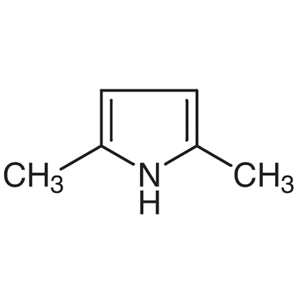
2,5-Dimethylpyrrole is a chemical compound classified under the heterocyclic category, featuring a pyrrole core with two methyl groups attached at positions 2 and 5. This compound plays a crucial role in laboratory settings as a building block for the synthesis of more complex organic molecules. Its versatility makes it a valuable tool in both organic chemistry and pharmacological research. In the lab, it serves as a key intermediate in reactions that lead to the formation of bioactive compounds, contributing to the development of new pharmaceuticals and chemical derivatives.
The reactivity and functional group compatibility of 2,5-Dimethylpyrrole make it a preferred choice for chemists. Its ability to participate in various reaction types, such as substitution, reduction, and ring-opening, allows for the synthesis of a wide range of heterocyclic compounds. The compound’s stable yet reactive nature ensures it can be reliably used in multiple experimental contexts. Its structural simplicity and functional versatility make it a go-to reagent for researchers aiming to explore new chemical pathways and molecular structures.
In Indonesian laboratories, 2,5-Dimethylpyrrole is widely used in organic chemistry research and drug development. It is a common reagent in academic and industrial settings, supporting the creation of novel compounds with potential therapeutic applications. Its availability and chemical properties make it a staple in laboratories focused on synthetic chemistry and pharmaceutical innovation. The compound's role in advancing scientific research is evident in its frequent use across various experimental protocols.
- Organic synthesis: 2,5-Dimethylpyrrole is widely used in the synthesis of complex organic molecules due to its reactivity and structural versatility.
- Pharmaceutical research: It serves as a building block for the development of bioactive compounds and drug candidates in medicinal chemistry.
- Heterocyclic compound synthesis: The compound is essential in creating other heterocyclic structures such as indoles and quinolines through various chemical reactions.
- Bioactive molecule development: Its ability to interact with functional groups makes it ideal for the synthesis of compounds with specific biological activities.
- Academic research: It is commonly used in university and research institute laboratories for teaching and experimental studies in organic chemistry.
| Brand | TCI |
|---|---|
| CAS number | 625-84-3 |
| Molecular formula | — |
| Purity | — |
| Category | Chemistry > Building Blocks > Heterocyclic Building Blocks |
| Pack sizes | Available in various quantities as per standard laboratory supply formats |
| Physical form | Liquid |
| Storage | Store in a cool, dry, and well-ventilated area away from light and incompatible substances |
2,5-Dimethylpyrrole should be stored in a cool, dry, and well-ventilated area, away from direct sunlight and sources of heat. It is recommended to use airtight containers made of materials compatible with organic solvents to prevent contamination and evaporation. Due to its reactivity, it should be kept away from strong oxidizers, acids, and bases. Laboratory personnel should wear appropriate personal protective equipment, including gloves and safety goggles, when handling the compound. Proper ventilation is essential to minimize exposure to vapors. The compound should be stored in a secure location to prevent accidental spills or contamination of other materials.
—
Produk Terkait
-
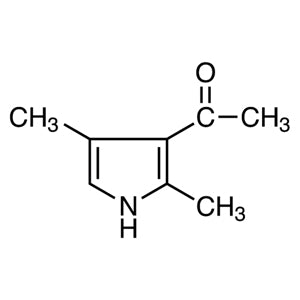
3-Acetyl-2,4-dimethylpyrrole TCI A2734
Regular price Rp 1.776.600,00Regular priceRp 1.257.900,00Sale price Rp 1.776.600,00 -
Ethyl2,4-Dimethylpyrrole-3-carboxylate TCI E1075
Regular price Rp 1.008.000,00Regular priceRp 720.300,00Sale price Rp 1.008.000,00 -
3-Ethyl-2,4-dimethylpyrrole TCI E0555
Regular price Rp 1.298.850,00Regular priceRp 924.000,00Sale price Rp 1.298.850,00 -
2,4-Dimethylpyrrole TCI D2848
Regular price Rp 1.272.600,00Regular priceRp 905.100,00Sale price Rp 1.272.600,00 -
1,2,5-Trimethylpyrrole TCI T1939
Regular price Rp 1.246.350,00Regular priceRp 887.250,00Sale price Rp 1.246.350,00 -
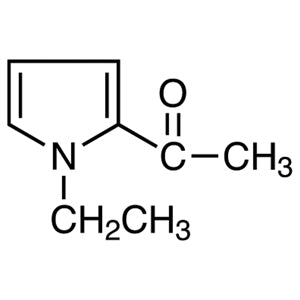
2-Acetyl-1-ethylpyrrole TCI A1977
Regular price Rp 1.008.000,00Regular priceRp 720.300,00Sale price Rp 1.008.000,00 -
2-Acetyl-1-methylpyrrole TCI A1014
Regular price Rp 1.167.600,00Regular priceRp 831.600,00Sale price Rp 1.167.600,00 -
3-Methylpyrrole TCI M1144
Regular price Rp 9.275.700,00Regular priceRp 6.501.600,00Sale price Rp 9.275.700,00