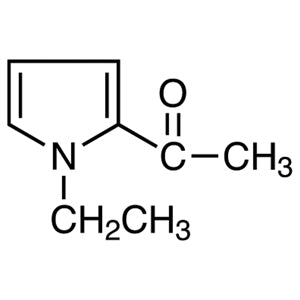
3-Acetyl-2,4-dimethylpyrrole is a chemical compound widely used in organic synthesis reactions. As a heterocyclic building block, it plays a crucial role in the development of complex molecules across various scientific disciplines. Its structural versatility allows it to participate in multiple reaction pathways, making it an essential component in the toolkit of synthetic chemists. In laboratory settings, this compound is frequently employed to construct more intricate molecular frameworks through substitution or ring-opening reactions.
The compound’s stable heterocyclic structure and favorable reactivity make it a preferred choice for researchers seeking to synthesize a wide range of compounds. Its ability to interact with various reagents under different reaction conditions enhances its utility in both academic and industrial applications. The chemical properties of 3-Acetyl-2,4-dimethylpyrrole enable it to serve as a versatile intermediate in the creation of pharmaceuticals, materials, and other specialized chemical products.
In Indonesian laboratories, 3-Acetyl-2,4-dimethylpyrrole is commonly used in research and development activities, particularly in higher education institutions and research organizations. Its role in advancing chemical synthesis and innovation makes it a sought-after material for scientists working in organic chemistry. The compound’s reliability and effectiveness contribute to its popularity among professionals in the field.
- Organic synthesis reactions benefit from 3-Acetyl-2,4-dimethylpyrrole as it provides a stable and reactive heterocyclic core for complex molecule construction.
- Pharmaceutical research utilizes this compound to develop new drug candidates due to its structural versatility and compatibility with various synthetic pathways.
- Material science applications leverage its chemical properties to create advanced polymers and functional materials with tailored characteristics.
- Academic research in chemistry often incorporates this compound to explore novel synthetic methods and reaction mechanisms.
- Industrial chemical production relies on its role as a building block for the synthesis of specialized compounds used in diverse applications.
| Brand | TCI |
|---|---|
| CAS number | 2386-25-6 |
| Molecular formula | — |
| Purity | — |
| Category | Chemistry > Building Blocks > Heterocyclic Building Blocks |
| Pack sizes | Available in various quantities as per standard laboratory requirements |
| Physical form | Solid, typically in crystalline or powder form |
| Storage | Store in a cool, dry place away from direct sunlight and moisture |
This compound should be stored in a cool, dry environment to maintain its chemical stability and prevent degradation. It is recommended to use airtight containers to minimize exposure to moisture and air, which could affect its reactivity. Proper labeling of storage containers is essential for safety and traceability. In laboratory settings, it should be handled with appropriate personal protective equipment, such as gloves and safety goggles, to ensure safe handling. Avoid contact with incompatible substances to prevent potential chemical reactions. Regular inspection of storage conditions ensures the compound remains in optimal condition for use in research and development activities.
—
Produk Terkait
-
Ethyl2,4-Dimethylpyrrole-3-carboxylate TCI E1075
Regular price From Rp 955.500,00Regular price -
3-Ethyl-2,4-dimethylpyrrole TCI E0555
Regular price From Rp 1.246.350,00Regular price -
2,4-Dimethylpyrrole TCI D2848
Regular price From Rp 1.220.100,00Regular price -
2,5-Dimethylpyrrole TCI D0260
Regular price From Rp 1.008.000,00Regular price -
1,2,5-Trimethylpyrrole TCI T1939
Regular price From Rp 1.193.850,00Regular price -
2-Acetyl-1-ethylpyrrole TCI A1977
Regular price From Rp 955.500,00Regular price -
2-Acetyl-1-methylpyrrole TCI A1014
Regular price From Rp 1.115.100,00Regular price -
3-Methylpyrrole TCI M1144
Regular price From Rp 9.223.200,00Regular price