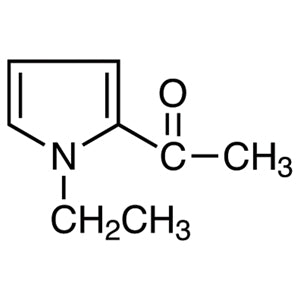
2-Acetyl-1-ethylpyrrole is a chemical compound widely used as a foundational building block in the synthesis of complex heterocyclic compounds. Its unique molecular structure makes it a valuable resource in organic chemistry laboratories, where it plays a critical role in constructing intricate molecular frameworks. This compound is particularly important for researchers working on the development of pharmaceuticals and advanced materials, as it can be incorporated into a variety of synthetic pathways. Its presence in laboratory settings underscores its significance in modern chemical research.
The compound is known for its chemical stability under controlled conditions, yet it exhibits high reactivity when exposed to elevated temperatures or catalytic influences. These properties make it a preferred choice for applications requiring precise chemical transformations. Its versatility allows it to be used in multiple reaction conditions, making it an essential tool for chemists aiming to explore new synthetic strategies. The ability to participate in diverse chemical reactions enhances its utility across various research fields.
In Indonesian laboratories, 2-Acetyl-1-ethylpyrrole is commonly utilized by chemists and researchers for organic synthesis, drug development, and material science studies. Its availability through suppliers like AMI Scientific ensures that it is accessible to academic and industrial researchers. This compound is a key component in the chemical inventory of research institutions, supporting a wide range of scientific investigations and innovations.
- Organic synthesis applications benefit from 2-Acetyl-1-ethylpyrrole’s ability to form complex heterocyclic structures, enabling the creation of novel compounds with potential pharmaceutical uses.
- Drug development research utilizes this compound to explore new synthetic routes for bioactive molecules, contributing to the discovery of therapeutic agents.
- Material science studies incorporate this compound to design advanced polymers and functional materials with unique chemical properties.
- Analytical chemistry laboratories use it as a reference standard for identifying and quantifying heterocyclic compounds in various samples.
- Educational institutions employ it in teaching laboratories to demonstrate the principles of heterocyclic chemistry and synthetic methodologies.
| Brand | TCI |
|---|---|
| CAS number | 39741-41-8 |
| Molecular formula | — |
| Purity | — |
| Category | Chemistry > Building Blocks > Heterocyclic Building Blocks |
| Pack sizes | Available in various quantities as per supplier specifications |
| Physical form | Liquid |
| Storage | Store in a cool, dry place away from light and incompatible substances |
This compound should be stored in a cool, dry environment, away from direct sunlight and sources of heat. It is recommended to use airtight containers made of materials compatible with its chemical nature, such as glass or high-density polyethylene. Due to its reactivity under certain conditions, it should be handled with care, using appropriate personal protective equipment. Avoid exposure to strong oxidizing agents or incompatible chemicals. Ensure proper ventilation in the workspace to minimize inhalation risks. Regular monitoring of storage conditions is advised to maintain the integrity and safety of the compound in the laboratory setting.
—
Produk Terkait
-
2-Ethylpyrrole TCI E0713
Regular price Rp 3.312.750,00Regular price -
1-Ethylpyrrole TCI E0444
Regular price From Rp 823.200,00Regular price -
1,2,5-Trimethylpyrrole TCI T1939
Regular price From Rp 1.193.850,00Regular price -
3-Acetyl-2,4-dimethylpyrrole TCI A2734
Regular price From Rp 1.724.100,00Regular price -
2-Acetyl-1-methylpyrrole TCI A1014
Regular price From Rp 1.115.100,00Regular price -
3-Methylpyrrole TCI M1144
Regular price From Rp 9.223.200,00Regular price -
Methyl1-Methylpyrrole-2-acetate TCI M0846
Regular price From Rp 1.220.100,00Regular price -
1-Methylpyrrole TCI M0414
Regular price From Rp 1.060.500,00Regular price