TCI E0444 1-Ethylpyrrole is an aromatic pyrrole derivative carrying an ethyl group bonded to the ring nitrogen atom. Pyrrole is a five-membered heterocycle with an unusually high electron density, and attaching an ethyl group to the nitrogen removes the N–H hydrogen while directing the reactivity of the ring toward its carbon positions. In everyday laboratory practice, this compound serves as a building block for constructing larger heterocyclic systems, as a model substrate in studies of electrophilic aromatic substitution, and as a monomer or precursor in research on polypyrrole-based materials.
The characteristics that make this material attractive begin with the high electron density of the ring, which causes pyrroles to react far more rapidly with electrophiles than benzene does, with a strong preference for the two- and five-positions. Substitution at the nitrogen brings practical advantages of its own: there is no N–H proton to interfere with strong bases or organometallic reagents, and solubility in organic solvents improves. The same electron-rich nature, however, makes the compound sensitive to air, light, and acid, so the material tends to darken over time if it is not stored correctly.
In Indonesian laboratory environments, 1-Ethylpyrrole is typically encountered in university research groups and institutional synthesis laboratories working on heterocyclic chemistry, conducting polymer research, and fine chemical intermediate preparation. It is generally handled in small quantities on the bench, where the working scale suits exploratory synthesis, method development, and student research projects. Because the material darkens when handled carelessly, laboratories that use it routinely tend to plan their consumption and storage arrangements around its sensitivity.
- Heterocyclic synthesis: the N-substituted pyrrole ring serves as a building block for assembling larger heterocyclic systems, with the nitrogen already blocked so that further work can proceed at the carbon positions.
- Electrophilic aromatic substitution studies: the pronounced electron richness of the pyrrole ring makes it a clear model substrate for demonstrating and measuring reactivity toward electrophiles relative to benzene.
- Regioselectivity investigations: the strong preference of the ring for reaction at the two- and five-positions makes this compound a convenient system for teaching and probing orientation effects in heterocycles.
- Polypyrrole materials research: the compound functions as a monomer or precursor in studies of conducting polymer systems based on polypyrrole, where the N-ethyl group alters the material properties.
- Organometallic and strong-base chemistry: the absence of an acidic N–H proton allows reactions with strongly basic or organometallic reagents that would otherwise be complicated by deprotonation of the ring nitrogen.
| Brand | TCI |
|---|---|
| CAS number | 617-92-5 |
| Molecular formula | — |
| Purity | — |
| Category | Chemistry > Building Blocks > Heterocyclic Building Blocks |
| Pack sizes | available in standard laboratory research pack sizes; please confirm the packaging option required when ordering. |
| Physical form | organic liquid reagent that tends to darken in color with age or improper storage. |
| Storage | keep protected from air, light, and acidic conditions. |
Store 1-Ethylpyrrole in a tightly closed container, protected from light and kept cool, since the electron-rich ring is sensitive to air, light, and acid. Amber glass bottles or original supplier packaging kept inside a dark cabinet are appropriate; containers should be resealed promptly after use, and storage under an inert atmosphere is advisable where the laboratory is equipped for it. Keep the material well away from acids and strong oxidizing agents. Handle it in a fume hood with gloves, safety glasses, and a laboratory coat, and avoid inhalation or skin contact. Some darkening over time is expected and reflects the chemistry of the ring rather than a handling error, though careful storage slows it considerably.
—
Produk Terkait
-
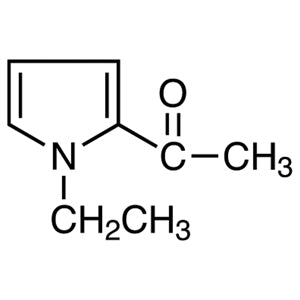
2-Acetyl-1-ethylpyrrole TCI A1977
Regular price From Rp 955.500,00Regular price -
2-Ethylpyrrole TCI E0713
Regular price Rp 3.312.750,00Regular price -
1,2,5-Trimethylpyrrole TCI T1939
Regular price From Rp 1.193.850,00Regular price -
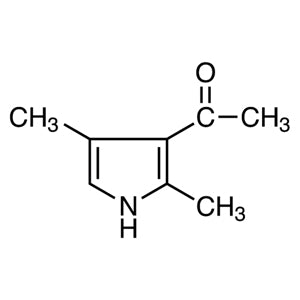
3-Acetyl-2,4-dimethylpyrrole TCI A2734
Regular price From Rp 1.724.100,00Regular price -
2-Acetyl-1-methylpyrrole TCI A1014
Regular price From Rp 1.115.100,00Regular price -
3-Methylpyrrole TCI M1144
Regular price From Rp 9.223.200,00Regular price -
Methyl1-Methylpyrrole-2-acetate TCI M0846
Regular price From Rp 1.220.100,00Regular price -
1-Methylpyrrole TCI M0414
Regular price From Rp 1.060.500,00Regular price