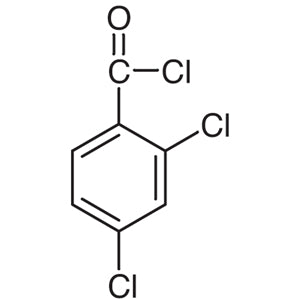
2,4-Dichlorobenzoyl Chloride is a chemical compound widely used as a foundational building block in organic synthesis. It plays a crucial role in laboratory settings where complex organic molecules are being developed. This reagent is commonly utilized in reactions involving aromatic compounds and their derivatives, making it essential for synthetic chemists. Its versatility allows it to participate in various types of chemical reactions, including electrophilic substitution and esterification. Due to its reactivity, it is a preferred choice for experiments that require controlled chemical environments.
The compound is known for its reactive nature and molecular stability, which makes it suitable for a wide range of chemical applications. It is hygroscopic and highly reactive with water, requiring careful handling to maintain its integrity. These properties make it ideal for use in reactions where precise control over the reaction environment is necessary. Its ability to interact with various functional groups enhances its utility in different synthetic pathways. This reactivity and functionality make it a valuable tool in both academic and industrial research.
In Indonesian laboratories, 2,4-Dichlorobenzoyl Chloride is extensively used in organic chemistry research, particularly in the pharmaceutical and chemical industries. It is a key component in the development of new compounds and is often used in the synthesis of pharmaceutical intermediates. Its availability and effectiveness make it a standard reagent in many research settings across Indonesia.
Related TCI products
- Organic synthesis applications benefit from its reactivity and ability to form ester bonds, making it ideal for creating complex organic molecules.
- Pharmaceutical research utilizes it for the synthesis of drug intermediates, as it can participate in electrophilic substitution reactions.
- Chemical reaction optimization relies on its stability and reactivity, allowing precise control over reaction conditions and outcomes.
- Industrial chemical processes incorporate it due to its versatility in forming various functional groups, enhancing product development.
- Analytical chemistry uses it as a reagent for testing and characterizing other compounds through reaction-based methods.
| Brand | TCI |
|---|---|
| CAS number | 89-75-8 |
| Molecular formula | — |
| Purity | — |
| Category | Chemistry > Building Blocks > Non-Heterocyclic Building Blocks |
| Pack sizes | Available in various quantities as per standard laboratory supply |
| Physical form | Solid, typically in crystalline or powder form |
| Storage | Requires dry, cool, and well-ventilated storage conditions |
2,4-Dichlorobenzoyl Chloride should be stored in a dry, cool, and well-ventilated area away from moisture and direct sunlight. It is hygroscopic and reacts with water, so it must be kept in a sealed container to prevent absorption of humidity. Suitable storage containers include glass or high-density polyethylene (HDPE) bottles with tight-fitting lids. Laboratory personnel should wear appropriate personal protective equipment, such as gloves and goggles, when handling this compound. It should be stored separately from incompatible materials like strong bases or aqueous solutions. Regular monitoring of storage conditions ensures the compound remains stable and safe for use in chemical experiments.
—
Produk Terkait
-
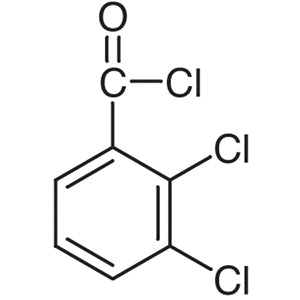
2,3-DichlorobenzoylChloride TCI D3206
Regular price Rp 1.246.350,00Regular price -
2,5-DichlorobenzoylChloride TCI D2953
Regular price From Rp 3.446.100,00Regular price -
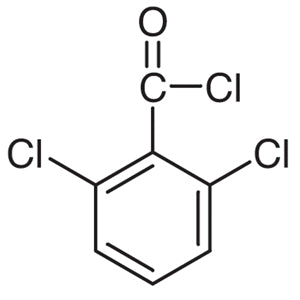
2,6-DichlorobenzoylChloride TCI D2064
Regular price From Rp 1.644.300,00Regular price -
3,5-DichlorobenzoylChloride TCI D1404
Regular price Rp 1.220.100,00Regular price -
3,4-DichlorobenzoylChloride TCI D0346
Regular price Rp 1.405.950,00Regular price -
2,3,4,5-TetrachlorobenzoylChloride TCI T2379
Regular price Rp 2.545.200,00Regular price -
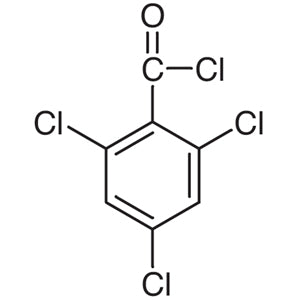
2,4,6-TrichlorobenzoylChloride TCI T1413
Regular price From Rp 2.466.450,00Regular price -
N-(4-Nitrobenzoyl)-beta-alanine TCI N0942
Regular price From Rp 664.650,00Regular price