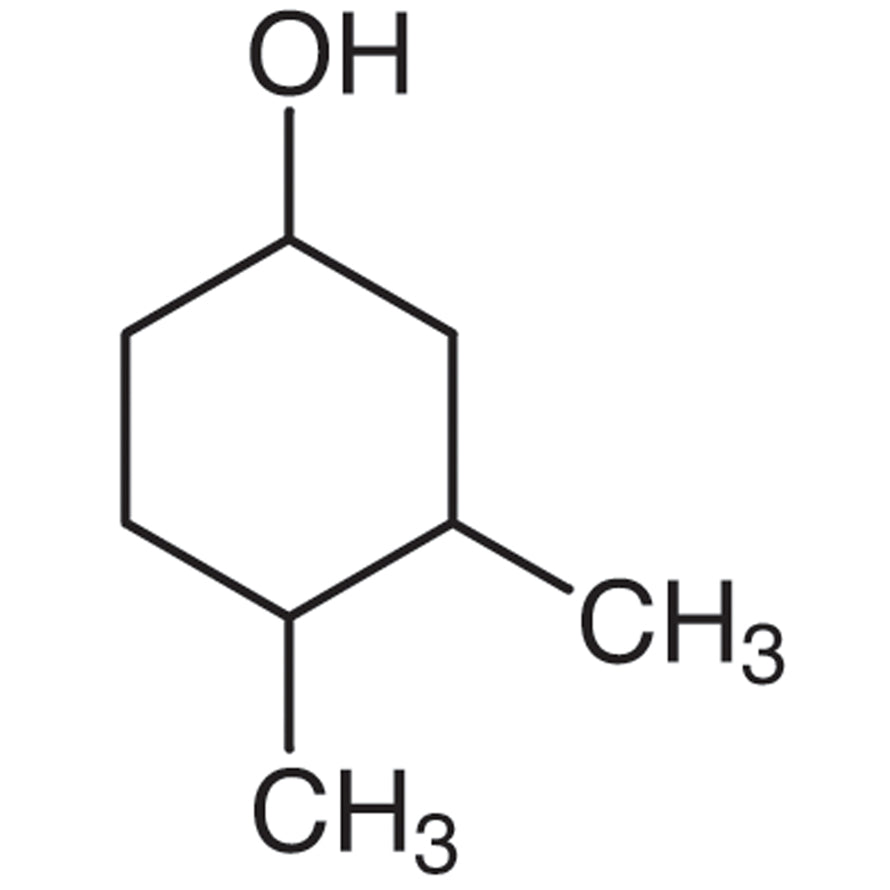
3,4-Dimethylcyclohexanol (mixture of isomers) is an organic compound widely used in chemical reactions for the synthesis of complex molecules. As a key building block in chemistry, it plays a vital role in both heterocyclic and non-heterocyclic synthesis processes. This compound is commonly found in various chemical applications, including pharmaceutical development, industrial raw materials, and scientific research. Its structural versatility allows it to participate in multiple reaction types, such as reduction, oxidation, and substitution, making it a valuable tool for chemists and researchers.
The compound’s high reactivity and stability under specific conditions make it a preferred choice for laboratory use. Its ability to undergo various chemical transformations enables researchers to create a wide range of derivatives and functional groups. This flexibility is especially important in the development of new compounds and the optimization of chemical processes. The compound’s chemical stability ensures that it remains effective even when stored properly, which is essential for maintaining the integrity of experimental results.
In Indonesian laboratories, 3,4-Dimethylcyclohexanol is extensively used in chemical research, particularly in pharmaceutical and chemical industries. It is a common component in experiments aimed at synthesizing new compounds, developing chemical products, and conducting structural characterization studies. Its availability and reliability make it a staple in academic and industrial research settings across the country.
Related TCI products
- TCI D1660 1502-24-5 2,3-Dimethylcyclohexanol (mixture of isomers)
- TCI D1578 5337-72-4 2,6-Dimethylcyclohexanol (mixture of isomers)
- TCI D0702 5441-52-1 3,5-Dimethylcyclohexanol (mixture of isomers)
- TCI V0195 106-87-6 3-(Oxiran-2-yl)-7-oxabicyclo[410]heptane (mixture of isomers)
- TCI B5497 17385-36-3 [1,1'-Bi(cyclohexane)]-2,2'-diol (mixture of isomers)
- TCI B1621 20601-38-1 4,4'-Bicyclohexanol (mixture of isomers)
- Pharmaceutical research for the synthesis of complex organic molecules and drug development.
- Industrial chemical synthesis as a building block for the production of specialty chemicals.
- Academic research in organic chemistry for the study of reaction mechanisms and functional group transformations.
- Material science applications in the development of new polymers and chemical intermediates.
- Analytical chemistry for the calibration of chemical sensors and the testing of reaction conditions.
| Brand | TCI |
|---|---|
| CAS number | 5715-23-1 |
| Molecular formula | — |
| Purity | — |
| Category | Chemistry > Building Blocks > Non-Heterocyclic Building Blocks |
| Pack sizes | Available in various quantities as per standard laboratory supply |
| Physical form | Liquid |
| Storage | Store in a cool, dry place away from direct sunlight |
This compound should be stored in a cool, dry environment, away from direct sunlight and sources of heat. It is recommended to use airtight containers made of glass or high-density polyethylene to prevent contamination and evaporation. Due to its reactivity, it should be handled with appropriate personal protective equipment, such as gloves and safety goggles. It is important to ensure proper ventilation in the laboratory to avoid inhalation of vapors. Avoid contact with incompatible substances, such as strong oxidizers, to prevent unwanted chemical reactions. Regular monitoring of storage conditions will help maintain the compound’s stability and effectiveness for experimental use.
—
Produk Terkait
-
2,3-Dimethylcyclohexanol(mixtureofisomers) TCI D1660
Regular price From Rp 2.016.000,00Regular price -
2,6-Dimethylcyclohexanol(mixtureofisomers) TCI D1578
Regular price Rp 2.359.350,00Regular price -
3,5-Dimethylcyclohexanol(mixtureofisomers) TCI D0702
Regular price From Rp 2.411.850,00Regular price -
3-(Oxiran-2-yl)-7-oxabicyclo[410]heptane(mixtureofisomers) TCI V0195
Regular price From Rp 3.870.300,00Regular price -
[1,1'-Bi(cyclohexane)]-2,2'-diol(mixtureofisomers) TCI B5497
Regular price Rp 6.333.600,00Regular price -
4,4'-Bicyclohexanol(mixtureofisomers) TCI B1621
Regular price From Rp 1.565.550,00Regular price -
4-Methyl-2-phenyl-1,3-dioxolane(mixtureofisomers) TCI B1094
Regular price Rp 477.750,00Regular price -
2,2-Bis(4-hydroxycyclohexyl)propane(mixtureofisomers) TCI B0928
Regular price From Rp 505.050,00Regular price


![106-87-6 3-(Oxiran-2-yl)-7-oxabicyclo[4.1.0]heptane (mixture of isomers) - AMI Scientific](http://amiscientific.com/cdn/shop/files/TCI2510V0195.jpg?v=1767145750&width=533)
![17385-36-3 [1,1'-Bi(cyclohexane)]-2,2'-diol (mixture of isomers) - AMI Scientific](http://amiscientific.com/cdn/shop/files/TCI2510B5497.jpg?v=1768815804&width=533)
![17385-36-3 [1,1'-Bi(cyclohexane)]-2,2'-diol (mixture of isomers) - AMI Scientific](http://amiscientific.com/cdn/shop/files/TCI2510B5497_214e3b8f-db40-41ba-82df-9eaf7780201b.jpg?v=1772180910&width=533)