

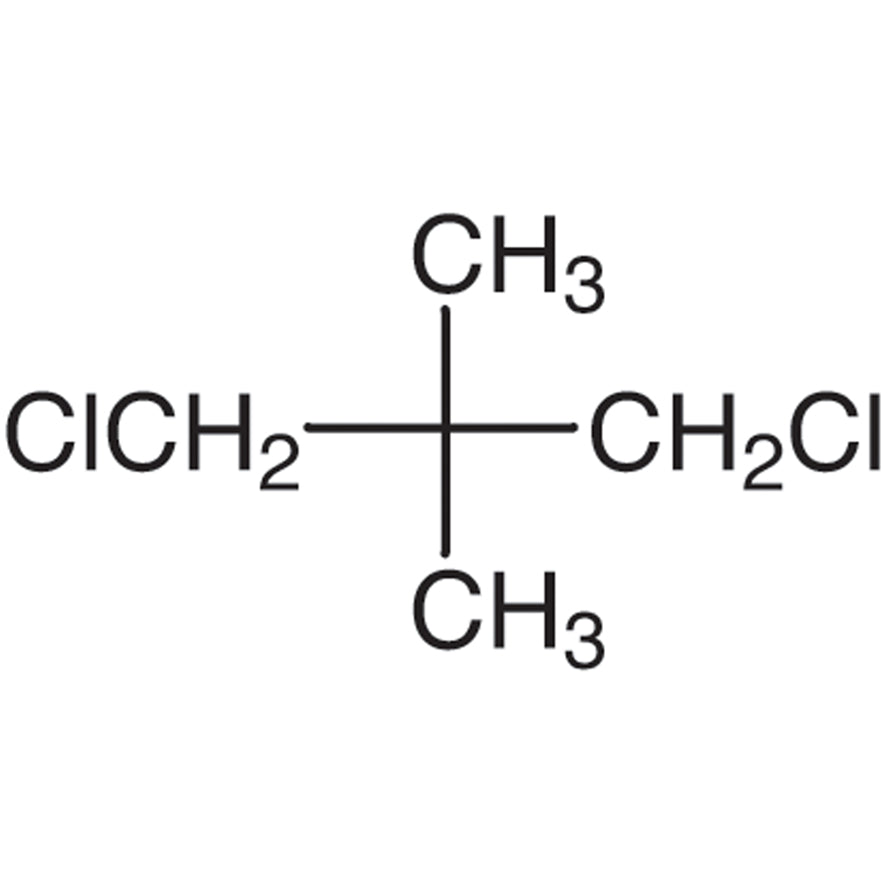
2,2-Dimethyl-1,3-dichloropropane is a chemical compound widely used as a building block in organic synthesis. It serves as a key reagent in the development of complex organic molecules, particularly in research settings where controlled chemical reactions are essential. This compound is valued for its structural versatility and reactivity, making it a fundamental component in various synthetic pathways. Its unique molecular structure, featuring two chlorine atoms and two methyl groups, allows for multiple functional group transformations, which is crucial in the design of new compounds with specific properties.
The compound's stability and controlled reactivity make it a preferred choice for laboratory applications. Its molecular structure provides a stable base for substitution reactions and electrophilic reactions, enabling chemists to manipulate its functional groups with precision. The presence of chlorine atoms enhances the molecule’s stability, while the methyl groups contribute to its reactivity, offering a balance between inertness and functionality. These properties make it suitable for use in both academic and industrial research environments.
In Indonesian laboratories, 2,2-Dimethyl-1,3-dichloropropane is commonly used in organic chemistry research, particularly in pharmaceutical and biochemical studies. Its role in the synthesis of bioactive compounds and pesticides makes it an essential material for researchers working on drug development and environmental chemistry. Its reliability and chemical stability ensure consistent results in experimental processes, supporting scientific innovation in the region.
- Organic synthesis is a primary application where this compound serves as a versatile building block for creating complex molecules with specific functional groups.
- Pharmaceutical research benefits from its use in the development of bioactive compounds, as it can be modified to produce drug candidates with desired properties.
- Biochemical studies often incorporate this compound to investigate molecular interactions and functional group transformations in biological systems.
- Environmental chemistry research utilizes it in the synthesis of pesticide compounds, contributing to the development of effective agricultural products.
- Academic laboratories use it as a standard reagent for teaching and research, providing students and researchers with a reliable material for chemical experimentation.
| Brand | TCI |
|---|---|
| CAS number | 29559-55-5 |
| Molecular formula | — |
| Purity | — |
| Category | Chemistry > Building Blocks > Non-Heterocyclic Building Blocks |
| Pack sizes | Available in standard laboratory quantities |
| Physical form | Liquid |
| Storage | Store in a cool, dry place away from light and incompatible materials |
This compound should be stored in a cool, dry environment, away from direct sunlight and sources of heat. It is recommended to use airtight containers made of materials compatible with organic solvents to prevent contamination and evaporation. Due to its chemical nature, it should be kept separate from strong oxidizers and reactive metals to avoid unintended reactions. Laboratory personnel should handle it with appropriate personal protective equipment, including gloves and safety goggles, to ensure safety during use and storage. Regular inspection of storage conditions is advised to maintain its integrity and ensure safe handling in the laboratory setting.
—
Produk Terkait
-
2,2-Dichloropropane TCI D0400
Regular price Rp 3.100.650,00Regular price -
1,3-Dichloropropane TCI D0399
Regular price From Rp 1.696.800,00Regular price -
1,2-Dichloropropane TCI D0398
Regular price From Rp 717.150,00Regular price -
1,1,1,3-Tetrachloropropane TCI T2426
Regular price Rp 1.856.400,00Regular price -
1,1,2,3-Tetrachloropropane TCI T0707
Regular price Rp 6.836.550,00Regular price -
1,1,2-Trichloropropane TCI T0686
Regular price Rp 2.757.300,00Regular price -
1,2,3-Trichloropropane TCI T0395
Regular price Rp 505.050,00Regular price -
1,1,1,2,3,3,3-Heptachloropropane TCI H0016
Regular price Rp 3.180.450,00Regular price


