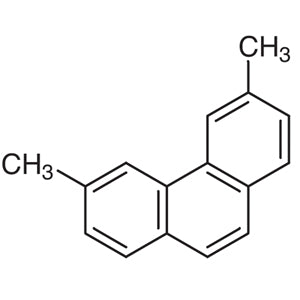
TCI D1235 3,6-Dimethylphenanthrene is a polycyclic aromatic hydrocarbon consisting of a phenanthrene skeleton bearing two methyl groups. In laboratory settings, compounds with this type of structure are generally used as reference materials and test substances in organic chemistry, environmental chemistry, and organic geochemistry research. The fused three-ring aromatic framework gives the molecule distinctive electronic and spectroscopic properties, which is why it is frequently employed to verify the performance of separation methods and to study the behaviour of polycyclic aromatic hydrocarbons under a range of experimental conditions in research laboratories.
The characteristic that makes this compound a preferred choice is its clearly defined aromatic structure with specific methyl substitution positions. Differences in the substitution pattern on the phenanthrene skeleton produce different chromatographic retention times, mass spectral patterns, and fluorescence characteristics, so a particular isomer becomes useful as a comparison standard when researchers need to confirm peak identity on a chromatogram. In addition, the electron-rich aromatic framework makes it an interesting substrate for studies of aromatic substitution reactions and controlled oxidation, where a well-characterised starting structure is essential for interpreting the products formed.
In Indonesian laboratories, this type of material is typically used in university research groups, analytical service laboratories, and environmental testing facilities that work with polycyclic aromatic hydrocarbons. It supports method development and verification work in chromatography, comparison studies between structural isomers, and organic geochemistry investigations. Supplied under the TCI brand within the Chemistry, Building Blocks, Non-Heterocyclic Building Blocks category, it is intended for professional research and analytical use rather than routine bulk applications.
- Chromatographic method verification — its defined structure and characteristic retention behaviour allow analysts to confirm that a separation system is resolving closely related aromatic compounds correctly.
- Peak identification and isomer comparison — differing substitution patterns produce distinguishable retention times and spectral responses, making this isomer a useful comparison point when assigning chromatogram peaks.
- Environmental chemistry research — as a polycyclic aromatic hydrocarbon reference substance, it supports studies of PAH behaviour, detection, and analytical response in environmental sample workflows.
- Organic geochemistry studies — methylated phenanthrenes are relevant structural markers, so this compound serves as a test material when investigating aromatic hydrocarbon distributions in geochemical research.
- Aromatic reactivity investigations — the electron-rich fused ring system makes it a suitable substrate for studying aromatic substitution and controlled oxidation reactions on a well-characterised framework.
| Brand | TCI |
|---|---|
| CAS number | 1576-67-6 |
| Molecular formula | — |
| Purity | — |
| Category | Chemistry > Building Blocks > Non-Heterocyclic Building Blocks |
| Pack sizes | — |
| Physical form | — |
| Storage | store according to the manufacturer's instructions stated on the product label and safety data sheet |
- Chemical name: 3,6-Dimethylphenanthrene
- Product code: D1235
Store the container tightly closed in a cool, dry, well-ventilated area, protected from direct sunlight and away from strong oxidising agents and ignition sources. Keep the material in its original manufacturer packaging, or transfer it to a clean, chemically compatible and clearly labelled container if subdividing is necessary. Handle in a fume hood using appropriate personal protective equipment, including gloves, safety glasses, and a laboratory coat, and avoid generating or inhaling dust. Always consult the manufacturer's safety data sheet before use, and follow institutional procedures for waste collection and disposal of aromatic hydrocarbon residues.
—
Produk Terkait
-
3-Methylphenanthrene TCI M0523
Regular price Rp 8.931.300,00Regular price -
Benzo[c]phenanthrene TCI B6541
Regular price From Rp 1.829.100,00Regular price -
2-Methylcyclopenta[l]phenanthrene TCI M1411
Regular price From Rp 2.279.550,00Regular price -
Phenanthren-3-ol TCI P3265
Regular price Rp 3.949.050,00Regular price -
1,2,3,4,5,6,7,8-Octahydrophenanthrene TCI O0021
Regular price From Rp 3.843.000,00Regular price -
9,10-Dihydrophenanthrene TCI D0554
Regular price From Rp 3.683.400,00Regular price -
Phenanthrene(purifiedbysublimation) TCI P2877
Regular price From Rp 1.353.450,00Regular price -
PhenanthreneZoneRefined(numberofpasses:30) TCI P0331
Regular price Rp 2.942.100,00Regular price
![Benzo[c]phenanthrene (CAS 195-19-7) - TCI B6541 - AMI Scientific](http://amiscientific.com/cdn/shop/files/TCI2510B6541.jpg?v=1767093862&width=533)
![121254-39-5 2-Methylcyclopenta[l]phenanthrene - AMI Scientific](http://amiscientific.com/cdn/shop/files/TCI2510M1411.jpg?v=1767124927&width=533)