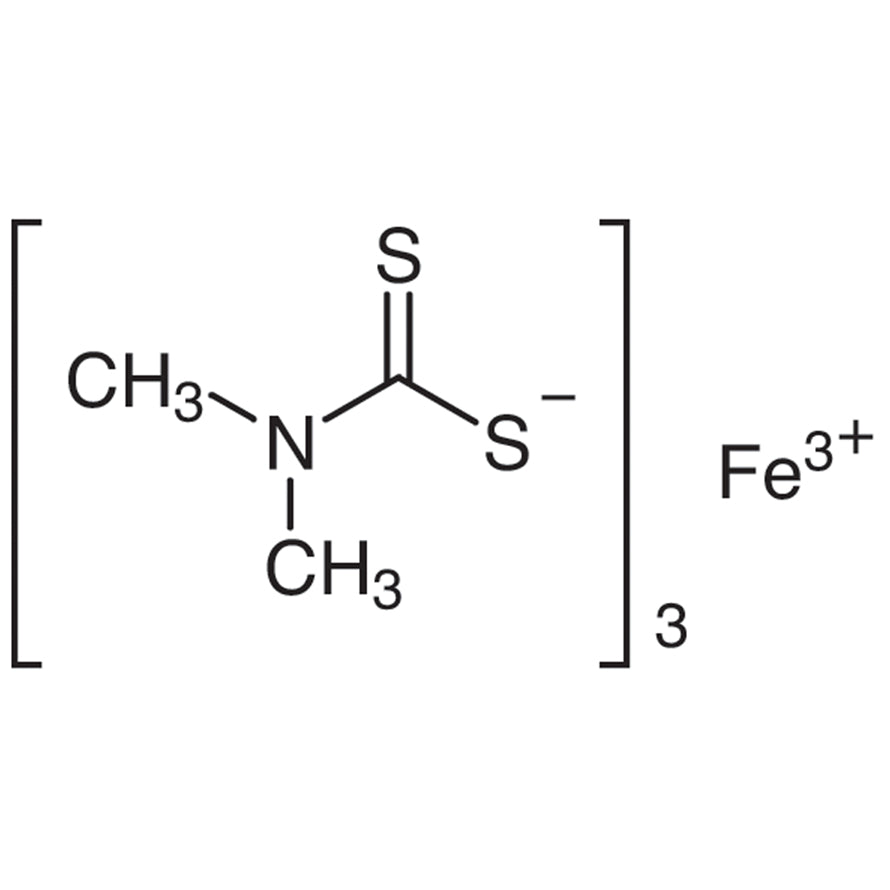
Iron(III) Dimethyldithiocarbamate is a chemical compound widely used in scientific experiments, particularly in the fields of chemistry and materials science. This compound plays a crucial role in the synthesis of metal complexes, especially those with magnetic properties. Its unique structure, composed of an iron(III) ion and dithiocarbamate ligands, makes it a valuable tool for researchers working on magnetic materials. Due to its stability and controlled reactivity, it is frequently employed in laboratory settings to develop new materials with specific magnetic behaviors.
The compound's chemical stability under certain conditions, combined with its reactivity in various chemical reactions, makes it a preferred choice for material scientists. Its ability to form complexes with other metal ions enhances its utility in creating compounds with tailored magnetic properties. This versatility allows it to be used in a wide range of applications, from fundamental research to the development of advanced magnetic materials. Its predictable behavior and compatibility with different chemical environments further contribute to its popularity in laboratory settings.
In Indonesian laboratories, Iron(III) Dimethyldithiocarbamate is commonly used in research related to magnetic materials and chemical synthesis. Its availability in solid form and ease of handling make it a practical choice for researchers. It is often incorporated into experiments aimed at understanding the behavior of magnetic metal complexes, supporting both academic and industrial research initiatives in the field of materials science.
- Magnetic Material Synthesis: Iron(III) Dimethyldithiocarbamate is ideal for creating metal complexes with magnetic properties, supporting research in advanced materials.
- Chemical Complex Formation: Its ability to bind with other metal ions makes it suitable for forming stable and reactive metal complexes in laboratory experiments.
- Research in Magnetic Properties: The compound is used to study the behavior of magnetic materials, aiding in the development of new magnetic substances.
- Educational Experiments: It is frequently used in academic settings to teach students about coordination chemistry and magnetic material synthesis.
- Industrial Material Development: Its stability and reactivity make it a valuable component in the production of magnetic compounds for industrial applications.
| Brand | TCI |
|---|---|
| CAS number | 14484-64-1 |
| Molecular formula | — |
| Purity | — |
| Category | Materials Science > Magnetic Materials > Magnetic Metal Complexes |
| Pack sizes | Available in various quantities as per standard laboratory supply |
| Physical form | Solid |
| Storage | Store in a cool, dry place away from moisture and direct sunlight |
Iron(III) Dimethyldithiocarbamate should be stored in a cool, dry environment to maintain its chemical stability. It is recommended to keep it in airtight containers to prevent exposure to moisture and air, which could affect its reactivity. Suitable storage conditions include a controlled temperature range, typically between 15°C and 25°C, to ensure long-term preservation. Laboratory personnel should handle the compound with care, using appropriate personal protective equipment such as gloves and safety goggles. It is important to avoid contact with incompatible substances and to follow standard safety protocols when working with this material. Proper storage and handling practices help maintain the compound's integrity and ensure safe usage in laboratory settings.
—
Produk Terkait
-
Copper(II)Dimethyldithiocarbamate TCI D1022
Regular price Rp 1.803.900,00Regular price -
Copper(II)Bis(2-hydroxyethyl)dithiocarbamate TCI B0491
Regular price From Rp 903.000,00Regular price -
Copper(II)Diethyldithiocarbamate TCI D0487
Regular price From Rp 875.700,00Regular price -
AllylDimethyldithiocarbamate TCI D1944
Regular price Rp 2.677.500,00Regular price -
ZincDimethyldithiocarbamate TCI D0717
Regular price From Rp 505.050,00Regular price -
SodiumDimethyldithiocarbamateDihydrate TCI D0716
Regular price From Rp 823.200,00Regular price -
DimethylammoniumDimethyldithiocarbamate TCI D0715
Regular price From Rp 1.115.100,00Regular price -
p-Xylylenebis(N,N-diethyldithiocarbamate) TCI X0056
Regular price Rp 3.605.700,00Regular price