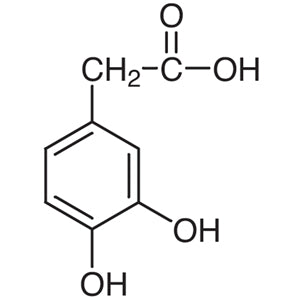
TCI D1283 3,4-Dihydroxyphenylacetic Acid, known among biomedical researchers as DOPAC, is an aromatic carboxylic acid carrying a catechol group that holds a special role as a major metabolite of dopamine in the body. Beyond serving as a non-heterocyclic building block for organic synthesis, this compound is widely used as a reference material and test substance in neurochemistry, pharmacology, and clinical biochemical analysis. Its availability allows researchers to trace catecholamine metabolic pathways and to evaluate the activity of the enzymes involved in those processes in a measurable way in the laboratory.
The principal characteristic of this material lies in the two adjacent phenolic hydroxyl groups on the aromatic ring, which together form a catechol motif. This motif confers reducing properties and the ability to bind metals through the formation of chelate complexes, while also making the compound electroactive and therefore readily detected using electrochemical detectors on HPLC systems. On the other hand, the catechol group also makes the compound sensitive to oxidation by air, light, and alkaline conditions, so handling demands care. The acetic acid group on the side chain contributes mild acidic character, giving the molecule a reactive handle for further derivatisation and for adjusting solubility in aqueous buffer systems.
In Indonesian laboratories, this reagent is typically used in university research groups, medical faculty laboratories, and analytical service units that study neurotransmitter systems and their metabolism. It commonly appears in chromatographic method development work, in the preparation of calibration standards, and in enzyme assay studies. Because of its sensitivity to oxidation, laboratories operating in a warm and humid tropical climate generally plan its handling around short, well-controlled working sessions and reserve the material for defined analytical or synthetic runs.
Related TCI products
- TCI V0052 776-99-8 3,4-Dimethoxyphenylacetone
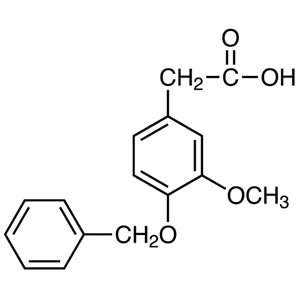
- TCI B4800 29973-91-9 4-Benzyloxy-3-methoxyphenylacetic Acid
- TCI B4742 4547-57-3 4-Butoxyphenylacetic Acid
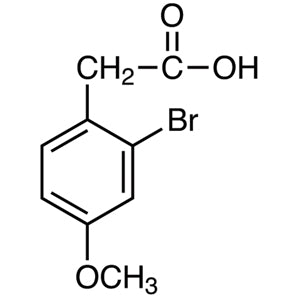
- TCI B4737 66916-99-2 2-Bromo-4-methoxyphenylacetic Acid
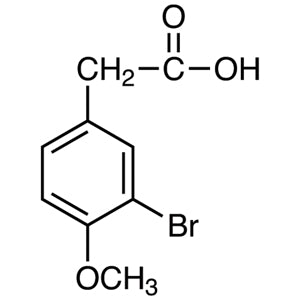
- TCI B4677 774-81-2 3-Bromo-4-methoxyphenylacetic Acid
- TCI B4674 1860-58-8 3-Benzyloxyphenylacetic Acid
- Catecholamine metabolism research: as a major dopamine metabolite, it allows researchers to trace metabolic pathways and quantify the products of dopamine turnover in a measurable, laboratory-controlled way.
- HPLC with electrochemical detection: the electroactive catechol motif responds directly at electrochemical detectors, making the compound well suited as a reference and calibration substance in chromatographic analysis.
- Enzyme activity evaluation: the compound serves as a test substance for assessing the activity of enzymes involved in catecholamine metabolism, supporting comparable and reproducible measurement between experimental runs.
- Non-heterocyclic organic synthesis: the acetic acid side chain and catechol ring provide reactive handles for derivatisation, so the material functions as a versatile building block for constructing more complex target molecules.
- Clinical biochemical and pharmacological analysis: it is used as a reference material in biochemical and pharmacological studies, where a well-defined metabolite standard is required to interpret analytical results correctly.
| Brand | TCI |
|---|---|
| CAS number | 102-32-9 |
| Molecular formula | — |
| Purity | — |
| Category | Chemistry > Building Blocks > Non-Heterocyclic Building Blocks |
| Pack sizes | available in the packaging options offered by the manufacturer for this catalogue item |
| Physical form | — |
| Storage | keep tightly closed and protected from air and light; sensitive to oxidation |
- Chemical character: aromatic carboxylic acid bearing a catechol (ortho-dihydroxy) group, also known as DOPAC
Store the container tightly closed in a cool, dry place, protected from direct light and from prolonged contact with air, since the catechol group is readily oxidised by air, light, and alkaline conditions. Amber glass or otherwise light-protected containers with well-sealed closures are appropriate, and the headspace should be kept to a minimum after each use. Weigh and transfer the material promptly, avoid alkaline environments during handling, and prepare working solutions shortly before use. Handle in a well-ventilated area or fume hood using standard laboratory personal protective equipment, including gloves, safety glasses, and a laboratory coat, and consult the manufacturer's safety data sheet before use.
—
Produk Terkait
-
3,4-Dimethoxyphenylacetone TCI V0052
Regular price From Rp 1.193.850,00Regular price -
4-Benzyloxy-3-methoxyphenylaceticAcid TCI B4800
Regular price Rp 2.518.950,00Regular price -
4-ButoxyphenylaceticAcid TCI B4742
Regular price From Rp 1.060.500,00Regular price -
2-Bromo-4-methoxyphenylaceticAcid TCI B4737
Regular price From Rp 848.400,00Regular price -
3-Bromo-4-methoxyphenylaceticAcid TCI B4677
Regular price From Rp 689.850,00Regular price -
3-BenzyloxyphenylaceticAcid TCI B4674
Regular price Rp 1.618.050,00Regular price -
4-BenzyloxyphenylaceticAcid TCI B1779
Regular price Rp 2.969.400,00Regular price -
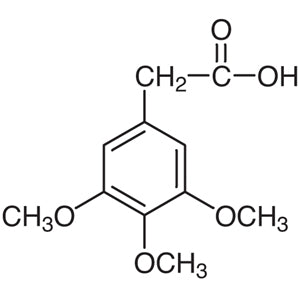
3,4,5-TrimethoxyphenylaceticAcid TCI T1105
Regular price From Rp 1.035.300,00Regular price