

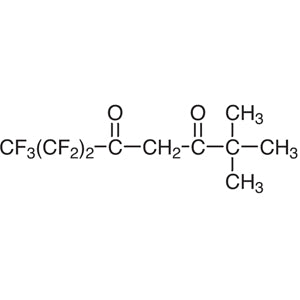
2,2-Dimethyl-6,6,7,7,8,8,8-heptafluoro-3,5-octanedione is a fluorinated organic compound with a complex molecular structure and unique chemical properties. It serves as a key building block in the synthesis of organofluorine compounds, which are widely used in pharmaceuticals, materials science, and organic chemistry. In the laboratory, this compound is essential for creating molecules with specific functional properties, such as chemical stability, environmental resistance, and electronic behavior. Its role as a foundational material enables researchers to design and develop advanced chemical structures with precise control over molecular characteristics.
The compound's high fluorine content contributes to its exceptional chemical stability and controlled reactivity, making it a preferred choice for synthetic applications. Fluorine atoms in the molecule influence its polarity and solubility, allowing it to participate in a variety of chemical reactions. These properties make it suitable for use in complex syntheses where precision and reliability are critical. The compound's unique combination of stability and reactivity also supports its application in the development of new materials and pharmaceutical compounds.
In Indonesian laboratories, this compound is commonly used in organic chemistry research, drug development, and the production of specialized materials. It is a valuable resource for academic institutions and research centers that focus on chemical innovation. Its versatility and reliability make it an essential component in many experimental processes within the scientific community in Indonesia.
TCI brochures (PDF)
- Fluorous Chemistry 2025-01-21 · p. 6
- Ligands 2025-12-01 · p. 18
- Fluorination Reagents, Fluorinated Building Blocks 2026-03-18 · p. 51
Related TCI products
- TCI H0548 375-01-9 2,2,3,3,4,4,4-Heptafluoro-1-butanol
- TCI T1511 17978-77-7 Tris(6,6,7,7,8,8,8-heptafluoro-2,2-dimethyl-3,5-octanedionato)praseodymium(III) [NMR Shift Reagent]
- TCI M2022 680-05-7 Methyl Heptafluoroisobutyrate
- TCI H1033 356-24-1 Methyl Heptafluorobutyrate
- TCI H0689 422-85-5 Heptafluoropropyl Bromide
- TCI H0629 677-69-0 Heptafluoroisopropyl Iodide
- Organic synthesis projects benefit from this compound's stability and reactivity, enabling the creation of complex fluorinated molecules with precise functional groups.
- Pharmaceutical research utilizes the compound to develop new drugs, as fluorinated compounds often exhibit improved bioavailability and metabolic stability.
- Material science applications leverage its unique properties to design advanced polymers and coatings with enhanced durability and chemical resistance.
- Academic research in chemistry relies on this compound as a fundamental building block for exploring new synthetic methodologies and molecular structures.
- Environmental studies may use it to investigate the behavior of fluorinated compounds in various chemical environments and their impact on material properties.
| Brand | TCI |
|---|---|
| CAS number | 17587-22-3 |
| Molecular formula | — |
| Purity | — |
| Category | Chemistry > Building Blocks > Fluorinated Building Blocks |
| Pack sizes | Available in standard laboratory quantities as per supplier specifications |
| Physical form | Solid or liquid, depending on the specific formulation |
| Storage | Store in a cool, dry place away from direct sunlight and moisture |
This compound should be stored in a cool, dry environment to maintain its chemical integrity. It is recommended to use sealed containers made of materials compatible with fluorinated compounds, such as glass or high-density polyethylene. Proper labeling and containment are essential to prevent accidental exposure. Due to its chemical nature, it should be handled with appropriate personal protective equipment, including gloves and safety goggles. Avoid direct contact with skin and inhalation of vapors. Ensure adequate ventilation in the laboratory workspace to minimize risk. Regular monitoring of storage conditions is advised to ensure long-term stability and safety.
—
Produk Terkait
-
2,2,3,3,4,4,4-Heptafluoro-1-butanol TCI H0548
Regular price From Rp 1.353.450,00Regular price -
Tris(6,6,7,7,8,8,8-heptafluoro-2,2-dimethyl-3,5-octanedionato)praseodymium(III)[NMRShiftReagent] TCI T1511
Regular price Rp 8.242.500,00Regular price -
MethylHeptafluoroisobutyrate TCI M2022
Regular price From Rp 4.028.850,00Regular price -
MethylHeptafluorobutyrate TCI H1033
Regular price From Rp 1.035.300,00Regular price -
HeptafluoropropylBromide TCI H0689
Regular price Rp 8.401.050,00Regular price -
HeptafluoroisopropylIodide TCI H0629
Regular price From Rp 2.147.250,00Regular price -
HeptafluoropropylIodide(stabilizedwithCopperchip) TCI H0596
Regular price From Rp 2.597.700,00Regular price -
EthylHeptafluorobutyrate TCI H0594
Regular price From Rp 928.200,00Regular price

![17978-77-7 Tris(6,6,7,7,8,8,8-heptafluoro-2,2-dimethyl-3,5-octanedionato)praseodymium(III) [NMR Shift Reagent] - AMI Scientific](http://amiscientific.com/cdn/shop/files/TCI2510T1511.jpg?v=1767141753&width=533)


