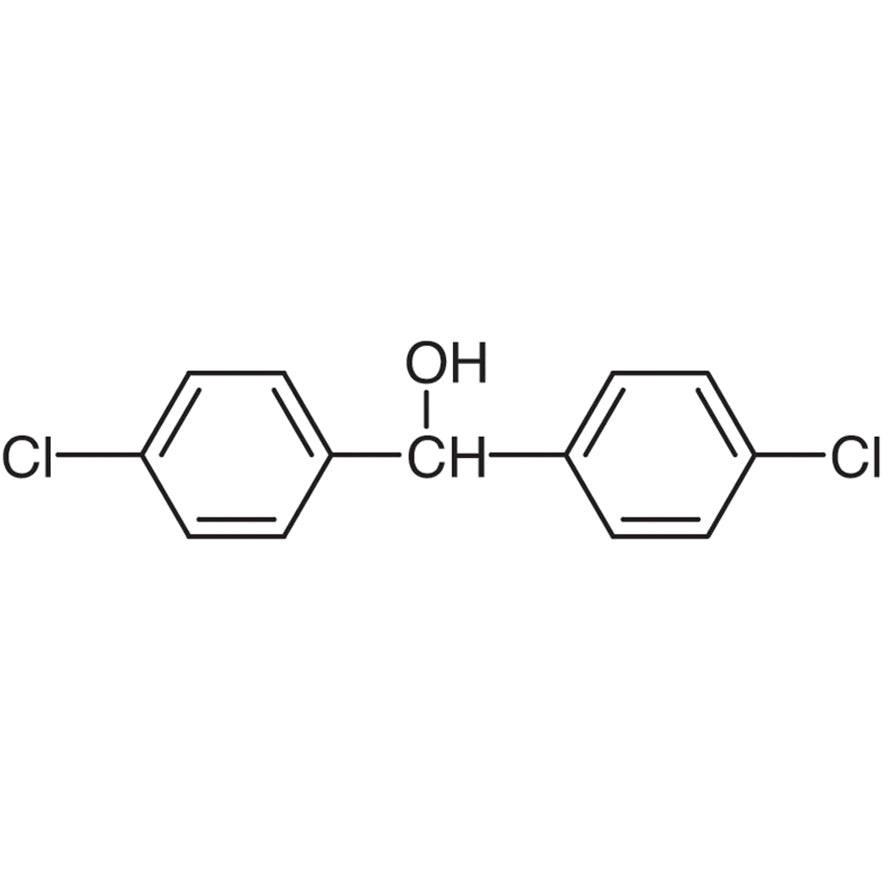
4,4'-Dichlorobenzhydrol (TCI D1915) is a chemical compound widely used as a building block in various chemical reactions within laboratory settings. This compound plays a crucial role in organic synthesis, particularly in the development of aromatic and heterocyclic compounds. Its molecular structure enables it to participate in multiple reaction types, making it a versatile reagent for chemists. It is commonly employed in substitution and condensation reactions, contributing to the synthesis of complex organic molecules. Due to its stability and reactivity, it is a valuable resource for researchers working on synthetic pathways and molecular design.
The compound’s chemical properties make it a preferred choice for laboratory applications. It exhibits good solubility in organic solvents, which simplifies its handling and integration into experimental procedures. Its stability under various reaction conditions ensures consistent results, reducing the risk of unwanted side reactions. Additionally, its controlled reactivity allows for precise manipulation in synthetic processes, enhancing the reproducibility of experiments. These characteristics make it an essential component in both academic and industrial research environments.
In Indonesian laboratories, 4,4'-Dichlorobenzhydrol is extensively used in organic chemistry research. It is commonly found in university laboratories and research institutions, where it supports the development of new compounds and structural studies. Its availability in the local market ensures accessibility for both students and researchers, facilitating hands-on learning and innovation. Its role in advancing chemical research is significant, particularly in the context of Indonesia’s growing scientific community.
- Organic synthesis is a primary application where TCI D1915 is used to build complex molecules through substitution and condensation reactions.
- Heterocyclic compound development benefits from its ability to participate in nucleophilic and electrophilic reactions, aiding in ring formation.
- Research in aromatic chemistry leverages its structural properties to explore new synthetic pathways and molecular transformations.
- Educational institutions use it to teach fundamental concepts in organic chemistry and reaction mechanisms to undergraduate students.
- Industrial research applications involve its use in the development of pharmaceuticals and specialty chemicals through controlled synthetic processes.
| Brand | TCI |
|---|---|
| CAS number | 90-97-1 |
| Molecular formula | — |
| Purity | — |
| Category | Chemistry > Building Blocks > Non-Heterocyclic Building Blocks |
| Pack sizes | Available in various quantities as per supplier specifications |
| Physical form | Solid or liquid, depending on the batch and supplier |
| Storage | Store in a cool, dry place away from direct sunlight and moisture |
4,4'-Dichlorobenzhydrol should be stored in a cool, dry environment to maintain its chemical stability. It is recommended to keep it in airtight containers to prevent exposure to moisture and air, which could affect its reactivity. Proper labeling of containers is essential for safe handling and identification. In laboratory settings, it should be handled with appropriate personal protective equipment, such as gloves and safety goggles, to minimize direct contact. Storage areas should be well-ventilated to reduce the risk of inhalation of any vapors. Regular monitoring of storage conditions ensures the compound remains suitable for use in chemical experiments.
—
Produk Terkait
-
Benzhydrol TCI D0898
Regular price From Rp 584.850,00Regular price -
4-Chlorobenzhydrol TCI C0989
Regular price From Rp 769.650,00Regular price -
4-Bromobenzhydrol TCI B4680
Regular price From Rp 955.500,00Regular price -
2-Methylbenzhydrol TCI M1309
Regular price Rp 848.400,00Regular price -
4-Methoxybenzhydrol TCI M1278
Regular price From Rp 2.147.250,00Regular price -
4-Methylbenzhydrol TCI M1176
Regular price Rp 1.776.600,00Regular price -
4,4'-Dimethylbenzhydrol TCI D5460
Regular price From Rp 2.016.000,00Regular price -
4,4'-Dichloro-alpha-methylbenzhydrol TCI D2692
Regular price Rp 1.644.300,00Regular price