TCI D2133 1,3-Dithiole-2-thione (CAS 930-35-8) is a cyclic organosulfur compound. Its five-membered ring contains two sulfur atoms and one thiocarbonyl group (C=S). Synthetic chemistry laboratories use it as an important precursor for building the 1,3-dithiole framework. It is especially useful for preparing tetrathiafulvalene (TTF) derivatives, which are widely studied as electron donors in conductive organic materials. For this reason, the compound is often the starting point for research into functional sulfur-based materials, and it supports careful multi-step synthesis work.
1,3-Dithiole-2-thione is valued for its high sulfur content and its reactive thiocarbonyl group. The C=S group can be converted into a carbonyl group to give 1,3-dithiol-2-one. It can also be used directly in coupling reactions, such as coupling mediated by trivalent phosphorus compounds, to produce both symmetrical and unsymmetrical TTF systems. The electron-rich dithiole ring can be modified at its vinylic carbon positions, so researchers can design molecules with the redox properties they need. TCI's consistent quality helps make synthesis results easier to reproduce from batch to batch.
In Indonesia, this compound is relevant to organic chemistry research groups and to chemistry and materials science laboratories at universities and research institutions. Typical work includes synthesising sulfur-rich heterocyclic building blocks, preparing TTF-based electron donors, and studying the redox behaviour of new organic molecules. Graduate students and lecturers working on organic electronics, conductive materials, or advanced organosulfur chemistry can use it as a reliable starting material for exploratory and methodological studies.
TCI brochures (PDF)
- Molecular Conductors 2025-11-13 · p. 6
Related TCI products
- TCI B2228 132765-35-6 4,5-Bis(2-cyanoethylthio)-1,3-dithiole-2-thione
- TCI B1778 49638-64-4 4,5-Bis(methylthio)-1,3-dithiole-2-thione
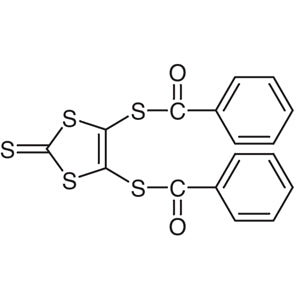
- TCI B1199 68494-08-6 4,5-Bis(benzoylthio)-1,3-dithiole-2-thione
- TCI P1635 202126-48-5 5-Propyl-1,3-dithiolo[4,5-d][1,3]dithiole-2-thione
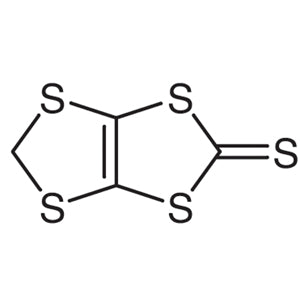
- TCI M1112 70800-59-8 4,5-Methylenedithio-1,3-dithiole-2-thione
- TCI H1163 202126-51-0 5-Hexyl-1,3-dithiolo[4,5-d][1,3]dithiole-2-thione
- Synthesis of tetrathiafulvalene (TTF) derivatives: the compound is a key precursor to the 1,3-dithiole framework, which forms the core of TTF electron donors used in conductive organic materials.
- Phosphorus-mediated coupling reactions: the thiocarbonyl group can take part directly in coupling mediated by trivalent phosphorus compounds, giving both symmetrical and unsymmetrical TTF systems for comparative studies.
- Preparation of 1,3-dithiol-2-one: the C=S group can be converted into a carbonyl group, giving researchers a closely related building block for further synthetic transformations and comparisons.
- Design of redox-active molecules: the electron-rich dithiole ring can be modified at its vinylic carbon positions, so the redox properties of target molecules can be tuned for specific research goals.
- Research into functional sulfur-based materials: its high sulfur content makes it a practical starting point for exploring new organosulfur materials in organic electronics and materials chemistry projects.
| Brand | TCI (product code D2133) |
|---|---|
| CAS number | 930-35-8 |
| Molecular formula | — |
| Purity | — |
| Category | Chemistry > Building Blocks > Non-Heterocyclic Building Blocks |
| Pack sizes | as offered in the TCI catalogue for product D2133; please contact us to confirm the current options |
| Physical form | refer to the TCI product label and Safety Data Sheet |
| Storage | follow the conditions stated on the TCI label and Safety Data Sheet |
Keep 1,3-Dithiole-2-thione in its original, tightly closed TCI container, clearly labelled, in a cool, dry, well-ventilated area away from direct sunlight, heat sources, and incompatible materials such as strong oxidising agents. Always follow the storage temperature and conditions given on the product label and Safety Data Sheet. Handle it in a fume hood while wearing a laboratory coat, safety glasses, and chemical-resistant gloves. Avoid inhaling dust or vapour and avoid contact with skin and eyes. Close the container promptly after each use to limit exposure to moisture and air. Dispose of residues and contaminated materials according to your institution's chemical waste procedures and local regulations.
—
Produk Terkait
-
4,5-Bis(2-cyanoethylthio)-1,3-dithiole-2-thione TCI B2228
Regular price Rp 4.382.000,00Regular priceRp 2.998.000,00Sale price Rp 4.382.000,00 -
4,5-Bis(methylthio)-1,3-dithiole-2-thione TCI B1778
Regular price Rp 3.578.000,00Regular priceRp 2.451.000,00Sale price Rp 3.578.000,00 -
4,5-Bis(benzoylthio)-1,3-dithiole-2-thione TCI B1199
Regular price From Rp 2.723.000,00Regular priceRp 1.868.000,00Sale price From Rp 2.723.000,00 -
5-Propyl-1,3-dithiolo[4,5-d][1,3]dithiole-2-thione TCI P1635
Regular price From Rp 2.204.000,00Regular priceRp 1.515.000,00Sale price From Rp 2.204.000,00 -
4,5-Methylenedithio-1,3-dithiole-2-thione TCI M1112
Regular price Rp 6.794.000,00Regular priceRp 4.639.000,00Sale price Rp 6.794.000,00 -
5-Hexyl-1,3-dithiolo[4,5-d][1,3]dithiole-2-thione TCI H1163
Regular price Rp 8.170.000,00Regular priceRp 5.574.000,00Sale price Rp 8.170.000,00 -
4,5-Ethylenedithio-1,3-dithiole-2-thione TCI E0429
Regular price From Rp 1.945.000,00Regular priceRp 1.339.000,00Sale price From Rp 1.945.000,00 -
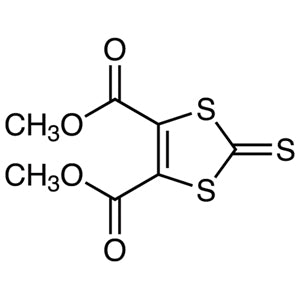
Dimethyl1,3-Dithiole-2-thione-4,5-dicarboxylate TCI D2127
Regular price From Rp 2.125.000,00Regular priceRp 1.462.000,00Sale price From Rp 2.125.000,00