


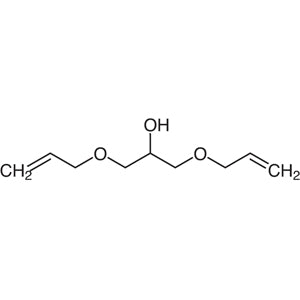
TCI D2146, CAS number 17018-07-4, is Glycerol alpha,alpha'-Diallyl Ether, a glycerol-derived compound in which the two terminal hydroxyl groups have been etherified with allyl groups while the hydroxyl group at the central position remains free. In the laboratory it is classified as a monomer within the polymer and macromolecule reagent group. Its role is to supply a small molecule carrying two terminal double bonds that are ready to participate in polymerization and cross-linking reactions, while at the same time bringing along a single hydroxyl group available for further functionalization.
The characteristic that makes this monomer a frequent choice is the combination of allyl difunctionality and a free hydroxyl group within one relatively small molecule built on a glycerol backbone. The two allyl groups allow the formation of three-dimensional networks through thiol-ene reactions, hydrosilylation, or radical polymerization, producing materials whose cross-link density can be adjusted as required. The central hydroxyl group raises polarity, improves adhesion to polar surfaces, and provides an entry point for esterification or reaction with isocyanates. Its liquid form means it can be mixed directly into formulations.
In Indonesian laboratories this monomer is typically handled in polymer and materials science work, where researchers prepare cross-linked networks, coating formulations, and modified resin systems on a bench scale. Because it is supplied as a liquid, it is measured and blended directly with other components without a separate dissolution step. It is generally used in university research groups, materials characterization laboratories, and industrial development units that build and evaluate polymer networks with adjustable cross-link density.
TCI brochures (PDF)
- Biomaterials Research Reagents 2025-02-19 · p. 16
- Monomers 2025-05-28 · p. 18
Related TCI products
- Thiol-ene network formation: the two terminal allyl double bonds react with polythiol partners, giving cross-linked networks whose density can be tuned by adjusting the monomer proportion in the mixture.
- Radical polymerization and cross-linking: the difunctional allyl structure lets this monomer act as a cross-linking agent that converts linear chains into three-dimensional networks during radical-initiated reactions.
- Hydrosilylation chemistry: the terminal double bonds serve as reaction sites for silicon-hydride addition, making the compound useful for building organosilicon-modified networks and hybrid materials in the laboratory.
- Polar surface coating formulations: the free central hydroxyl group raises overall polarity and improves adhesion to polar substrates, which suits the material to coating and adhesive development work.
- Post-polymerization functionalization: the untouched central hydroxyl group provides an entry point for esterification or reaction with isocyanates, allowing further chemical modification after the network has formed.
| Brand | TCI |
|---|---|
| CAS number | 17018-07-4 |
| Molecular formula | — |
| Purity | — |
| Category | Materials Science > Polymer/Macromolecule Reagents > Monomers |
| Pack sizes | available in the standard TCI catalogue packaging options for this product code |
| Physical form | liquid, suitable for direct mixing into formulations |
| Storage | store in a closed container under the conditions stated on the manufacturer label |
- Chemical name: Glycerol alpha,alpha'-Diallyl Ether
Store this monomer in its original tightly closed container, kept upright in a cool, dry, and well-ventilated area away from heat sources, open flames, and direct sunlight. As an allyl-functional liquid monomer, it should be kept away from radical initiators, peroxides, and strong oxidizing agents to avoid unintended polymerization. Use chemically compatible glass or manufacturer-supplied containers, and reseal immediately after dispensing to limit exposure to air and moisture. Handle inside a fume hood while wearing safety goggles, chemically resistant gloves, and a laboratory coat. Transfer using clean, dry glassware, keep labels intact, and always consult the manufacturer safety data sheet before use, storage, or disposal.
—
Product Categories
- Polymer/Macromolecule ReagentsMonomersDivinyl Monomers and Diallyl Monomers
- Biomaterials/Biocompatible Materials Research ReagentsMonomers and Macromonomers [Biomaterials/Biocompatible Materials Research Reagents]Divinyl Monomers and Diallyl Monomers [Biomaterials/Biocompatible Materials Research Reagents]
Produk Terkait
-
DiallylAdipate TCI A0824
Regular price Rp 1.538.250,00Regular priceRp 1.075.200,00Sale price Rp 1.538.250,00 -
DiallylMaleate(stabilizedwithHQ) TCI D5508
Regular price From Rp 610.050,00Regular priceRp 442.050,00Sale price From Rp 610.050,00 -
Diallyl1,4-Cyclohexanedicarboxylate(cis-andtrans-mixture) TCI D3768
Regular price From Rp 2.942.100,00Regular priceRp 2.056.950,00Sale price From Rp 2.942.100,00 -
DiallylTerephthalate TCI T1483
Regular price Rp 1.273.650,00Regular priceRp 890.400,00Sale price Rp 1.273.650,00 -
DiallylPhthalate TCI P0290
Regular price From Rp 505.050,00Regular priceRp 352.800,00Sale price From Rp 505.050,00 -
DiallylIsophthalate TCI I0450
Regular price From Rp 505.050,00Regular priceRp 352.800,00Sale price From Rp 505.050,00 -
DiallylPropylIsocyanurate(stabilizedwithBHT) TCI I0409
Regular price Rp 5.724.600,00Regular priceRp 4.018.350,00Sale price Rp 5.724.600,00 -
2,4,6-Trimethyl-2,4,6-trivinylcyclotrisiloxane TCI T3745
Regular price From Rp 689.850,00Regular priceRp 497.700,00Sale price From Rp 689.850,00


