

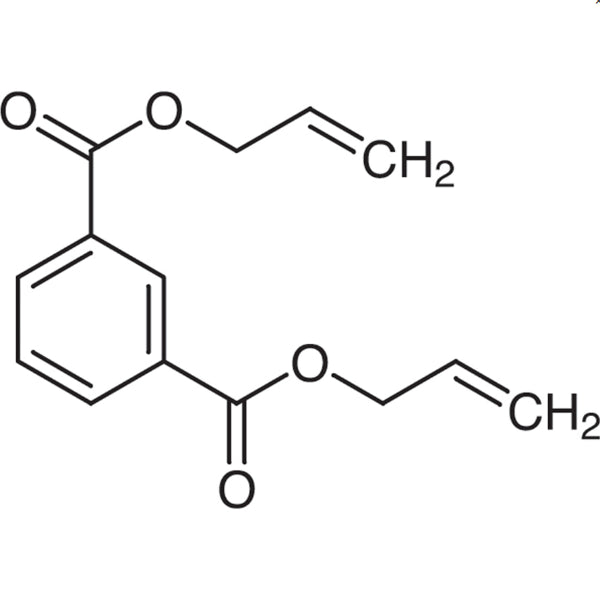
Diallyl Isophthalate is a chemical compound widely utilized in scientific experiments, particularly in the fields of materials science and polymer chemistry. As a monomer, it plays a crucial role in polymerization processes, enabling the formation of complex compounds with specific physical and chemical properties. Its versatility makes it an essential component in various laboratory applications, supporting the development of advanced materials and synthetic polymers. This compound is commonly found in research settings where the synthesis of polymers and composite materials is required, contributing to innovations in multiple industries.
Diallyl Isophthalate is valued for its stable chemical structure and high reactivity, which facilitate efficient polymerization reactions. These properties make it a preferred choice for researchers aiming to achieve controlled and reproducible results in polymer synthesis. Additionally, its thermoplastic characteristics allow for precise manipulation during experimental processes, enhancing the reliability of the final products. The compound’s consistent performance and adaptability to different reaction conditions further solidify its position as a reliable reagent in scientific research.
In Indonesian laboratories, Diallyl Isophthalate is extensively used in chemical, material, and engineering research. It is frequently employed in academic institutions, research organizations, and manufacturing companies that require foundational materials for product development. Its availability and reliability make it a popular choice for experiments involving polymer synthesis and composite material creation, supporting both educational and industrial research efforts.
TCI brochures (PDF)
- Monomers 2025-05-28 · p. 18
Related TCI products
- TCI T1483 1026-92-2 Diallyl Terephthalate
- TCI A0824 2998-04-1 Diallyl Adipate
- TCI P0290 131-17-9 Diallyl Phthalate
- TCI I0409 5320-25-2 Diallyl Propyl Isocyanurate (stabilized with BHT)
- TCI D5508 999-21-3 Diallyl Maleate (stabilized with HQ)
- TCI D3768 20306-22-3 Diallyl 1,4-Cyclohexanedicarboxylate (cis- and trans- mixture)
- Polymer synthesis experiments benefit from Diallyl Isophthalate due to its ability to form stable and reactive polymers, ideal for creating advanced composite materials.
- Epoxide resin development relies on this compound as a key monomer, enabling the production of high-performance resins used in various industrial applications.
- Composite material research utilizes Diallyl Isophthalate to enhance the mechanical and thermal properties of polymer-based composites.
- Chemical synthesis projects leverage its reactivity to produce complex organic compounds with tailored properties for specialized applications.
- Material science studies incorporate this compound to investigate the behavior and performance of new polymer structures under different conditions.
| Brand | TCI |
|---|---|
| CAS number | 1087-21-4 |
| Molecular formula | — |
| Purity | — |
| Category | Materials Science > Polymer/Macromolecule Reagents > Monomers |
| Pack sizes | Available in various quantities as per supplier specifications |
| Physical form | Solid or liquid, depending on the specific product variant |
| Storage | Store in a cool, dry place away from direct sunlight and incompatible materials |
Diallyl Isophthalate should be stored in a cool, dry environment, away from direct sunlight and sources of heat. It is recommended to use sealed containers made of inert materials such as glass or polyethylene to prevent contamination and maintain chemical stability. Proper labeling of storage containers is essential to ensure safe handling and prevent accidental exposure. In laboratory settings, it is important to follow standard safety protocols, including the use of personal protective equipment when handling the compound. Adequate ventilation should be maintained in the workspace to minimize inhalation risks. Regular monitoring of storage conditions ensures the compound remains in optimal condition for use in research applications.
—
Produk Terkait
-
DiallylTerephthalate TCI T1483
Regular price Rp 1.273.650,00Regular priceRp 890.400,00Sale price Rp 1.273.650,00 -
DiallylAdipate TCI A0824
Regular price Rp 1.538.250,00Regular priceRp 1.075.200,00Sale price Rp 1.538.250,00 -
DiallylPhthalate TCI P0290
Regular price Rp 505.050,00Regular priceRp 352.800,00Sale price Rp 505.050,00 -
DiallylPropylIsocyanurate(stabilizedwithBHT) TCI I0409
Regular price Rp 5.724.600,00Regular priceRp 4.018.350,00Sale price Rp 5.724.600,00 -
DiallylMaleate(stabilizedwithHQ) TCI D5508
Regular price Rp 610.050,00Regular priceRp 442.050,00Sale price Rp 610.050,00 -
Diallyl1,4-Cyclohexanedicarboxylate(cis-andtrans-mixture) TCI D3768
Regular price Rp 2.942.100,00Regular priceRp 2.056.950,00Sale price Rp 2.942.100,00 -
Glycerolalpha,alpha'-DiallylEther TCI D2146
Regular price Rp 2.677.500,00Regular priceRp 1.887.900,00Sale price Rp 2.677.500,00 -
Bis(2-ethylhexyl)Isophthalate TCI B4302
Regular price Rp 584.850,00Regular priceRp 408.450,00Sale price Rp 584.850,00


