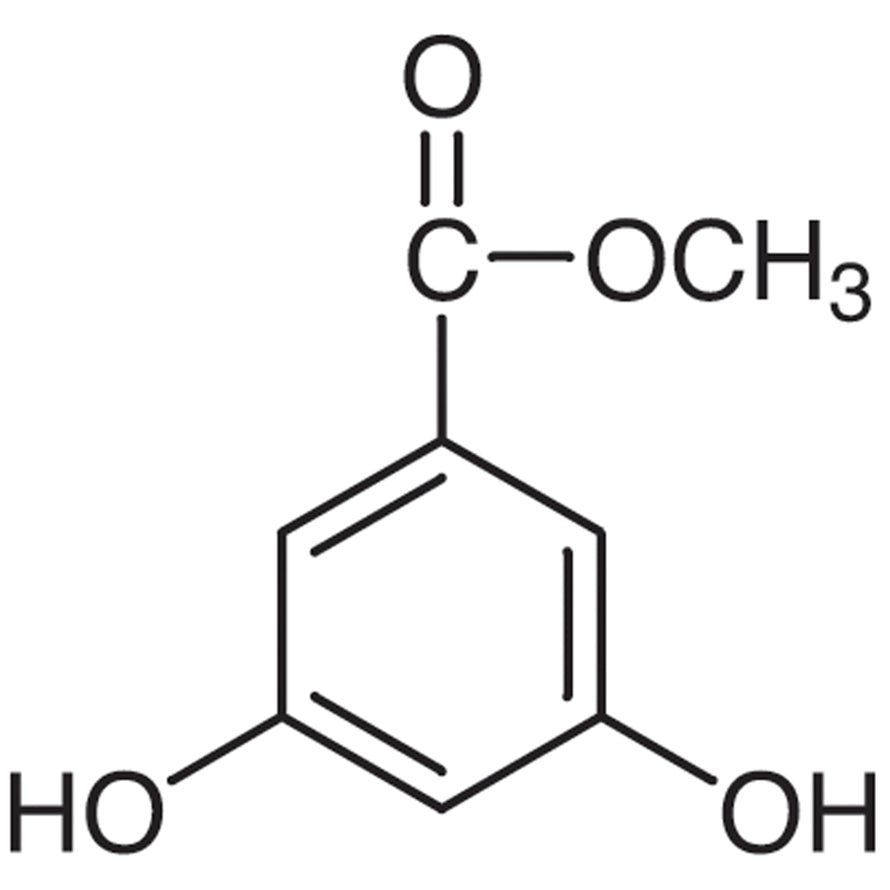
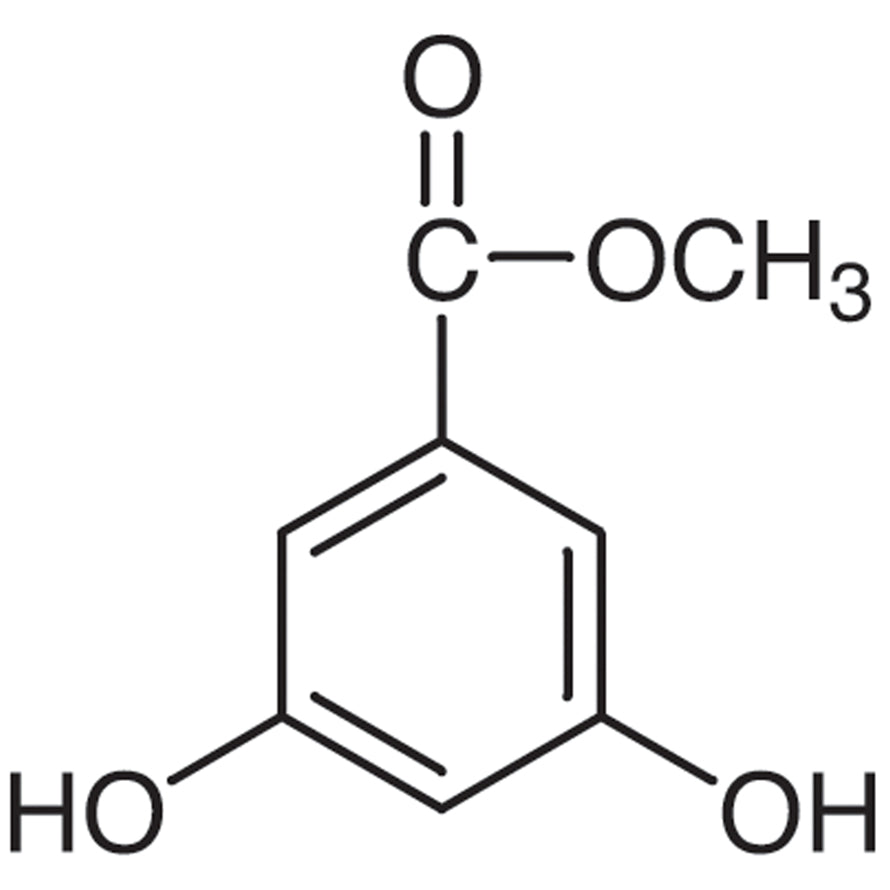
TCI D2215 Methyl 3,5-Dihydroxybenzoate is a benzoic acid derivative carrying a methyl ester group together with two phenolic hydroxyl groups at the 3 and 5 positions of the aromatic ring. This symmetrically arranged combination of three functional groups makes it one of the most versatile intermediates available in the organic synthesis laboratory, because a single molecule supplies two phenolic branching points alongside one ester linking point. The material is widely recognised as a building unit in the construction of branched molecules and supramolecular materials.
The property that makes this compound so highly valued is its AB₂ branching pattern. Both hydroxyl groups can be alkylated or acylated simultaneously to grow two new branches, while the ester group can be hydrolysed, reduced, or converted into an amide in order to connect the molecule to the next unit in a sequence. For this reason the compound has become a classic starting material for the synthesis of generational dendrimers and fan-shaped molecules. In addition, the phenolic groups provide hydrogen-bonding capability and antioxidant behaviour that are attractive subjects for study, while the symmetrical aromatic ring simplifies the interpretation of spectroscopic data.
In Indonesian laboratories, this material is used extensively across university research groups and institutional synthesis facilities. It supports organic chemistry work in which a reliable, well-defined branching unit is required, and it appears routinely in postgraduate and thesis-level research programmes concerned with the preparation of branched architectures, functional organic materials, and derivatives built from phenolic aromatic cores. Its predictable reactivity makes it equally suitable for teaching-oriented synthesis exercises and for exploratory materials development.
Related TCI products
- Dendrimer synthesis — the AB₂ arrangement allows two branches to be grown per generation from the twin phenolic hydroxyls while the ester serves as the focal connection point.
- Fan-shaped and branched molecule construction — the symmetrical 3,5-substitution pattern directs growth outward in a controlled geometry, giving predictable wedge-shaped molecular architectures.
- Supramolecular materials research — the two phenolic hydroxyl groups act as hydrogen-bond donors, enabling self-assembly studies and the design of non-covalently organised molecular systems.
- Selective functionalisation studies — chemists exploit the difference in reactivity between the phenolic hydroxyls and the methyl ester to perform stepwise alkylation, acylation, hydrolysis, reduction, or amidation.
- Antioxidant and structure–activity investigations — the phenolic groups on the aromatic ring provide antioxidant character worth examining, and the symmetrical core keeps spectroscopic assignment straightforward.
| Brand | TCI (Tokyo Chemical Industry) |
|---|---|
| CAS number | 2150-44-9 |
| Molecular formula | — |
| Purity | — |
| Category | Chemistry > Building Blocks > Non-Heterocyclic Building Blocks |
| Pack sizes | available in standard TCI research and laboratory pack sizes |
| Physical form | — |
| Storage | keep in the original tightly closed container, protected from light and moisture |
- Catalogue Code: D2215
Store the container tightly closed in a cool, dry, and well-ventilated place, away from light, moisture, and incompatible chemicals. The original supplier packaging is the most suitable container; if the material is transferred, use a clean, chemically resistant, tightly sealing container that is clearly labelled with the compound name and CAS number. Handle the solid in a fume hood or well-ventilated area to avoid generating dust, and wear standard laboratory personal protective equipment including safety glasses, gloves, and a laboratory coat. Avoid inhalation and contact with skin and eyes, use clean and dry spatulas when weighing to prevent contamination, and reseal the container immediately after use. Always consult the manufacturer's Safety Data Sheet before handling and follow institutional procedures for chemical waste disposal.
—
Produk Terkait
-
Methyl2,5-Dihydroxybenzoate TCI M2006
Regular price From Rp 1.246.350,00Regular price -
Methyl3,4-Dihydroxybenzoate TCI M1943
Regular price From Rp 1.167.600,00Regular price -
Methyl2,4-Dihydroxybenzoate TCI M1796
Regular price From Rp 557.550,00Regular price -
Methyl2,3-Dihydroxybenzoate TCI M1737
Regular price From Rp 2.757.300,00Regular price -
2,4-Dihydroxybenzoate TCI D2007
Regular price Rp 3.472.350,00Regular price -
Methyl2,6-Dihydroxybenzoate TCI D1461
Regular price From Rp 1.829.100,00Regular price -
Ethyl3,4-Dihydroxybenzoate TCI D0571
Regular price From Rp 689.850,00Regular price -
Ethyl2,5-Dihydroxybenzoate TCI E1559
Regular price Rp 1.829.100,00Regular price