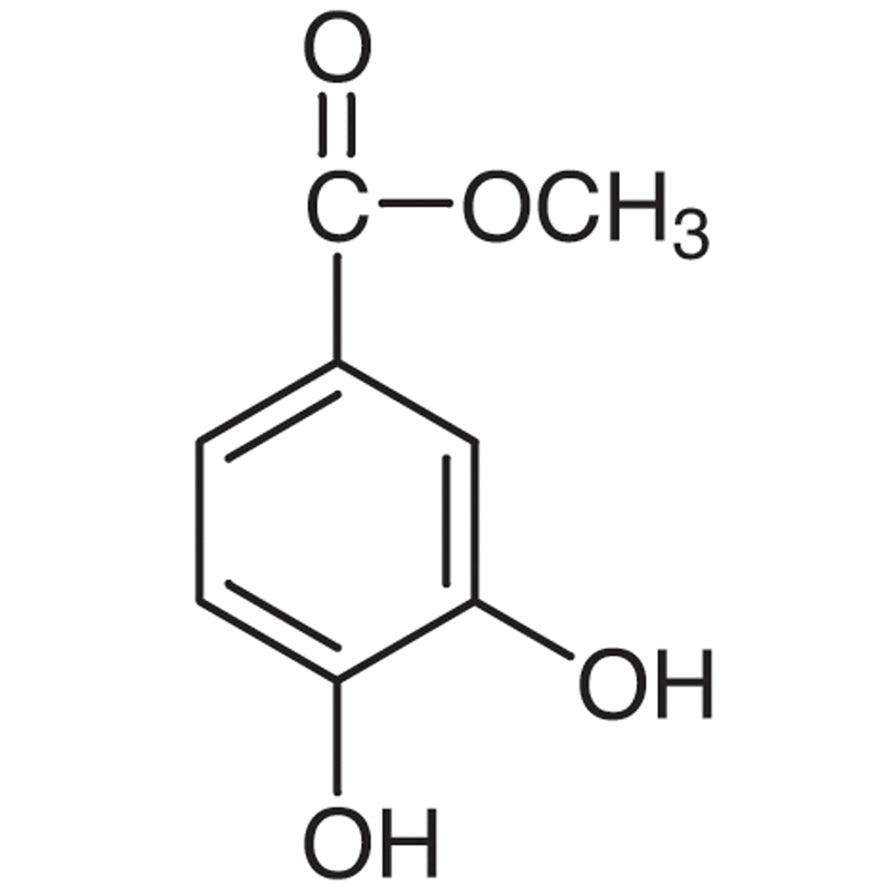
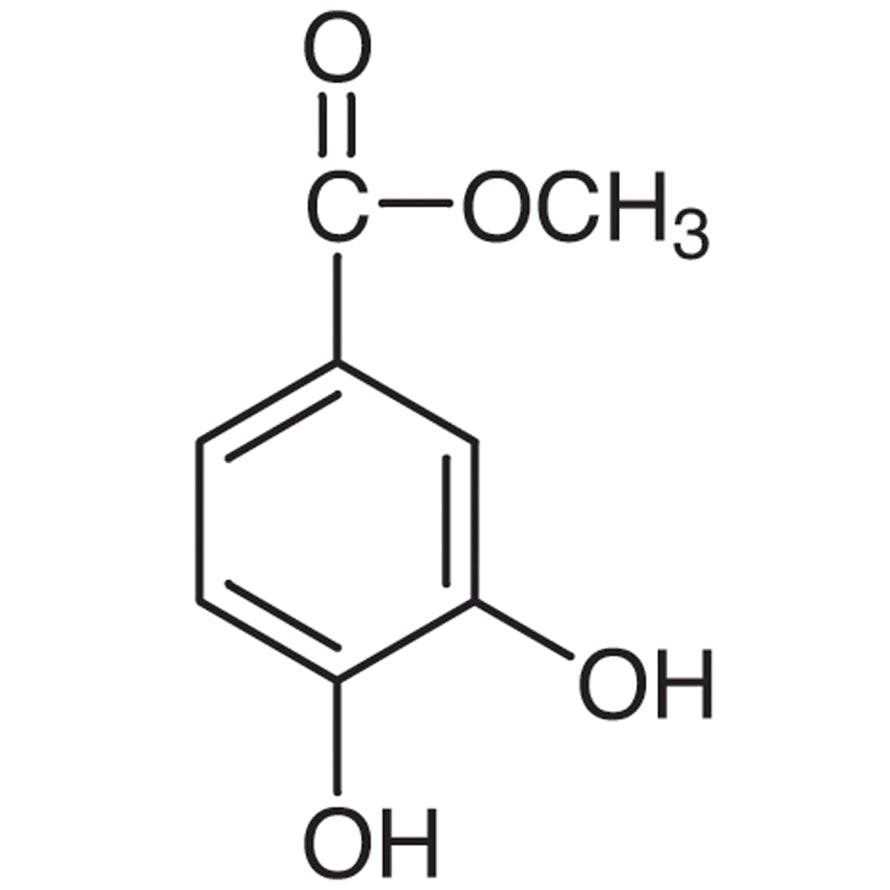
Methyl 3,4-Dihydroxybenzoate, commonly known as methyl protocatechuate, is the methyl ester of 3,4-dihydroxybenzoic acid and carries a catechol group on its aromatic ring. The compound has become a familiar material in both organic chemistry and biochemistry laboratories because it combines a simple polyphenol framework with an ester group that is easy to modify. Its roles include supplying a catechol scaffold for the synthesis of derivative compounds, serving as a test substance in antioxidant studies, and acting as a reagent in cell biology research that examines proline hydroxylation pathways and collagen formation.
The characteristic that makes this material so widely chosen is the pair of adjacent hydroxyl groups that form the catechol motif. This motif is known to be highly effective at donating hydrogen atoms, allowing it to quench free radicals, while at the same time binding transition metal ions through its two neighbouring oxygen atoms. The methyl ester group makes the compound more readily soluble in organic solvents than the free acid, so handling in organic-solvent reactions becomes more practical. The ester also functions as a temporary protecting group for the carboxylate, which can be hydrolysed back at a later stage of a synthetic sequence.
In Indonesian laboratories, this building block is typically found in university organic synthesis groups, natural product chemistry laboratories, and research units working on antioxidant activity and cell biology. It is commonly used at bench scale for method development, derivative preparation, and comparative assay work, where a well-defined catechol reference compound is needed. Research institutions and industrial laboratories also draw on it when developing analytical procedures or preparing intermediates for further study.
Related TCI products
- Catechol scaffold synthesis — the aromatic ring with its adjacent hydroxyl pair provides a ready starting framework for preparing derivative compounds without the need to construct the catechol motif from simpler precursors.
- Antioxidant research — the catechol motif donates hydrogen atoms very effectively and quenches free radicals, making this compound a practical test substance in laboratory studies of antioxidant behaviour and radical scavenging.
- Transition metal coordination studies — the two neighbouring oxygen atoms of the catechol group bind transition metal ions, allowing researchers to examine chelation behaviour and metal-polyphenol interactions under controlled bench conditions.
- Cell biology reagent work — the compound is used as a reagent in biological research that focuses on proline hydroxylation pathways and collagen formation, supporting mechanistic studies in cultured cell systems.
- Protecting group strategies — the methyl ester serves as a temporary protecting group for the carboxylate function and can be hydrolysed back at a later stage, giving synthetic chemists flexibility in multi-step reaction sequences.
| Brand | TCI |
|---|---|
| CAS number | 2150-43-8 |
| Molecular formula | — |
| Purity | — |
| Category | Chemistry > Building Blocks > Non-Heterocyclic Building Blocks |
| Pack sizes | available in standard TCI research pack sizes; please confirm the currently listed option when ordering |
| Physical form | — |
| Storage | store in a tightly closed container, protected from light, in a cool and dry place |
- Catalogue code: M1943
Store this material in its original tightly closed container in a cool, dry area away from direct sunlight, as catechol-bearing compounds are sensitive to light and to prolonged contact with air. Amber glass bottles or the supplier's original packaging are suitable containers, and the cap should be replaced immediately after each use. Handle the compound in a well-ventilated area or a fume hood, wearing a laboratory coat, safety glasses, and chemical-resistant gloves. Use clean, dry spatulas to prevent contamination and moisture uptake, keep the material away from strong oxidising agents and sources of heat, and consult the manufacturer's safety data sheet before first use.
—
Produk Terkait
-
Methyl2,5-Dihydroxybenzoate TCI M2006
Regular price From Rp 1.246.350,00Regular price -
Methyl2,4-Dihydroxybenzoate TCI M1796
Regular price From Rp 557.550,00Regular price -
Methyl2,3-Dihydroxybenzoate TCI M1737
Regular price From Rp 2.757.300,00Regular price -
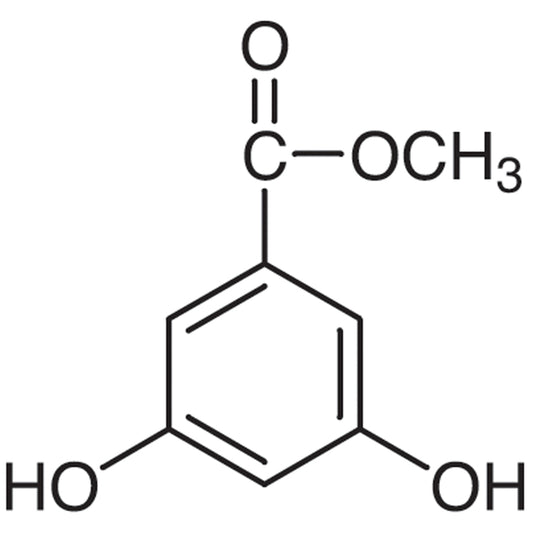
Methyl3,5-Dihydroxybenzoate TCI D2215
Regular price Rp 2.121.000,00Regular price -
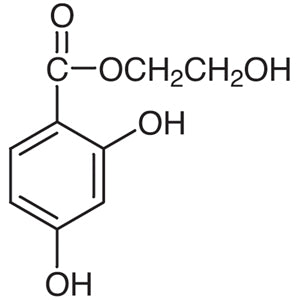
2,4-Dihydroxybenzoate TCI D2007
Regular price Rp 3.472.350,00Regular price -
Methyl2,6-Dihydroxybenzoate TCI D1461
Regular price From Rp 1.829.100,00Regular price -
Ethyl3,4-Dihydroxybenzoate TCI D0571
Regular price From Rp 689.850,00Regular price -
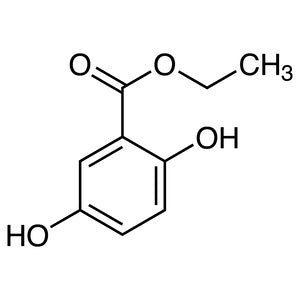
Ethyl2,5-Dihydroxybenzoate TCI E1559
Regular price Rp 1.829.100,00Regular price