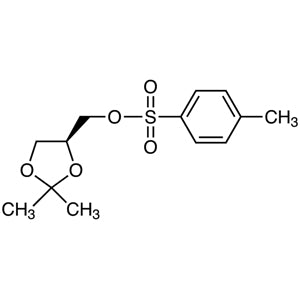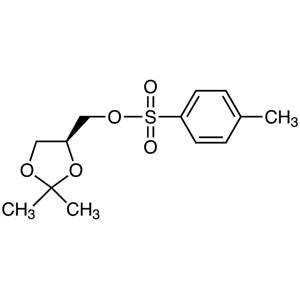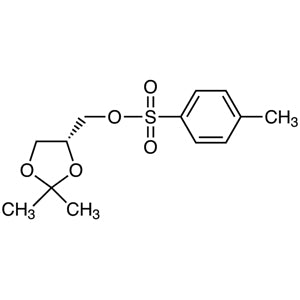
(R)-(-)-2,2-Dimethyl-1,3-dioxolan-4-ylmethyl p-Toluenesulfonate is a chiral compound widely used in asymmetric synthesis to construct molecules with optical activity. This reagent plays a crucial role in organic chemistry laboratories, where precise control over molecular configuration is essential. Its chiral nature allows for the selective formation of specific enantiomers, making it a valuable tool in the development of bioactive compounds and pharmaceuticals. As a key intermediate in complex synthetic pathways, it supports the creation of compounds with defined stereochemistry, which is critical in drug discovery and development.
The compound’s unique structure enables it to act as an activator in certain chemical reactions, enhancing reaction efficiency and selectivity. Its ability to form stable complexes with various functional groups further expands its utility in synthetic chemistry. These properties make it a preferred choice for researchers aiming to achieve high stereocontrol in their synthetic processes. The compound’s reliability and consistency in performance are key factors in its widespread use across academic and industrial research settings.
In Indonesian laboratories, this compound is commonly used in organic chemistry, pharmacology, and biochemical research. Its application is particularly relevant in institutions focused on drug development and molecular structure analysis. Researchers in Indonesia rely on this compound to advance their studies in asymmetric synthesis, contributing to the growth of scientific innovation in the region.
TCI brochures (PDF)
- Chiral Building Blocks 2025-04-14 · p. 15
Related TCI products
- TCI D2550 23735-43-5 (S)-(+)-2,2-Dimethyl-1,3-dioxolan-4-ylmethyl p-Toluenesulfonate
- TCI T1612 70987-78-9 (2S)-(+)-Glycidyl p-Toluenesulfonate
- TCI T1611 113826-06-5 (2R)-(-)-Glycidyl p-Toluenesulfonate
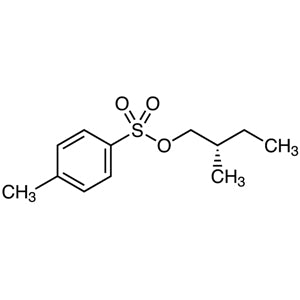
- TCI T1595 38261-81-3 (S)-2-Methylbutyl p-Toluenesulfonate
- TCI T2718 115754-62-6 Tributyl(1,3-dioxolan-2-ylmethyl)phosphonium Bromide
- TCI E1417 6290-17-1 Ethyl 2-(2,4-Dimethyl-1,3-dioxolan-2-yl)acetate (mixture of diastereoisomers)
- Asymmetric synthesis is a key application where this compound enables precise control over enantiomer formation, crucial for pharmaceutical development.
- Organic chemistry research benefits from its role as a chiral building block, supporting the synthesis of complex molecules with defined stereochemistry.
- Pharmacological studies utilize it to develop bioactive compounds, as its chiral nature is essential for creating drug molecules with specific biological activity.
- Biochemical research employs it to study molecular interactions and enzyme mechanisms, leveraging its optical activity for structural analysis.
- Academic institutions use it in teaching and research to train students in advanced synthetic techniques and stereochemical control.
| Brand | TCI |
|---|---|
| CAS number | 23788-74-1 |
| Molecular formula | — |
| Purity | — |
| Category | Chemistry > Asymmetric Synthesis > Chiral Building Blocks |
| Pack sizes | Available in various quantities as per supplier specifications |
| Physical form | Solid (as per standard chemical properties) |
| Storage | Store in a cool, dry place away from light and moisture |
This compound should be stored in a cool, dry environment, away from direct sunlight and moisture to maintain its chemical integrity. It is recommended to use airtight containers made of glass or high-density polyethylene to prevent contamination and degradation. Due to its chiral nature, it is important to handle it with care to avoid any unintended racemization or loss of optical purity. In laboratory settings, it should be kept in a designated chemical storage cabinet, ensuring safe access and proper labeling. Always use appropriate personal protective equipment, such as gloves and safety goggles, when handling this compound to ensure laboratory safety.
—
Produk Terkait
-
(S)-(+)-2,2-Dimethyl-1,3-dioxolan-4-ylmethylp-Toluenesulfonate TCI D2550
Regular price From Rp 3.446.100,00Regular price -
(2S)-(+)-Glycidylp-Toluenesulfonate TCI T1612
Regular price From Rp 1.220.100,00Regular price -
(2R)-(-)-Glycidylp-Toluenesulfonate TCI T1611
Regular price Rp 1.644.300,00Regular price -
(S)-2-Methylbutylp-Toluenesulfonate TCI T1595
Regular price From Rp 1.458.450,00Regular price -
Tributyl(1,3-dioxolan-2-ylmethyl)phosphoniumBromide TCI T2718
Regular price Rp 4.081.350,00Regular price -
Ethyl2-(2,4-Dimethyl-1,3-dioxolan-2-yl)acetate(mixtureofdiastereoisomers) TCI E1417
Regular price From Rp 610.050,00Regular price -
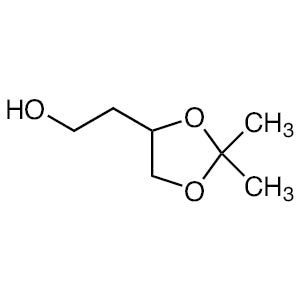
2-(2,2-Dimethyl-1,3-dioxolan-4-yl)ethan-1-ol TCI D5914
Regular price From Rp 1.803.900,00Regular price -
DimethylD-(-)-Tartrate TCI T1659
Regular price From Rp 584.850,00Regular price