

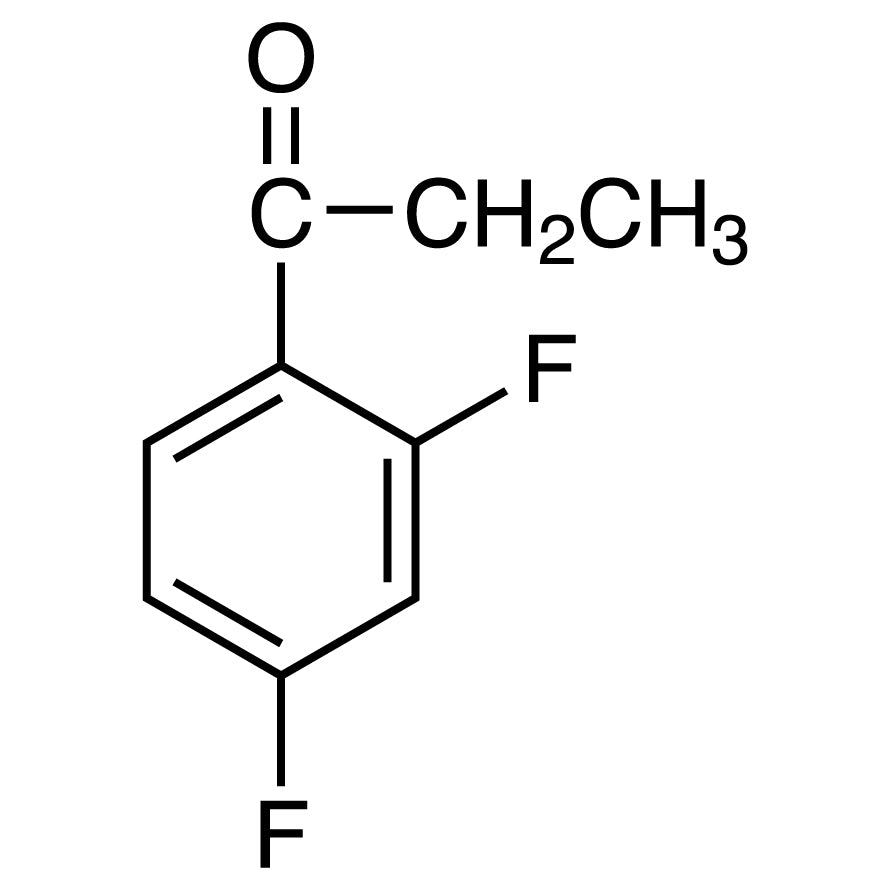
2',4'-Difluoropropiophenone is an organic fluorinated compound widely used as a building block in the synthesis of complex molecules. This versatile reagent plays a crucial role in organic chemistry laboratories, where it serves as a key intermediate in various synthetic pathways. Its unique chemical structure, featuring two fluorine atoms positioned on the propionophenone backbone, allows for precise functionalization and modification of target molecules. Due to its reactivity and compatibility with a range of chemical environments, it is a preferred choice for researchers aiming to develop new compounds with specific properties.
The compound’s high polarity, derived from the presence of fluorine atoms, makes it ideal for applications requiring controlled reactivity and solubility. Its stability under certain conditions ensures reliable performance in laboratory settings, while its non-volatile nature simplifies handling and storage. These characteristics make it a valuable tool for chemists working on advanced synthetic projects. Additionally, its ability to participate in substitution and bond-forming reactions enhances its utility in diverse chemical processes.
In Indonesian laboratories, 2',4'-Difluoropropiophenone is commonly used in research focused on organic synthesis, particularly in the development of complex molecules and functional materials. Its application spans across academic and industrial research, supporting advancements in chemical innovation. The compound is especially favored for its precision in creating compounds with tailored properties, making it an essential component in modern chemical laboratories.
TCI brochures (PDF)
- Fluorination Reagents, Fluorinated Building Blocks 2026-03-18 · p. 30
- Organic synthesis of complex molecules where precise functionalization is required due to its reactivity and fluorine content.
- Development of functional materials with controlled properties as it offers high polarity and solubility in various solvents.
- Research in pharmaceutical chemistry for the creation of drug candidates with specific reactivity and solubility profiles.
- Academic studies in fluorinated chemistry for understanding reaction mechanisms and molecular behavior.
- Industrial applications in chemical manufacturing where stability and controlled reactivity are critical for process efficiency.
| Brand | TCI |
|---|---|
| CAS number | 85068-30-0 |
| Molecular formula | — |
| Purity | — |
| Category | Chemistry > Building Blocks > Fluorinated Building Blocks |
| Pack sizes | 30 g |
| Physical form | Solid |
| Storage | Store in a cool, dry place away from light and moisture |
This compound should be stored in a cool, dry environment, away from direct sunlight and moisture to maintain its stability and prevent degradation. It is recommended to use airtight containers made of glass or high-density polyethylene to ensure containment and minimize exposure to air and humidity. Due to its polar nature, it is advisable to handle it with appropriate personal protective equipment, such as gloves and safety goggles, to ensure safe laboratory practices. The compound is non-volatile, which simplifies handling and reduces the risk of evaporation during storage. Proper labeling and storage conditions are essential to maintain its integrity and ensure safe usage in laboratory environments.
—
Produk Terkait
-
2,3,6-Trifluorophenol TCI T3129
Regular price From Rp 955.500,00Regular price -
2,4,5-TrifluorophenylaceticAcid TCI T2407
Regular price Rp 1.193.850,00Regular price -
3,4,5-Trifluorophenol TCI T2299
Regular price From Rp 1.220.100,00Regular price -
2,3,4-Trifluorophenol TCI T1616
Regular price From Rp 875.700,00Regular price -
5-Bromo-2,3-difluorophenol TCI B4490
Regular price From Rp 769.650,00Regular price -
2-Bromo-4,5-difluorophenol TCI B3845
Regular price From Rp 584.850,00Regular price -
2-Bromo-4,6-difluorophenol TCI B3004
Regular price From Rp 795.900,00Regular price -
Methyl3,3,3-Trifluoropropionate TCI M2783
Regular price From Rp 2.227.050,00Regular price


