

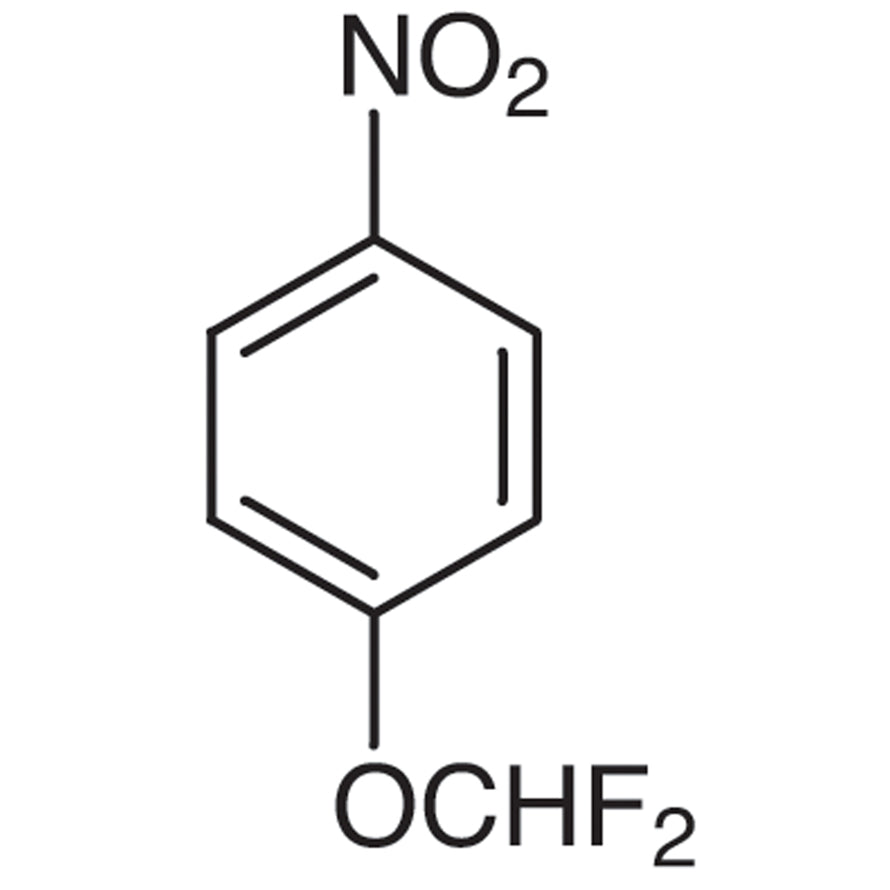
TCI D2601 4-(Difluoromethoxy)nitrobenzene is an aromatic compound that combines a nitro group and a difluoromethoxy group in a para relationship to one another on the benzene ring. This arrangement makes it a highly useful starting material in organic synthesis laboratories, particularly when researchers need a benzene scaffold that already carries an OCF2H group from the earliest stage of a route. The difluoromethoxy group is itself a motif of considerable interest in modern medicinal chemistry and agrochemical research, so this compound frequently serves as a practical entry point compared with installing the group through direct fluorination reactions that demand specialised handling.
The characteristic that leads chemists to select this compound is the complementary behaviour of its two functional groups. The nitro group is a strong electron-withdrawing substituent, activating the ring toward nucleophilic aromatic substitution while simultaneously acting as an amine precursor that can be reduced in a controlled manner to a substituted aniline. The difluoromethoxy group, in turn, contributes a distinctive lipophilicity together with relative stability across many reaction conditions, so it remains intact while the nitro group is transformed. The clearly defined para pattern also removes ambiguity about regiochemistry, giving a predictable substitution outcome in subsequent steps.
In Indonesian laboratories, this building block is typically used in university and institutional research groups working on organic synthesis, medicinal chemistry, and agrochemical discovery, where fluorinated intermediates are required but local preparation would be impractical. It is normally handled at bench scale in fume-hood work, supporting method development, route scouting, and the preparation of small quantities of downstream intermediates rather than production-scale manufacture.
TCI brochures (PDF)
- Difluoromethylated Compounds 2025-05-01 · p. 1
- Fluorination Reagents, Fluorinated Building Blocks 2026-03-18 · p. 37
Related TCI products
- TCI D4956 3447-53-8 4-(Difluoromethoxy)benzyl Bromide
- TCI D4955 90446-25-6 4-(Difluoromethoxy)benzonitrile
- TCI D4914 458-92-4 (Difluoromethoxy)benzene
- TCI D4837 71653-64-0 2-(Difluoromethoxy)benzaldehyde
- TCI D4778 874781-09-6 4-(Difluoromethoxy)benzenesulfonamide
- TCI D4762 4837-20-1 4-(Difluoromethoxy)benzoic Acid
- Fluorinated building block synthesis: the compound delivers a ready-made OCF2H-bearing benzene ring, sparing researchers the specialised equipment and handling that direct fluorination chemistry would otherwise require.
- Nucleophilic aromatic substitution studies: the strongly electron-withdrawing para nitro group activates the aromatic ring, allowing nucleophiles to displace ring substituents under conditions that are convenient to run at the bench.
- Preparation of substituted anilines: controlled reduction of the nitro group converts the material into the corresponding aniline while the difluoromethoxy group remains intact for further elaboration.
- Medicinal chemistry route scouting: because the difluoromethoxy motif appears widely in drug discovery programmes, this compound gives synthetic chemists a convenient entry point into analogue series.
- Agrochemical research intermediates: the combination of a defined para substitution pattern and characteristic lipophilicity supports the preparation of candidate structures explored in modern crop protection chemistry.
| Brand | TCI |
|---|---|
| CAS number | 1544-86-1 |
| Molecular formula | — |
| Purity | — |
| Category | Chemistry > Building Blocks > Fluorinated Building Blocks |
| Pack sizes | available in the pack sizes listed on this product page |
| Physical form | — |
| Storage | store according to the conditions stated on the manufacturer's label and safety data sheet |
- Chemical name: 4-(Difluoromethoxy)nitrobenzene
- Catalogue code: D2601
Store the container tightly closed in a cool, dry, well-ventilated area away from direct sunlight, ignition sources, and incompatible materials, following the conditions given on the manufacturer's label and safety data sheet. Keep the material in its original supplier container, or in a chemically compatible, clearly labelled vessel if transferred. All handling, weighing, and transfer operations should be carried out inside a working fume hood by trained personnel wearing appropriate personal protective equipment, including safety glasses, gloves, and a laboratory coat. Avoid inhalation of vapours and contact with skin and eyes, close containers immediately after use to limit exposure to air and moisture, and dispose of residues and contaminated materials as chemical waste in line with institutional procedures.
—
Produk Terkait
-
4-(Difluoromethoxy)benzylBromide TCI D4956
Regular price From Rp 1.538.250,00Regular price -
4-(Difluoromethoxy)benzonitrile TCI D4955
Regular price From Rp 1.035.300,00Regular price -
(Difluoromethoxy)benzene TCI D4914
Regular price From Rp 1.035.300,00Regular price -
2-(Difluoromethoxy)benzaldehyde TCI D4837
Regular price From Rp 795.900,00Regular price -
4-(Difluoromethoxy)benzenesulfonamide TCI D4778
Regular price From Rp 1.696.800,00Regular price -
4-(Difluoromethoxy)benzoicAcid TCI D4762
Regular price From Rp 823.200,00Regular price -
4'-(Difluoromethoxy)acetophenone TCI D4760
Regular price From Rp 1.749.300,00Regular price -
4-(Difluoromethoxy)benzaldehyde TCI D4334
Regular price From Rp 477.750,00Regular price


