

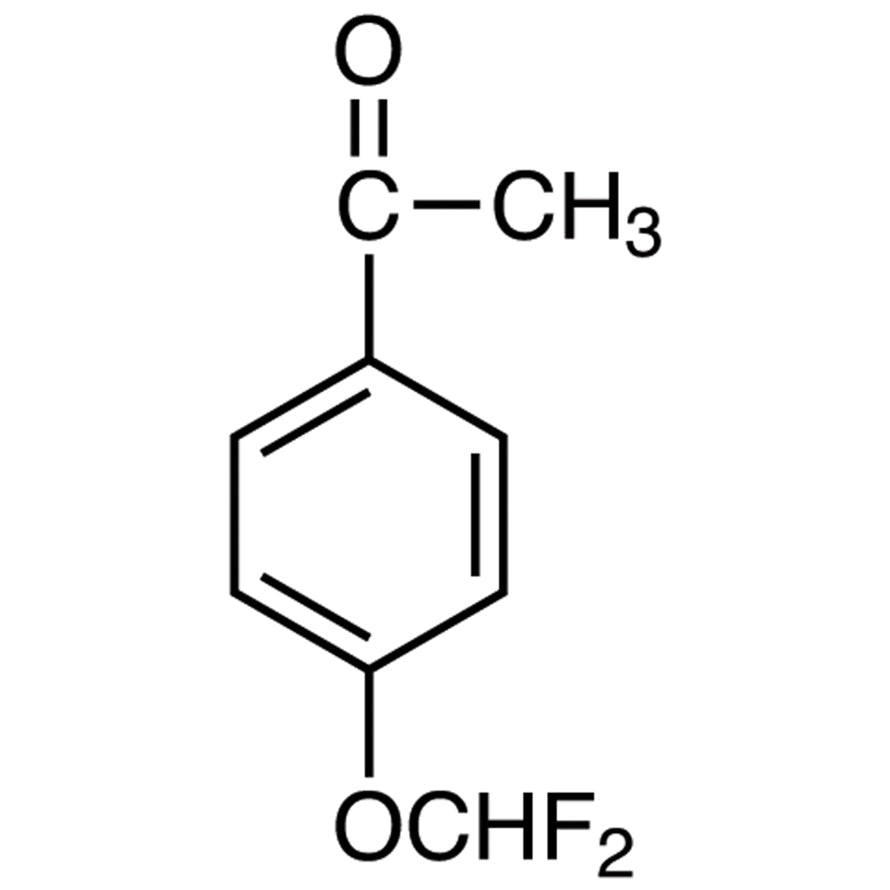
TCI D4760 4'-(Difluoromethoxy)acetophenone is a substituted acetophenone that carries a difluoromethoxy group at the para position of the benzene ring. In the laboratory it serves as a fluorinated building block, meaning a starting material that already bears a fluorine motif, so researchers do not have to perform a fluorination step that normally demands specialised reagents and careful handling. Its methyl ketone group is one of the most productive reaction points in organic chemistry, because it can be directed toward a wide range of new molecular frameworks through condensation, alkylation, reduction, or heterocyclic ring formation.
What makes this compound attractive is that it combines two design elements at once. The difluoromethoxy motif is widely used in medicinal chemistry and agrochemistry because it influences the electronic character, lipophilicity, and metabolic stability of the parent molecule, and it can also act as a weak hydrogen bond donor. The acetyl group at the para position, meanwhile, gives direct access to aldol and Claisen–Schmidt condensations, chalcone formation, and the synthesis of pyrazoles, isoxazoles, and pyrimidines. Because both features are present in a single, ready-to-use structure, a synthetic route can be shortened considerably.
In Indonesian laboratories, this type of fluorinated building block is typically used by university research groups, pharmaceutical and agrochemical development teams, and contract synthesis laboratories working on small-scale exploratory chemistry. It is normally purchased in research quantities for method development, analogue series preparation, and reference material synthesis, rather than for production. Because it removes the need for in-house fluorination, it is particularly valuable in facilities where handling specialised fluorinating reagents would be impractical.
TCI brochures (PDF)
- Difluoromethylated Compounds 2025-05-01 · p. 1
- Fluorination Reagents, Fluorinated Building Blocks 2026-03-18 · p. 37
Related TCI products
- TCI D4956 3447-53-8 4-(Difluoromethoxy)benzyl Bromide
- TCI D4955 90446-25-6 4-(Difluoromethoxy)benzonitrile
- TCI D4914 458-92-4 (Difluoromethoxy)benzene
- TCI D4837 71653-64-0 2-(Difluoromethoxy)benzaldehyde
- TCI D4778 874781-09-6 4-(Difluoromethoxy)benzenesulfonamide
- TCI D4762 4837-20-1 4-(Difluoromethoxy)benzoic Acid
- Fluorinated building block supply — provides a ready difluoromethoxy motif so that the research team can skip a fluorination step that would otherwise require specialised reagents and careful handling.
- Chalcone synthesis via Claisen–Schmidt condensation — the reactive methyl ketone couples readily with aromatic aldehydes, giving fluorinated chalcone scaffolds for further cyclisation and structure–activity work.
- Heterocycle construction — the acetyl group serves as a starting point for building pyrazole, isoxazole, and pyrimidine rings, all of which are common cores in medicinal chemistry programmes.
- Medicinal chemistry analogue preparation — the difluoromethoxy substituent modifies electronic character, lipophilicity, and metabolic stability, making it useful when a compound series must be tuned systematically.
- Agrochemical research intermediates — the same fluorine motif is widely applied in agrochemical discovery, so this material supports exploratory synthesis of new candidate structures at laboratory scale.
| Brand | TCI (Tokyo Chemical Industry) |
|---|---|
| CAS number | 83882-67-1 |
| Molecular formula | — |
| Purity | — |
| Category | Chemistry > Building Blocks > Fluorinated Building Blocks |
| Pack sizes | please refer to the manufacturer's current catalogue listing for this catalogue code |
| Physical form | — |
| Storage | keep the container tightly closed in a cool, dry place away from light and ignition sources |
- Chemical name: 4'-(Difluoromethoxy)acetophenone
- Catalogue code: D4760
Store the container tightly closed in a cool, dry, and well-ventilated area, away from direct sunlight, heat, and sources of ignition, and keep it separated from strong oxidising agents. Use the original manufacturer's container wherever possible, or transfer only to chemically compatible, clearly labelled vessels with a secure closure. Handle the material inside a fume hood, wearing safety glasses, chemically resistant gloves, and a laboratory coat, and avoid inhalation of vapours or contact with skin and eyes. Reseal the container promptly after weighing to limit exposure to moisture and air. Always consult the manufacturer's Safety Data Sheet before first use, and follow institutional procedures for chemical waste collection and disposal.
—
Produk Terkait
-
4-(Difluoromethoxy)benzylBromide TCI D4956
Regular price From Rp 1.538.250,00Regular price -
4-(Difluoromethoxy)benzonitrile TCI D4955
Regular price From Rp 1.035.300,00Regular price -
(Difluoromethoxy)benzene TCI D4914
Regular price From Rp 1.035.300,00Regular price -
2-(Difluoromethoxy)benzaldehyde TCI D4837
Regular price From Rp 795.900,00Regular price -
4-(Difluoromethoxy)benzenesulfonamide TCI D4778
Regular price From Rp 1.696.800,00Regular price -
4-(Difluoromethoxy)benzoicAcid TCI D4762
Regular price From Rp 823.200,00Regular price -
4-(Difluoromethoxy)benzaldehyde TCI D4334
Regular price From Rp 477.750,00Regular price -
4-(Difluoromethoxy)nitrobenzene TCI D2601
Regular price Rp 903.000,00Regular price


