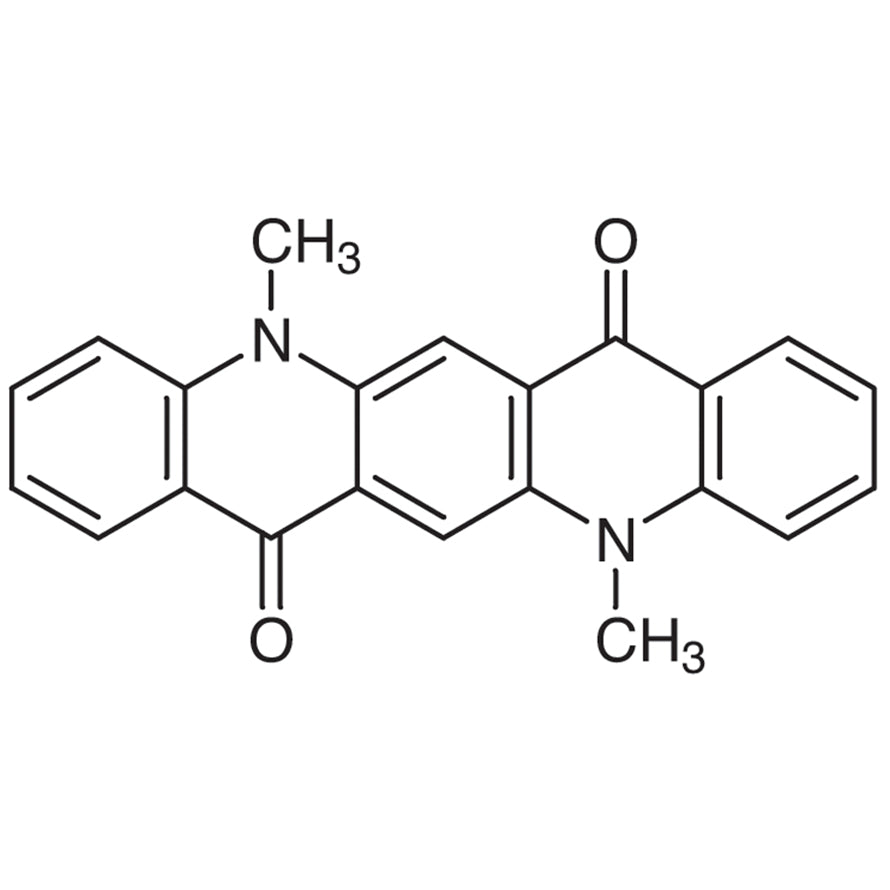
N,N’-Dimethylquinacridone (purified by sublimation), with CAS number 19205-19-7, is an organic compound widely used in optoelectronic material research, particularly in the development of Organic Light-Emitting Diode (OLED) materials. This compound plays a crucial role in laboratories where researchers are focused on creating advanced display technologies and light-emitting devices. Its unique chemical structure allows it to emit light within specific spectral ranges, making it a key component in the synthesis of materials with tailored optical properties. Due to its stability and high purity, it is a preferred choice for applications requiring precision and consistency.
The compound’s high chemical stability and purity, achieved through sublimation purification, make it an ideal material for use in sensitive and high-precision experiments. Its ability to maintain structural integrity under various experimental conditions ensures reliable results in material synthesis and characterization. Additionally, its optical properties enable it to function effectively as an active layer in devices that require efficient light emission. These characteristics make it a valuable tool for researchers working on next-generation optoelectronic materials.
In Indonesian laboratories, N,N’-Dimethylquinacridone is commonly used in research related to OLED development, display technologies, and optoelectronic device fabrication. Its application is particularly prevalent in academic and industrial settings where high-quality, stable organic materials are required. The compound is also used in material synthesis processes that demand precise control over chemical and optical properties. Its reliability and performance make it a standard material in many advanced research projects.
Related TCI products
- TCI T2685 435293-93-9 Tris[1-phenylisoquinoline-C2,N]iridium(III) (purified by sublimation)
- TCI T2238 2085-33-8 Tris(8-quinolinolato)aluminum (purified by sublimation)
- TCI T2233 517-51-1 5,6,11,12-Tetraphenylnaphthacene (purified by sublimation)
- TCI T1946 94928-86-6 Tris(2-phenylpyridinato)iridium(III) (purified by sublimation)
- TCI P1629 198-55-0 Perylene (purified by sublimation)
- TCI D2687 19205-19-7 N,N'-Dimethylquinacridone
- OLED Material Development: This compound is essential for creating organic light-emitting diodes due to its ability to emit light in specific wavelengths, making it ideal for display technologies.
- Optoelectronic Device Fabrication: It serves as a key component in the production of devices that require efficient light emission and stable optical properties.
- Material Synthesis Research: Its chemical stability and high purity make it a preferred choice for synthesizing advanced organic materials with tailored properties.
- Spectroscopy Studies: The compound’s unique optical characteristics are useful in spectroscopic analysis to study light emission behavior and material performance.
- Display Technology Innovation: It is used in the development of next-generation display technologies, including flexible and high-resolution screens.
| Brand | TCI |
|---|---|
| CAS number | 19205-19-7 |
| Molecular formula | — |
| Purity | — |
| Category | Materials Science > Electronic Materials > Organic Light-Emitting Diode (OLED) Materials |
| Pack sizes | Available in standard laboratory quantities as specified by the supplier |
| Physical form | Solid, with high purity achieved through sublimation purification |
| Storage | — |
This compound should be stored in a cool, dry, and well-ventilated area away from direct sunlight and sources of heat. It is recommended to use airtight containers made of glass or high-density polyethylene to prevent contamination and maintain its purity. Due to its chemical stability, it does not require refrigeration but should be protected from moisture and potential reactive substances. In laboratory settings, it is important to handle the compound with appropriate personal protective equipment to ensure safety during use and storage. Proper labeling and storage conditions are essential to maintain its integrity and effectiveness in research applications.
—
Product Categories
- Electronic MaterialsOrganic Light-Emitting Diode (OLED) MaterialsLight Emitters and Dopants [Organic Light-Emitting Diode (OLED) Materials]
- High Purity CompoundsCompounds Purified by SublimationOrganic Semiconductors [Compounds Purified by Sublimation]
- Photonic Materials and Optical MaterialsQuinacridone Dyes
Produk Terkait
-
Tris[1-phenylisoquinoline-C2,N]iridium(III)(purifiedbysublimation) TCI T2685
Regular price Rp 10.733.100,00Regular price -
Tris(8-quinolinolato)aluminum(purifiedbysublimation) TCI T2238
Regular price Rp 5.407.500,00Regular price -
5,6,11,12-Tetraphenylnaphthacene(purifiedbysublimation) TCI T2233
Regular price From Rp 2.279.550,00Regular price -
Tris(2-phenylpyridinato)iridium(III)(purifiedbysublimation) TCI T1946
Regular price Rp 8.187.900,00Regular price -
Perylene(purifiedbysublimation) TCI P1629
Regular price Rp 2.359.350,00Regular price -
N,N'-Dimethylquinacridone TCI D2687
Regular price From Rp 1.881.600,00Regular price -
N,N,N',N'-Tetraphenylbenzidine(purifiedbysublimation) TCI T3266
Regular price From Rp 2.121.000,00Regular price -
N,N,N',N'-Tetrakis(p-tolyl)benzidine(purifiedbysublimation) TCI T3265
Regular price Rp 2.094.750,00Regular price
![435293-93-9 Tris[1-phenylisoquinoline-C2,N]iridium(III) (purified by sublimation) - AMI Scientific](http://amiscientific.com/cdn/shop/files/TCI2510T2685.jpg?v=1767143248&width=533)