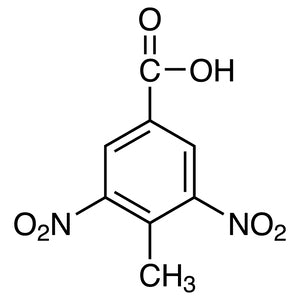
4-Methyl-3,5-dinitrobenzoic Acid is a chemical compound widely used in laboratory settings for the synthesis of complex organic molecules. It serves as a key building block in chemical reactions, particularly in the development of aromatic and heterocyclic compounds. This compound is valued for its ability to participate in various synthetic pathways, making it an essential reagent in organic chemistry research. Its versatility allows it to be incorporated into a range of experimental designs, supporting both academic and industrial research efforts.
The compound is known for its chemical stability, which ensures consistent performance in laboratory applications. However, its nitro groups contribute to high reactivity, requiring careful handling. This reactivity makes it suitable for reactions that demand precise control and high efficiency. Additionally, its solubility in organic solvents facilitates easy processing and isolation, simplifying laboratory workflows. These properties make it a reliable choice for researchers aiming to achieve accurate and reproducible results.
In Indonesian laboratories, 4-Methyl-3,5-dinitrobenzoic Acid is commonly used in organic synthesis and chemical reactivity studies. It is a preferred material for students and researchers in higher education institutions and research organizations. Its role in producing complex compounds supports both fundamental research and applied studies, contributing to advancements in chemical science.
- Organic Synthesis: This compound is ideal for synthesizing aromatic and heterocyclic compounds due to its reactivity and structural versatility.
- Chemical Reactivity Studies: It is used to investigate the behavior of nitro groups in various reaction conditions, providing insights into chemical mechanisms.
- Research and Development: Its application supports the development of new compounds and materials in both academic and industrial settings.
- Analytical Chemistry: It serves as a reference standard for analytical techniques such as spectroscopy and chromatography.
- Educational Purposes: It is frequently used in teaching laboratories to demonstrate synthetic methods and chemical reactivity principles.
| Brand | TCI |
|---|---|
| CAS number | 16533-71-4 |
| Molecular formula | — |
| Purity | — |
| Category | Chemistry > Building Blocks > Non-Heterocyclic Building Blocks |
| Pack sizes | Available in various quantities as per supplier specifications |
| Physical form | Solid |
| Storage | Store in a cool, dry place away from direct sunlight and incompatible materials |
This compound should be stored in a cool, dry environment to maintain its stability and prevent degradation. It is recommended to use airtight containers to minimize exposure to moisture and air, which could affect its reactivity. Due to its high reactivity, it should be handled in a well-ventilated area with appropriate personal protective equipment. Avoid contact with incompatible substances such as strong reducing agents. Proper labeling and storage conditions are essential to ensure safety and maintain the integrity of the compound during laboratory use.
—
Produk Terkait
-
3,5-DinitrobenzoicAcid TCI D0824
Regular price From Rp 557.550,00Regular price -
3,4-DinitrobenzoicAcid TCI D0823
Regular price From Rp 1.298.850,00Regular price -
4-Chloro-3,5-dinitrobenzoicAcid TCI C0607
Regular price From Rp 1.326.150,00Regular price -
2,4-Dinitrobenzaldehyde TCI D6153
Regular price From Rp 1.193.850,00Regular price -
3,4'-Dinitrobenzophenone TCI D2551
Regular price From Rp 1.458.450,00Regular price -
3,3'-Dinitrobenzophenone TCI D1688
Regular price From Rp 6.440.700,00Regular price -
1,2-Dimethoxy-4,5-dinitrobenzene TCI D6509
Regular price Rp 4.771.200,00Regular price -
1,5-Dichloro-2,4-dinitrobenzene TCI D4205
Regular price Rp 2.094.750,00Regular price