

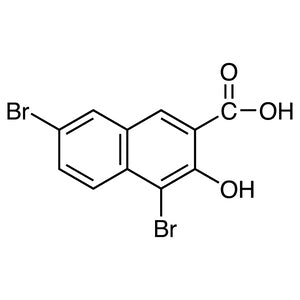
TCI D3646 4,7-Dibromo-3-hydroxy-2-naphthoic Acid is a non-heterocyclic building block based on a naphthalene framework that carries a hydroxyl group, a carboxylic acid group at the adjacent position, and two bromine atoms. The 3-hydroxy-2-naphthoic acid skeleton is itself a classic motif in dye and pigment chemistry, and the presence of two bromine substituents enriches the range of possible downstream transformations. In the laboratory, this compound serves as a starting material for preparing naphthol amides, esters, and azo compounds, and also as a substrate for cross-coupling reactions, because the carbon–bromine bonds on the aromatic ring are readily activated by transition metal catalysts.
The properties that make this material a preferred choice are the combination of hydroxyl and carboxyl groups positioned close together on an extended aromatic system. That proximity allows intramolecular hydrogen bonding, supports the formation of stable metal complexes, and produces a conjugated system with light-absorption characteristics that are of interest in chromophore research. The bromine atoms contribute two roles at once: they increase the molecular weight and polarizability of the molecule, which influences the colour and crystallinity of the product, while simultaneously acting as synthetic handles for coupling reactions.
In Indonesian laboratories, a building block of this type is typically used in academic and industrial research settings where organic synthesis is carried out on a preparative scale. It is commonly found in university research groups working on dye and pigment chemistry, in synthesis laboratories developing new aromatic compounds, and in R&D units that require well-defined starting materials for multi-step routes. Because it is supplied as a catalogue chemical from TCI, it fits workflows where consistent, documented starting materials are required.
Related TCI products
- TCI B3229 2208-15-3 4-Bromo-3-hydroxy-2-naphthoic Acid
- TCI B3180 1779-11-9 7-Bromo-3-hydroxy-2-naphthoic Acid
- TCI H0886 2437-17-4 6-Hydroxy-1-naphthoic Acid
- TCI H0783 6704-40-1 3-Hydroxy-2-naphthoic Acid 2-Chloroanilide
- TCI H0707 143355-56-0 3-Hydroxy-7-methoxy-2-naphthoic Acid
- TCI H0612 16712-64-4 6-Hydroxy-2-naphthoic Acid
- Naphthol amide synthesis: the adjacent hydroxyl and carboxylic acid groups allow the acid function to be converted into amide derivatives while the naphthol core is retained.
- Ester preparation: the carboxylic acid group provides a direct point for esterification, giving access to derivatives built on the same brominated naphthalene framework.
- Azo compound chemistry: the 3-hydroxy-2-naphthoic acid motif is a classic coupling component in dye chemistry, making this material suitable for preparing azo structures.
- Transition metal catalysed cross-coupling: the two aromatic carbon–bromine bonds are readily activated by transition metal catalysts and act as synthetic handles for further ring functionalisation.
- Chromophore and metal complex research: the extended conjugated system and the neighbouring hydroxyl and carboxyl groups support intramolecular hydrogen bonding and the formation of stable metal complexes.
| Brand | TCI |
|---|---|
| CAS number | 1779-10-8 |
| Molecular formula | — |
| Purity | — |
| Category | Chemistry > Building Blocks > Non-Heterocyclic Building Blocks |
| Pack sizes | please refer to the available catalogue pack options for this item |
| Physical form | — |
| Storage | store according to the manufacturer's instructions stated on the product label and Safety Data Sheet |
- Chemical name: 4,7-Dibromo-3-hydroxy-2-naphthoic Acid
- Catalogue code: D3646
Store the material in its original tightly closed container, kept in a cool, dry, and well ventilated area away from direct sunlight, heat sources, and incompatible substances. Amber glass or the supplied original packaging is suitable for keeping the compound protected from light and moisture. Handle the solid inside a fume hood, using a laboratory coat, chemical resistant gloves, and safety goggles, and avoid generating or inhaling dust. Use clean, dry spatulas to prevent contamination between batches, close containers promptly after use, and always consult the manufacturer's Safety Data Sheet before handling, storage, or disposal.
—
Produk Terkait
-
4-Bromo-3-hydroxy-2-naphthoicAcid TCI B3229
Regular price From Rp 2.174.550,00Regular price -
7-Bromo-3-hydroxy-2-naphthoicAcid TCI B3180
Regular price From Rp 769.650,00Regular price -
6-Hydroxy-1-naphthoicAcid TCI H0886
Regular price From Rp 5.750.850,00Regular price -
3-Hydroxy-2-naphthoicAcid2-Chloroanilide TCI H0783
Regular price Rp 3.100.650,00Regular price -
3-Hydroxy-7-methoxy-2-naphthoicAcid TCI H0707
Regular price Rp 1.881.600,00Regular price -
6-Hydroxy-2-naphthoicAcid TCI H0612
Regular price From Rp 477.750,00Regular price -
3-Hydroxy-2-naphthoicAcidHydrazide TCI H0282
Regular price Rp 1.405.950,00Regular price -
3-Hydroxy-2-naphthoicAcid TCI H0281
Regular price From Rp 717.150,00Regular price


