

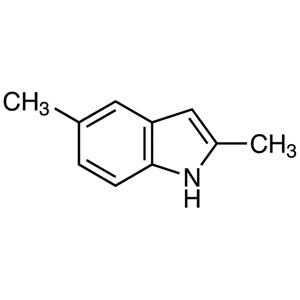
2,5-Dimethylindole is a chemical compound classified under heterocyclic building blocks, known for its indole core with two methyl groups at positions 2 and 5. This compound plays a crucial role in laboratory settings as a fundamental building block for the synthesis of complex molecules. Its structural versatility makes it a valuable resource in organic chemistry and pharmacology research, where it is used to develop compounds with specific biological activities. Due to its reactivity and compatibility with various functional groups, it is widely utilized in both academic and industrial research environments.
The compound's chemical properties, including its reactivity and ability to form stable intermediates, make it a preferred choice for chemists. It is non-colored and solid in form, with a distinct odor that can be detected in the air. These characteristics, combined with its stability under controlled conditions, allow it to be a reliable component in synthetic pathways. Its reactivity also means that it requires careful handling to ensure safe and effective use in laboratory processes.
In Indonesian laboratories, 2,5-Dimethylindole is commonly used in research focused on organic synthesis and drug development. Its availability in small quantities, such as 1g and 5g, facilitates its use in laboratory-scale experiments. Its role in creating compounds with specific biological functions makes it an essential material for both academic and applied research in the region.
- Organic synthesis applications benefit from 2,5-Dimethylindole due to its reactivity and ability to form complex molecular structures, making it ideal for creating diverse chemical compounds.
- Pharmacological research utilizes this compound to develop new drugs, as its structural features can be modified to target specific biological pathways.
- Heterocyclic chemistry studies rely on this material for its role in constructing indole-based frameworks, which are common in natural products and pharmaceuticals.
- Industrial chemical processes incorporate it as a building block for the production of specialty chemicals and intermediates.
- Analytical chemistry laboratories use it as a reference standard for testing and characterizing other compounds with similar structures.
| Brand | TCI |
|---|---|
| CAS number | 1196-79-8 |
| Molecular formula | — |
| Purity | — |
| Category | Chemistry > Building Blocks > Heterocyclic Building Blocks |
| Pack sizes | 1g, 5g |
| Physical form | Solid |
| Storage | Store in a cool, dry place away from light and moisture |
2,5-Dimethylindole should be stored in a cool, dry environment, away from direct light and moisture to maintain its stability. It is recommended to use airtight containers to prevent exposure to air and potential degradation. Due to its reactivity, it should be handled with care, using appropriate personal protective equipment such as gloves and safety goggles. In laboratory settings, it should be stored in a well-ventilated area to minimize the risk of inhalation of its characteristic odor. Proper labeling of containers is essential to ensure safe handling and prevent accidental exposure. Always follow standard laboratory safety protocols when working with reactive compounds like 2,5-Dimethylindole.
—
Produk Terkait
-
2,3-Dimethylindole TCI D1579
Regular price From Rp 1.936.200,00Regular price -
1,2-Dimethylindole TCI D1391
Regular price From Rp 1.405.950,00Regular price -
5-Amino-2-methylindole TCI A1539
Regular price From Rp 1.353.450,00Regular price -
2,3,3-Trimethylindolenine TCI T0766
Regular price From Rp 1.405.950,00Regular price -
4-Methylindole TCI M1745
Regular price Rp 1.298.850,00Regular price -
7-Methylindole TCI M1702
Regular price From Rp 823.200,00Regular price -
1-Methylindole-2-carboxylicAcid TCI M1519
Regular price From Rp 1.193.850,00Regular price -
2-Methylindole-3-carboxaldehyde TCI M1485
Regular price From Rp 2.121.000,00Regular price


