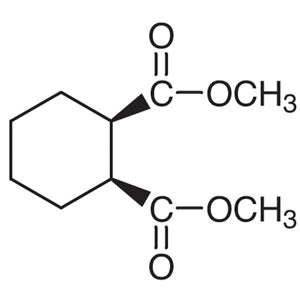
TCI D3702 Dimethyl cis-1,2-Cyclohexanedicarboxylate is the dimethyl diester of 1,2-cyclohexanedicarboxylic acid, with both carboxylate groups fixed in the cis configuration on adjacent ring positions. In the laboratory it serves as a non-heterocyclic building block that supplies a saturated cyclohexane framework together with two ester groups that can be modified in a controlled manner. Chemists commonly use it as a starting point for preparing diols, diamines, dicarboxylic acids, anhydrides, lactones, and other cyclic compounds. Because the stereochemistry is already defined, researchers obtain a consistent starting material without needing to separate isomers first.
The properties that make this material a preferred choice are its clearly defined cis stereochemistry and its manageable physical handling. The cis configuration places both ester groups on the same face of the cyclohexane ring, holding them close enough to interact with one another. That proximity enables intramolecular reactions such as cyclic anhydride formation, selective monohydrolysis, and enzymatic desymmetrization, which yields chiral products from a meso starting material. The saturated cyclohexane framework provides moderate conformational rigidity, giving predictable geometry while leaving the two ester groups accessible to standard transformations used in organic synthesis.
In Indonesian laboratories, this ester is typically used in university and institutional organic synthesis groups, in research on ligands and chiral intermediates, and in laboratories developing new synthetic routes and reference materials. It is generally purchased in small research quantities rather than production volumes, since it functions as an intermediate rather than a finished product. Analytical and method development laboratories may also use it when a well-defined cyclohexane diester is needed as a synthetic reference or a comparison compound.
Related TCI products
- TCI D3723 3399-22-2 Dimethyl trans-1,4-Cyclohexanedicarboxylate
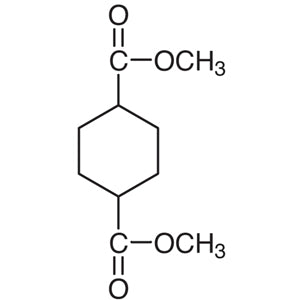
- TCI C1154 94-60-0 Dimethyl 1,4-Cyclohexanedicarboxylate (cis- and trans- mixture)
- TCI M2526 15177-67-0 Monomethyl trans-1,4-Cyclohexanedicarboxylate
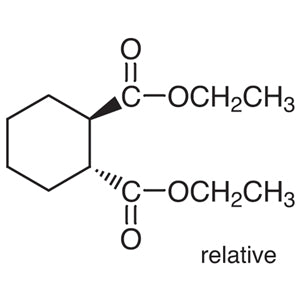
- TCI D3713 17351-07-4 Diethyl cis-1,2-Cyclohexanedicarboxylate
- TCI D3684 17351-22-3 Diethyl trans-1,2-Cyclohexanedicarboxylate
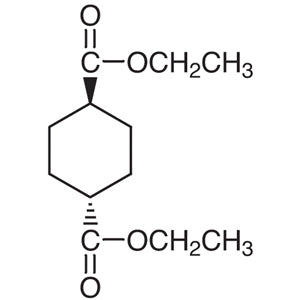
- TCI D3639 19145-96-1 Diethyl trans-1,4-Cyclohexanedicarboxylate
- Synthesis of diols and diamines: the two ester groups can be reduced or converted to nitrogen functionality, giving symmetrical cyclohexane derivatives from a single, stereochemically defined starting material.
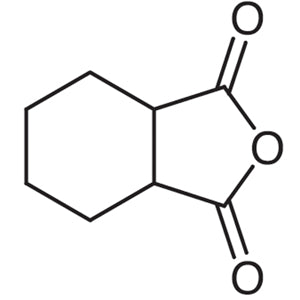
- Preparation of cyclic anhydrides: the cis arrangement places both carboxylate groups on the same ring face, so intramolecular closure to the anhydride proceeds far more readily than with the trans isomer.
- Enzymatic desymmetrization studies: as a meso diester it allows lipases and esterases to differentiate the two ester groups, producing chiral half-esters useful in asymmetric synthesis research.
- Selective monohydrolysis work: one ester can be hydrolysed while the other is retained, giving half-ester intermediates for stepwise functionalization in multi-step organic synthesis routes.
- Building block for lactones and cyclic scaffolds: the saturated ring and paired esters serve as a rigid framework when constructing lactones, macrocycles, and other non-heterocyclic target structures.
| Brand | TCI |
|---|---|
| CAS number | 1687-29-2 |
| Molecular formula | — |
| Purity | — |
| Category | Chemistry > Building Blocks > Non-Heterocyclic Building Blocks |
| Pack sizes | available in standard research pack sizes; please confirm the currently listed packaging option when ordering. |
| Physical form | — |
| Storage | — |
- Chemical name: Dimethyl cis-1,2-Cyclohexanedicarboxylate
- Catalogue code: D3702
Store this reagent in its original tightly closed container in a cool, dry, well-ventilated area away from heat, ignition sources, and direct sunlight. Keep it separated from strong oxidizing agents, strong acids, and strong bases. Use glass or other chemically compatible containers, and reseal promptly after dispensing to limit moisture ingress and evaporative loss. Handle in a fume hood using laboratory gloves, safety goggles, and a lab coat, avoiding inhalation of vapours and contact with skin or eyes. Always consult the manufacturer's safety data sheet before use, and follow institutional procedures for chemical waste disposal.
—
Produk Terkait
-
Dimethyltrans-1,4-Cyclohexanedicarboxylate TCI D3723
Regular price From Rp 1.008.000,00Regular price -
Dimethyl1,4-Cyclohexanedicarboxylate(cis-andtrans-mixture) TCI C1154
Regular price From Rp 717.150,00Regular price -
Monomethyltrans-1,4-Cyclohexanedicarboxylate TCI M2526
Regular price From Rp 1.008.000,00Regular price -
Diethylcis-1,2-Cyclohexanedicarboxylate TCI D3713
Regular price Rp 5.089.350,00Regular price -
Diethyltrans-1,2-Cyclohexanedicarboxylate TCI D3684
Regular price Rp 9.223.200,00Regular price -
Diethyltrans-1,4-Cyclohexanedicarboxylate TCI D3639
Regular price From Rp 3.075.450,00Regular price -
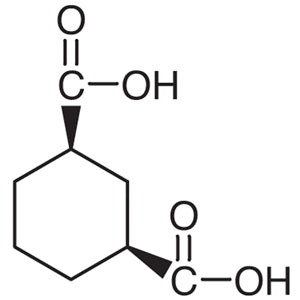
cis-1,3-CyclohexanedicarboxylicAcid TCI C2197
Regular price From Rp 4.240.950,00Regular price -
(+/-)-trans-1,2-CyclohexanedicarboxylicAnhydride TCI C1657
Regular price From Rp 2.942.100,00Regular price