
![Di-mu-chlorobis[5-hydroxy-2-[1-(hydroxyimino)ethyl]phenyl]palladium(II) Dimer (CAS 419581-64-9) - TCI D3807 - AMI Scientific](http://amiscientific.com/cdn/shop/files/TCI2510D3807.jpg?v=1767106587&width=1946)
![Di-mu-chlorobis[5-hydroxy-2-[1-(hydroxyimino)ethyl]phenyl]palladium(II) Dimer (CAS 419581-64-9) - TCI D3807 - AMI Scientific](http://amiscientific.com/cdn/shop/files/TCI2510D3807.jpg?v=1767106587&width=1445)
TCI D3807 with CAS number 419581-64-9 is Di-mu-chlorobis[5-hydroxy-2-[1-(hydroxyimino)ethyl]phenyl]palladium(II) Dimer, an oxime-derived palladacyclic complex arranged as a dimer with chloride bridges. The product functions as a palladium precatalyst with a well-defined organometallic structure, so researchers can weigh it out and use it directly without having to formulate a catalyst system from separate palladium salts and ligands. In synthetic laboratories, its principal role is to serve as a source of active palladium species for carbon–carbon bond forming reactions, which form the backbone of many modern synthetic routes.
The characteristic that distinguishes this material from its chlorinated analogue is the presence of hydroxy groups on the aromatic rings. Hydroxy groups are polar and capable of forming hydrogen bonds, so this complex shows better compatibility with reaction media containing water or polar solvents. That property is attractive to researchers who wish to run coupling reactions under more environmentally friendly conditions without relying entirely on dry organic solvents. In addition, the palladacyclic framework provides stability in the solid state, which makes the material practical to store and handle as a bench reagent.
In Indonesian laboratories, this precatalyst is typically used in university and institutional research settings where organic synthesis, methodology development, and fine chemical work are carried out. Because it is supplied as a defined organometallic solid, it suits laboratories that prefer a ready-to-use catalyst rather than preparing palladium–ligand mixtures in house. It is generally purchased in small research quantities and used for method screening, reaction optimization, and preparative work on a laboratory scale.
TCI brochures (PDF)
- Useful Palladacycle Catalysts 2025-04-17 · p. 1
- Transition Metal Catalysts 2026-04-10 · p. 14
- Suzuki-Miyaura Cross Coupling Reaction 2025-12-01 · p. 23
Related TCI products
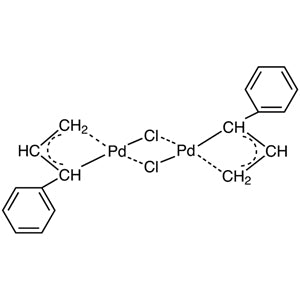
- TCI P2017 12131-44-1 Palladium(II)(pi-cinnamyl) Chloride Dimer
- TCI D3806 287410-78-0 Di-mu-chlorobis[5-chloro-2-[(4-chlorophenyl)(hydroxyimino)methyl]phenyl]palladium(II) Dimer
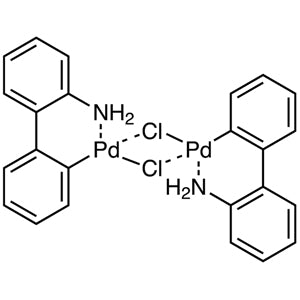
- TCI D4191 847616-85-7 Di-mu-chlorobis(2'-amino-1,1'-biphenyl-2-yl-C,N)dipalladium(II)
- TCI D3847 18987-59-2 Di-mu-chlorobis[2-[(dimethylamino)methyl]phenyl-C,N]dipalladium(II)
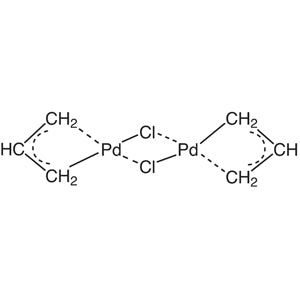
- TCI A1479 12012-95-2 Allylpalladium(II) Chloride Dimer
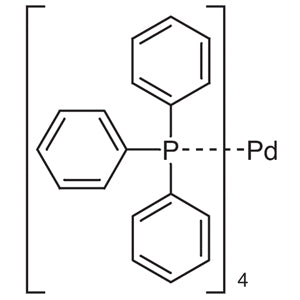
- TCI T1350 14221-01-3 Tetrakis(triphenylphosphine)palladium(0)
- Suzuki–Miyaura coupling: the complex releases active palladium species that mediate carbon–carbon bond formation, and its hydroxy-substituted framework tolerates aqueous or polar reaction media commonly used in this coupling.
- Heck-type olefination: as a structurally defined palladacyclic precatalyst, it removes the need to pre-mix palladium salts with ligands, giving more reproducible conditions across repeated runs in methodology studies.
- General carbon–carbon bond forming methodology: researchers developing new synthetic routes can weigh the solid directly, which simplifies screening experiments and makes catalyst loading easier to control accurately.
- Aqueous and polar-solvent catalysis studies: the polar, hydrogen-bonding hydroxy groups improve compatibility with water-containing media, supporting work aimed at reducing dependence on dry organic solvents.
- Green chemistry and solvent-reduction research: the material allows coupling chemistry to be explored under more environmentally friendly conditions, which suits laboratories investigating cleaner catalytic protocols and comparative solvent systems.
| Brand | TCI |
|---|---|
| CAS number | 419581-64-9 |
| Molecular formula | — |
| Purity | — |
| Category | Chemistry > Catalysis and Inorganic Chemistry > Transition Elements [Catalysis and Inorganic Chemistry] |
| Pack sizes | research-scale packaging; please confirm the available pack size when ordering |
| Physical form | solid, supplied as a defined organometallic palladacyclic complex |
| Storage | store in a closed original container under the conditions stated on the manufacturer's label |
- Chemical name: Di-mu-chlorobis[5-hydroxy-2-[1-(hydroxyimino)ethyl]phenyl]palladium(II) Dimer
Store the material in its original tightly closed container, kept in a cool, dry, and well-ventilated place away from moisture, direct sunlight, and sources of heat or ignition. Amber glass or the supplier's original packaging is suitable, and containers should be resealed promptly after each use to limit exposure to humid air. Handle the solid inside a fume hood, using gloves, safety glasses, and a laboratory coat, and avoid generating dust when weighing. Use clean, dry spatulas to prevent contamination that could affect catalytic performance. Keep the material separate from strong oxidizing agents, label all working solutions clearly, and dispose of residues and contaminated consumables as palladium-containing chemical waste following institutional procedures and the manufacturer's safety data sheet.
—
Product Categories
- Catalysis and Inorganic ChemistryTransition Elements [Catalysis and Inorganic Chemistry]Palladium [Catalysis and Inorganic Chemistry]
- Catalysis and Inorganic ChemistryCross-coupling Reaction using Transition Metal Catalysts [C-C Bond Formation]Palladium Catalysts [Cross-coupling Reaction using Transition Metal Catalysts]
- Synthetic ReagentsC-C Bond Formation [Synthetic Reagents]Cross-coupling Reaction using Transition Metal Catalysts [C-C Bond Formation]
Produk Terkait
-
Palladium(II)(pi-cinnamyl)ChlorideDimer TCI P2017
Regular price Rp 1.431.150,00Regular price -
![Di-mu-chlorobis[5-chloro-2-[(4-chlorophenyl)(hydroxyimino)methyl]phenyl]palladium(II) Dimer (CAS 287410-78-0) - TCI D3806 - AMI Scientific](//amiscientific.com/cdn/shop/files/TCI2510D3806.jpg?v=1767106583&width=533)
Di-mu-chlorobis[5-chloro-2-[(4-chlorophenyl)(hydroxyimino)methyl]phenyl]palladium(II)Dimer TCI D3806
Regular price From Rp 1.908.900,00Regular price -
Di-mu-chlorobis(2'-amino-1,1'-biphenyl-2-yl-C,N)dipalladium(II) TCI D4191
Regular price Rp 3.127.950,00Regular price -
Di-mu-chlorobis[2-[(dimethylamino)methyl]phenyl-C,N]dipalladium(II) TCI D3847
Regular price Rp 3.100.650,00Regular price -
Allylpalladium(II)ChlorideDimer TCI A1479
Regular price From Rp 2.306.850,00Regular price -
Tetrakis(triphenylphosphine)palladium(0) TCI T1350
Regular price From Rp 1.405.950,00Regular price -
Bis[1,2-bis(diphenylphosphino)ethane]palladium(0) TCI B3224
Regular price Rp 2.306.850,00Regular price -
Bis(tri-tert-butylphosphine)palladium(0) TCI B3161
Regular price From Rp 2.650.200,00Regular price
![Di-mu-chlorobis[5-chloro-2-[(4-chlorophenyl)(hydroxyimino)methyl]phenyl]palladium(II) Dimer (CAS 287410-78-0) - TCI D3806 - AMI Scientific](http://amiscientific.com/cdn/shop/files/TCI2510D3806.jpg?v=1767106583&width=533)
![Di-mu-chlorobis[2-[(dimethylamino)methyl]phenyl-C,N]dipalladium(II) (CAS 18987-59-2) - TCI D3847 - AMI Scientific](http://amiscientific.com/cdn/shop/files/TCI2510D3847.jpg?v=1767106660&width=533)
![31277-98-2 Bis[1,2-bis(diphenylphosphino)ethane]palladium(0) - AMI Scientific](http://amiscientific.com/cdn/shop/files/TCI2510B3224_8c85b882-6dd5-4a37-880a-a8e8601dc8ca.jpg?v=1767431836&width=533)
