

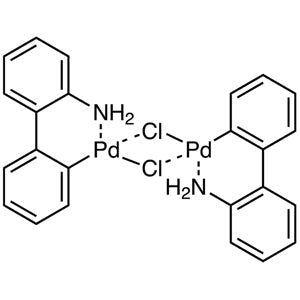
TCI D4191, Di-mu-chlorobis(2'-amino-1,1'-biphenyl-2-yl-C,N)dipalladium(II) with CAS number 847616-85-7, is a chloride-bridged dimeric palladium(II) complex belonging to the catalysis and inorganic chemistry group of transition element materials. Each palladium centre is bound to an aminobiphenyl framework through both a carbon and a nitrogen bond, forming a stable palladacyclic skeleton. In synthesis laboratories, this compound serves as a key starting material for preparing palladium precatalysts that are active in cross-coupling reactions, making it an important bridge between the phosphine or carbene ligand selected by the researcher and a ready-to-use catalytic system.
The advantage that makes this complex a widely preferred choice is its stability as a solid that is easy to weigh out and store, in contrast to many palladium(0) species that are sensitive and difficult to handle. The chloride-bridged dimeric structure is readily cleaved by donor ligands, giving mono-ligated complexes with a clearly defined metal-to-ligand ratio. The aminobiphenyl framework is also known to facilitate the formation of the active palladium species under the basic conditions commonly used in coupling reactions. This combination gives researchers reliable control over precatalyst preparation.
In Indonesian laboratories, this material is typically used in university and institutional research groups working on organic synthesis, methodology development, and the preparation of fine chemical intermediates. It suits work in which a defined palladium source is needed as the starting point for building a tailored catalytic system, rather than relying on a fixed pre-formed catalyst. Its solid, weighable nature makes it practical for laboratories that handle air-sensitive chemistry with standard Schlenk or glovebox facilities.
Related TCI products
- TCI D3847 18987-59-2 Di-mu-chlorobis[2-[(dimethylamino)methyl]phenyl-C,N]dipalladium(II)
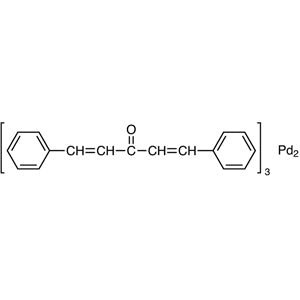
- TCI T2184 51364-51-3 Tris(dibenzylideneacetone)dipalladium(0)
- TCI D3807 419581-64-9 Di-mu-chlorobis[5-hydroxy-2-[1-(hydroxyimino)ethyl]phenyl]palladium(II) Dimer
- TCI D3806 287410-78-0 Di-mu-chlorobis[5-chloro-2-[(4-chlorophenyl)(hydroxyimino)methyl]phenyl]palladium(II) Dimer
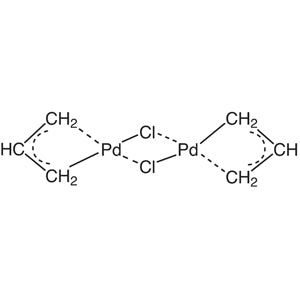
- TCI A1479 12012-95-2 Allylpalladium(II) Chloride Dimer
- TCI B6255 887919-35-9 Bis[di-tert-butyl(4-dimethylaminophenyl)phosphine]dichloropalladium(II)
- Precatalyst synthesis for cross-coupling — the chloride-bridged dimer is cleaved by phosphine or carbene ligands to give mono-ligated palladium precatalysts with a clearly defined metal-to-ligand ratio.
- Carbon–nitrogen bond formation methodology — the aminobiphenyl palladacyclic framework readily generates the active palladium species under the basic conditions typical of amination coupling protocols.
- Carbon–carbon coupling research — serves as a defined palladium(II) source from which researchers build catalytic systems tailored to the specific coupling transformation being studied.
- Ligand screening and catalyst development studies — a single stable palladium starting material can be combined with a range of donor ligands, keeping the metal source constant across comparisons.
- Fine chemical intermediate preparation — provides a weighable, storable palladium input for synthetic routes where sensitive palladium(0) reagents would be impractical to handle routinely.
| Brand | TCI (Tokyo Chemical Industry) |
|---|---|
| CAS number | 847616-85-7 |
| Molecular formula | — |
| Purity | — |
| Category | Chemistry > Catalysis and Inorganic Chemistry > Transition Elements [Catalysis and Inorganic Chemistry] |
| Pack sizes | — |
| Physical form | solid, supplied in standard TCI research pack sizes |
| Storage | keep in the tightly closed original container, protected from moisture |
- Chemical name: Di-mu-chlorobis(2'-amino-1,1'-biphenyl-2-yl-C,N)dipalladium(II)
Store the container tightly closed in a cool, dry, well-ventilated area away from moisture and incompatible chemicals, keeping the material in its original supplier packaging or an equivalent tightly sealed glass or chemically resistant container. As with other palladium complexes intended for catalytic use, minimise unnecessary exposure to air and humidity during weighing so that catalytic performance is preserved. Handle in a fume hood using safety glasses, gloves, and a laboratory coat, avoid generating dust, and wash hands after handling. Weigh out only the quantity required, reseal promptly, and follow the supplier safety data sheet together with local institutional waste-disposal procedures for palladium-containing residues.
—
Product Categories
- Catalysis and Inorganic ChemistryTransition Elements [Catalysis and Inorganic Chemistry]Palladium [Catalysis and Inorganic Chemistry]
- Catalysis and Inorganic ChemistryCross-coupling Reaction using Transition Metal Catalysts [C-C Bond Formation]Palladium Catalysts [Cross-coupling Reaction using Transition Metal Catalysts]
- Synthetic ReagentsC-C Bond Formation [Synthetic Reagents]Cross-coupling Reaction using Transition Metal Catalysts [C-C Bond Formation]
Produk Terkait
-
Di-mu-chlorobis[2-[(dimethylamino)methyl]phenyl-C,N]dipalladium(II) TCI D3847
Regular price Rp 3.100.650,00Regular price -
Tris(dibenzylideneacetone)dipalladium(0) TCI T2184
Regular price From Rp 2.545.200,00Regular price -
Di-mu-chlorobis[5-hydroxy-2-[1-(hydroxyimino)ethyl]phenyl]palladium(II)Dimer TCI D3807
Regular price From Rp 1.510.950,00Regular price -
![Di-mu-chlorobis[5-chloro-2-[(4-chlorophenyl)(hydroxyimino)methyl]phenyl]palladium(II) Dimer (CAS 287410-78-0) - TCI D3806 - AMI Scientific](//amiscientific.com/cdn/shop/files/TCI2510D3806.jpg?v=1767106583&width=533)
Di-mu-chlorobis[5-chloro-2-[(4-chlorophenyl)(hydroxyimino)methyl]phenyl]palladium(II)Dimer TCI D3806
Regular price From Rp 1.908.900,00Regular price -
Allylpalladium(II)ChlorideDimer TCI A1479
Regular price From Rp 2.306.850,00Regular price -
Bis[di-tert-butyl(4-dimethylaminophenyl)phosphine]dichloropalladium(II) TCI B6255
Regular price Rp 4.611.600,00Regular price -
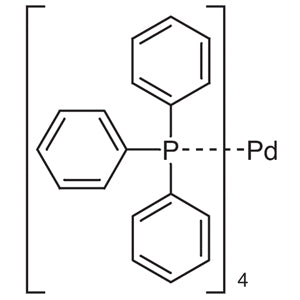
Tetrakis(triphenylphosphine)palladium(0) TCI T1350
Regular price From Rp 1.405.950,00Regular price -
Bis[1,2-bis(diphenylphosphino)ethane]palladium(0) TCI B3224
Regular price Rp 2.306.850,00Regular price
![Di-mu-chlorobis[2-[(dimethylamino)methyl]phenyl-C,N]dipalladium(II) (CAS 18987-59-2) - TCI D3847 - AMI Scientific](http://amiscientific.com/cdn/shop/files/TCI2510D3847.jpg?v=1767106660&width=533)
![Di-mu-chlorobis[5-hydroxy-2-[1-(hydroxyimino)ethyl]phenyl]palladium(II) Dimer (CAS 419581-64-9) - TCI D3807 - AMI Scientific](http://amiscientific.com/cdn/shop/files/TCI2510D3807.jpg?v=1767106587&width=533)
![Di-mu-chlorobis[5-chloro-2-[(4-chlorophenyl)(hydroxyimino)methyl]phenyl]palladium(II) Dimer (CAS 287410-78-0) - TCI D3806 - AMI Scientific](http://amiscientific.com/cdn/shop/files/TCI2510D3806.jpg?v=1767106583&width=533)
![Bis[di-tert-butyl(4-dimethylaminophenyl)phosphine]dichloropalladium(II) (CAS 887919-35-9) - TCI B6255 - AMI Scientific](http://amiscientific.com/cdn/shop/files/TCI2510B6255.jpg?v=1767093364&width=533)
![Bis[di-tert-butyl(4-dimethylaminophenyl)phosphine]dichloropalladium(II) - brosur TCI: Palladium Complex Catalyzing the Suzuki-Miyaura Coupling Reactions of Heteroaryl Chlorides](http://amiscientific.com/cdn/shop/files/TCI_Brochure_RR175_hal1.png?v=1791547479&width=533)
![31277-98-2 Bis[1,2-bis(diphenylphosphino)ethane]palladium(0) - AMI Scientific](http://amiscientific.com/cdn/shop/files/TCI2510B3224_8c85b882-6dd5-4a37-880a-a8e8601dc8ca.jpg?v=1767431836&width=533)